

If you’ve never sat down and mapped out an estate plan — or if it’s been a while since you last looked at yours — you’re not alone.
Estate planning is one of those tasks that’s easy to keep putting off, partly because it can feel complicated, and partly because it means thinking about things we’d rather not think about.
But a good estate plan doesn’t have to be complicated, and it isn’t just for the ultra-wealthy.
It’s simply a way of making sure your wishes are carried out, your loved ones are protected, and the people you trust have clear authority to act on your behalf if you ever can’t act for yourself.
What Is an Estate Plan, and Why Does It Matter?
At its core, an estate plan is a set of legal documents that spells out two things:
- who makes decisions on your behalf if you become unable to make them yourself
- who receives your property when you pass away
That’s it. Everything else — trusts, tax strategies, beneficiary designations — exists to support those two goals.
Without a plan, state law fills the gap, and state law doesn’t know your family, your wishes, or your relationships. If you die without a will, state intestacy rules decide who inherits your assets, and the outcome may look nothing like what you intended.
If you become incapacitated without the right documents in place, your family may need to petition a court for guardianship just to pay your bills or make medical decisions — a process that costs time, money, and often adds stress at an already difficult moment.
Put simply: an estate plan isn’t about how much you have. It’s about making sure the people you love aren’t left guessing, or worse, fighting, over decisions you could have made in advance.
The Core Documents Everyone Should Have
A complete estate plan generally rests on four foundational documents:
- Last Will and Testament: Directs how your property is distributed at death and names an executor to settle your affairs. Importantly, a will does not avoid probate — the court process of validating a will and overseeing the distribution of assets.
- Durable Financial Power of Attorney: Names someone to handle financial matters on your behalf (paying bills, managing accounts, filing taxes) if you’re unable to.
- Health Care Power of Attorney: Names someone to make medical decisions for you if you can’t communicate your own wishes.
- Living Will: Documents your preferences for life-sustaining treatment (resuscitation, artificial nutrition, ventilation, etc.) if you’re terminally ill and incapacitated.
These four documents cover the essentials for nearly everyone. A trust is a common — and often valuable — addition, but it’s not a requirement for a complete plan. We’ll get into why you might (or might not) want one next.
What Is a Trust, and Why Consider One?
A trust is a legal arrangement in which one party (the trustee) holds and manages property for the benefit of another (the beneficiary), according to instructions the person creating the trust (the grantor) has laid out.
The most common version — a revocable living trust — is created while you’re alive and can be changed or revoked at any time.
The main appeal of a revocable living trust is that assets held in it bypass probate entirely. That means a faster, more private transfer of assets to your heirs, without the court filings and public record that come with probate.
Trusts can also give you more control — for example, spelling out that a beneficiary receives distributions in stages rather than all at once, which can be valuable if you’re providing for a minor, a beneficiary who struggles with money management, or a blended family with competing interests.
That said, a trust isn’t automatically necessary for everyone. If your goals can be met through straightforward beneficiary designations, joint ownership, and transfer-on-death titling, a trust may add cost and complexity without adding much benefit.
It’s worth weighing your specific situation — family structure, asset types, and privacy or control preferences — before deciding.
For those who do have a need, a few purpose-built trusts come up often, particularly for couples and larger estates:
- Marital (“A”) and Bypass (“B”) Trusts — Used together by married couples to make full use of both spouses’ estate tax exemptions while still providing for a surviving spouse.
- Spousal Lifetime Access Trust (SLAT) — Removes assets from one spouse’s taxable estate while still allowing the other spouse access to the trust for support.
- Irrevocable Life Insurance Trust (ILIT) — Holds a life insurance policy outside your taxable estate, while still providing liquidity to your beneficiaries.
- Special Needs Trust (SNT) — Provides for a beneficiary with a disability without disqualifying them from means-tested government benefits.
These are more specialized tools, and whether any of them make sense depends on the size of your estate, your family circumstances, and your goals — not something to adopt off a checklist.
Putting It Together: A Snapshot of a Comprehensive Estate Plan
Here’s how the pieces above typically fit together, along with the key people involved in carrying them out:
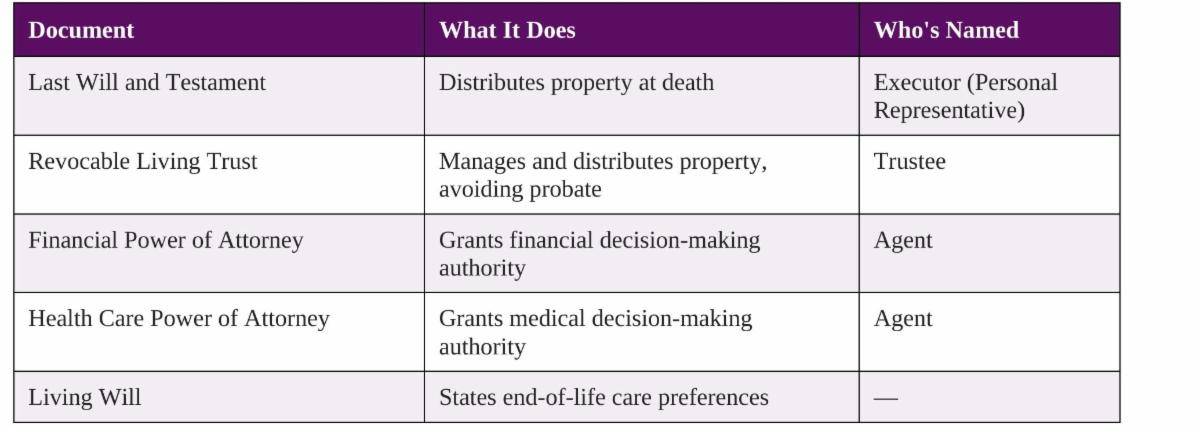
Source: Moore Financial Advisors
And a few of the people who carry out these documents:
- Executor — Settles the estate as directed by the will (probate, debts, final taxes, distributions)
- Trustee — Manages trust assets and carries out the trust’s instructions for beneficiaries
- Agent (Power of Attorney) — Makes financial and/or medical decisions on your behalf
- Guardian — Cares for minor children, typically named in the will
A note on terminology: you’ll often see the term Personal Representative used alongside — or in place of — “Executor.”
Personal Representative is the broader, more modern legal term for the person who administers an estate under the court’s supervision; many states, including Massachusetts, now use it as the official title in place of “Executor.”
In everyday conversation, the two terms are generally used interchangeably, and you may see either one depending on which state’s forms or statutes are being referenced.
Seeing it laid out this way helps clarify a point worth repeating: these documents work as a system. A gap in one (say, an outdated will or a trust that was never funded) can undercut the whole plan.
How a Will and a Trust Work Together
If you have both a will and a trust, it’s important to understand how they interact. A trust only avoids probate for assets that have actually been retitled, or “funded,” into it — a trust that owns nothing accomplishes nothing.
Because it’s common for a few assets to be missed along the way, most trust-based plans also include a pour-over will, which directs any assets left in your individual name at death into the trust. Those “poured over” assets still pass through probate, but the pour-over will acts as a safety net to make sure nothing falls outside the plan entirely.
Even with a fully funded trust, you still need a will. Wills handle things a trust doesn’t: naming guardians for minor children, addressing personal property not held in the trust, and serving as the final backstop for anything unaccounted for.
Why Reviewing Beneficiaries Matters
Here’s a detail that surprises many people: beneficiary designations on accounts like retirement plans, life insurance, and annuities override what your will or trust says. If your 401(k) still lists an ex-spouse, or your IRA names your estate instead of a person, that’s what governs — regardless of your other planning documents.
A few things worth checking periodically:
- Do your named beneficiaries reflect your current wishes and family situation?
- Have you listed your “estate” as a beneficiary anywhere? (This forces those assets through probate)
- Are any beneficiaries minors? (Minors generally can’t inherit directly, which can trigger a court-appointed conservatorship)
- If a trust is named as beneficiary, is that trust still current and appropriate?
- A quick beneficiary review takes a few minutes and can prevent outcomes no one intended
How Often Should You Update Your Estate Plan?
There’s no fixed schedule that fits everyone, but two categories of events should prompt a review:
- Life events: marriage, divorce, births, the death of a named executor, trustee, or agent, a move to a new state, or a significant change in your assets.
- Law changes: federal and state estate tax rules shift periodically. As of 2026, the federal estate and gift tax exemption increased to $15 million per individual ($30 million for married couples) — a change that affects very few households directly. Massachusetts is a different story: the state estate tax exemption remains $2 million per person, and unlike the federal exemption, it is not portable between spouses.
For many Massachusetts homeowners, home equity and retirement accounts alone can approach that threshold — which is exactly the kind of gap a periodic review is meant to catch.
As a general rule of thumb, a full review every three to five years — or immediately after any major life event — is a reasonable cadence.
Why Use an Estate Planning Attorney — and Is It Worth the Cost?
It’s tempting to reach for an online template to save money, and for very simple situations that may work. But an estate planning attorney brings a few things a template can’t:
- State-specific compliance. Estate law varies significantly by state, and a document valid in one state may not hold up in another
- Tailored drafting. Your family situation, assets, and goals are unique; a generic template can’t anticipate the details that matter for your plan
- Coordination. An attorney ensures your will, trust, and powers of attorney work together rather than contradicting each other
- Accountability. Attorneys carry malpractice coverage and professional responsibility that a downloaded form does not
The cost of hiring an attorney is real, but it’s worth weighing against the alternative: a contested or invalid will, a costly and public probate process, or family conflict that a properly drafted plan could have prevented. For most families, the upfront cost of good legal work is modest compared to what’s at stake.
This is general education, not a recommendation for your specific situation — if you don’t already have a trusted estate planning attorney, we’re glad to make an introduction.
What Role Does a Financial Advisor Play in Estate Planning?
Our role is to work alongside your attorney and tax preparer, not in place of them. In practice, that means:
- Making sure beneficiary designations on your investment and retirement accounts match your overall estate planning intentions
- Reviewing how assets are titled (individually, jointly, or in trust) to ensure alignment with your plan
- Keeping an eye on how life changes or new laws might affect your existing plan, and flagging when it may be time to revisit it with your attorney
We’re not attorneys, and we don’t draft legal documents or give legal advice — but we do help make sure the financial side of your plan supports the legal side.
-RK