

Medicare’s annual Open Enrollment Period runs from October 15 through December 7, 2026, and any changes you make take effect January 1, 2027. It is the one time each year when most people on Medicare can freely change how they receive their coverage.
We’ve written about Open Enrollment each fall, and the core advice hasn’t changed: plans change their costs, networks, and drug lists every year, so last year’s good choice may not be this year’s.
What is different for 2027 is the size of the changes. Drug plan costs are shifting, many Medicare Advantage plans are being cut or reshaped, and a federal subsidy that held down drug plan premiums is ending. That makes this a good year to take a careful look, even if you’ve been happy with your coverage.
What You Can Change During Open Enrollment
Between October 15 and December 7, you can:
- Switch Part D drug plans or join one if you don’t have drug coverage.
- Move from Original Medicare to a Medicare Advantage plan (Part C).
- Switch from one Medicare Advantage plan to another, with or without drug coverage.
- Return from Medicare Advantage to Original Medicare and add a stand-alone Part D plan.
If you’re in a Medicare Advantage plan, you get a second chance from January 1 through March 31, 2027 to switch to a different Advantage plan or return to Original Medicare.
A note for Massachusetts residents: Medicare Supplement (Medigap) rules here are more flexible than in most states. You can generally change Medigap plans at any time of year without medical underwriting, so you aren’t locked into the October–December window for that decision.
Clients living in other states should check with us first, because a Medigap application outside a protected window can be denied based on health.
What’s New for 2027
The headline for 2027 is that drug coverage costs more up front, while Medicare Advantage plans are getting leaner. Here are the key figures:
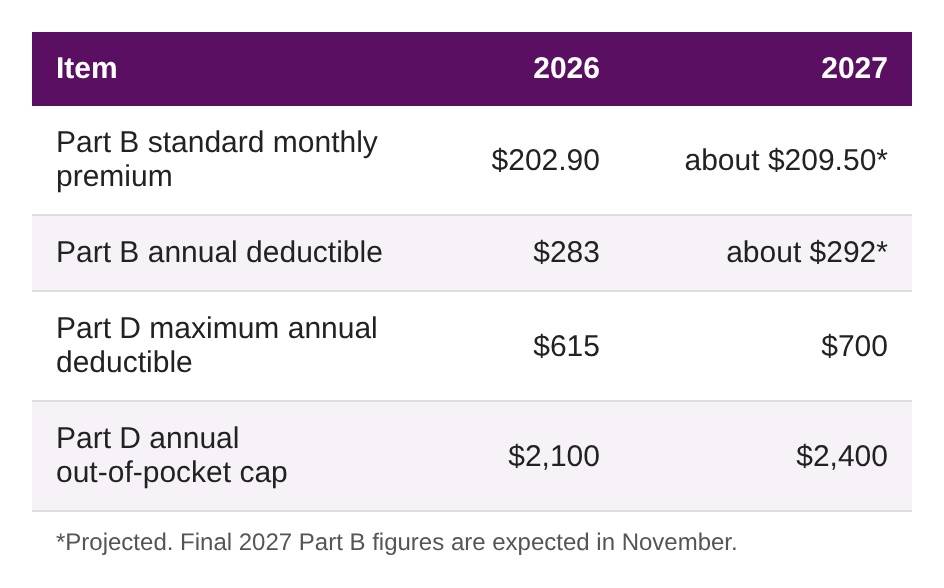
Source: Moore Financial Advisors
Drug Plan Premiums May Rise as a Federal Subsidy Ends
For the past two years, a temporary federal program has helped hold down premiums on stand-alone Part D drug plans.
That program ends on December 31, 2026, a year earlier than planned. Some drug plans may raise premiums noticeably for 2027, so check your plan’s new premium rather than assuming it will stay the same.
The $2,400 out-of-pocket cap is still a strong protection. Once you reach it, you pay nothing more for covered drugs for the rest of the year. If you take expensive medications, you can also spread those costs into monthly payments through the Medicare Prescription Payment Plan instead of paying large amounts early in the year.
Lower Negotiated Prices on 15 More Drugs
Starting January 1, 2027, Medicare’s negotiated prices take effect for a second group of 15 drugs, including Ozempic and Wegovy and treatments for diabetes, asthma, COPD, and certain cancers.
How much you save depends on your plan. If your plan charges a percentage of the drug’s cost, you’re more likely to see a lower bill. If it charges a flat copay, your cost may not change much.
Medicare Advantage: Lower Average Premiums, Leaner Plans
CMS projects that the average Medicare Advantage premium will fall to about $12 a month in 2027.
But a low premium doesn’t tell the whole story. Insurers are cutting thousands of plans and leaving hundreds of counties nationwide. Plans that remain are, on average, raising their out-of-pocket maximums about 10% and trimming extras such as dental coverage.
If your Medicare Advantage plan is ending, you should have received a notice.
You’ll have until the end of February 2027 to choose a new plan, and you’ll have a guaranteed right to buy a Medigap policy if you return to Original Medicare.
If you do nothing, you’ll generally be moved to Original Medicare without drug coverage, so please don’t let that happen by default.
Closer to Home: Massachusetts Networks
Provider networks continue to shift here in Massachusetts. For example, Mass General Brigham primary care is no longer in network with UnitedHealthcare or Blue Cross Blue Shield of Massachusetts Medicare Advantage plans in eastern Massachusetts.
If you’re in a Medicare Advantage plan, confirm that your doctors and hospitals will be in network for 2027 before you renew.
Your Review Checklist
Start with the Annual Notice of Change your plan mailed by September 30. It lists every change to your premium, costs, network, and drug list for 2027.
If you have Original Medicare (Parts A and B):
- Part D drug plan: Are all your medications still covered? Have their tiers, copays, or pharmacy rules changed? Has the premium gone up?
- Medigap policy: Has your premium increased? Would a different plan serve you better at a lower cost?
- Total cost: Use the Plan Finder at Medicare.gov to compare your full expected cost for 2027 (premiums plus drug costs), not just the monthly premium.
If you have a Medicare Advantage plan:
- Is your plan continuing? If not, choose a new plan before December 7.
- Network: Are your doctors, specialists, and hospitals still in network for 2027?
- Drugs: Are your medications still on the drug list? Do any now need prior approval?
- Costs: Have the premium, deductible, copays, or out-of-pocket maximum changed?
- Extras: If you rely on dental, vision, or hearing benefits, are they still offered at the same level?
Before you compare plans, it helps to write down your “must-haves”: your doctors, your medications, your preferred pharmacy, and any travel plans that require coverage out of state.
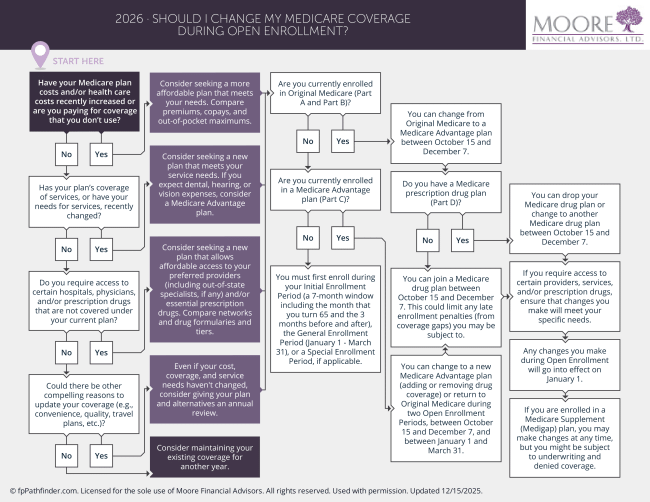
For further reference, here’s a flowchart that helps you decide if you should change your Medicare coverage during open enrollment. Click on the image to receive a pdf that you can download and print.
A Reminder About IRMAA
Higher-income Medicare enrollees pay a surcharge on Part B and Part D premiums, known as IRMAA. Your 2027 surcharge will be based on the income on your 2025 tax return.
In 2026, IRMAA applied above $109,000 of modified adjusted gross income for single filers and $218,000 for joint filers. The 2027 thresholds will be announced in November.
Two points worth keeping in mind:
- If your income has dropped because of a life-changing event, such as retirement, the loss of a pension, or the death of a spouse, you can ask Social Security to use more recent income by filing Form SSA-44.
- Because of the two-year lookback, decisions you make this year, such as Roth conversions or realizing capital gains, can affect your Medicare premiums in 2028. We factor this into our year-end tax planning with you.
Next Steps
- Read your Annual Notice of Change as soon as possible, and note anything that has changed.
- Use the enclosed checklist, “Should I Change My Medicare Coverage During Open Enrollment?”, to work through whether a change makes sense for you.
- Compare plans on Medicare.gov if your costs, network, or drugs have changed. Starting early in the window gives you time to ask questions.
- Get free, unbiased help if you’d like it. In Massachusetts, SHINE (Serving the Health Insurance Needs of Everyone) offers free one-on-one counseling. You can also call 1-800-MEDICARE.
- Make any changes by December 7. New coverage begins January 1, 2027.
As a fee-only firm, we don’t sell insurance and receive no commissions, so our role is to help you think through your options objectively. We’re happy to review your Annual Notice of Change with you, talk through how Medicare costs fit into your retirement budget, and coordinate on IRMAA planning. Please reach out with any questions.
-SM