
To my gridiron-wired mind, aspects of the “other football” are curious and bemusing.
For example:
- The clock counts up, not down, and keeps running during stoppages, resulting in time mysteriously tacked on at the end of the game
- Ties are allowed, considered normal – and often celebrated
- Flopping appears to be a legitimate tactic
- Offside: a player can be offside without touching the ball: simply interfering with an opponent’s ability to play – blocking their line of sight, for example – while in an offside position can be deemed a violation
- Cards: penalty cards accumulate across games: get two yellow cards in separate matches and a player can be suspended for the next match
- Advantage Rule: a referee can see a clear foul happen and simply not blow the whistle, waving play on because the fouled team already has the ball in a good position
- Substituted players can’t return: once you’re subbed off, you’re done for the match
Fortunately, World Cup games include a break that allows for reflection, discussion with more soccer-savvy acquaintances, and, if necessary, online search to figure out what transpired during the past 45 minutes of play.
Thank goodness for halftime.
Since we’ve reached the halfway point of the calendar year, it’s appropriate to reflect on some of the key developments in the financial markets so far in 2026:
- AI: Enthusiasm for Artificial Intelligence (AI) and the ecosystem that supports its development has been a driving force behind demand for technology stocks
- Earnings: Strong first-quarter earnings reports from large US companies, along with upward revisions to earnings forecasts, have also helped to buoy stocks
- War: US-Iran conflict caused severe dislocation in the oil trade, but the geopolitical shock was short-lived for US investors
- Inflation: It has remained sticker than hoped – well above the Federal Reserve’s 2% target – keeping bond yields elevated
- The Fed: Leadership change at the Federal Reserve has shifted the interest rate policy outlook – new Fed Chair Kevin Warsh has signaled a firm commitment to bringing inflation back to 2%, raising the odds of Fed rate hikes later in the year
- SpaceX: The company’s Initial Public Offering (IPO) created a major market event – it was the biggest IPO in history. The rocket-satellite-AI company became the sixth largest firm globally and it demonstrated investor interest for new, tech focused companies.
- Stock market leadership is broadening beyond technology: after years of tech stock dominance, industrials, financial institutions, healthcare, and small-company stocks began participating more meaningfully in June, a sign often associated with a healthier bull market.
The phenomenon mentioned in the last bullet point has been labelled “The Great Rotation” by some Wall Street commentators.
For more than a decade, a highly concentrated group of very large technology-oriented
companies has driven positive stock market performance.
However, the massive amounts of spending tech companies are now undertaking to actualize their AI-related plans is coming under greater scrutiny by investors.
If the pundits are correct in their characterization of this emerging “rotation” situation, investors have started pulling money out of the “expensive” tech stocks and redeploying that cash into less expensive areas of the market.
The result of a typical rotation is that money stays in the stock market, leadership changes, and positive overall stock market performance continues.
Thus far in 2026, stocks of all shapes and stripes are having another good year, as the middle column in the table below indicates.
But take a closer look at the June data in the left-hand column. US Industrial stocks top the list in performance of the Asset Class Returns table.
The Industrials index, made up mostly of “old economy stocks” – companies such as Caterpillar, Boeing, Union Pacific (railroads), and Eaton (electrical equipment) – outpaced the Technology index (which includes Nvidia, Broadcom, and Meta) by more than 10 percentage points last month.
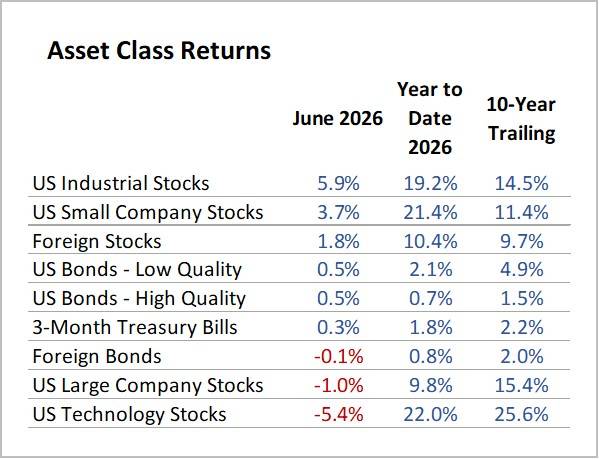
Note: YTD 2026 as of 6/30/2026; Source: Morningstar
And two other non-tech sectors, Healthcare (+11.5%) and Financials (+9.7%) had even stronger performance in June than Industrials.
One month of old economy stocks outperforming new economy stocks fails to indicate a true “Great Rotation”.
But the shifting of preferences and performance displayed in June are noteworthy and may be a positive sign for the stock market as a whole – and for investors who maintain broadly diversified portfolios.
-RK