

In July, I visited Old Orchard Beach, Maine. The cottage where I stayed with extended family is a short walk from Palace Playland, an amusement park, which first opened in 1902.
My style of ride is the Merry-Go-Round: old-fashioned, somewhat whimsical – and most importantly, one directional. My 12-year-old niece has a different vibe.
Attempting to curry favor, I accompanied her on HyperJump, which Palace Playland’s website describes as: “feel your heart race as you spin around and defy gravity with bursts of speed that send you soaring up and down.”
The HyperJump description is accurate; I may have scored a point with my niece; and two minutes of terror reaffirmed my amusement park ride preferences.
July’s market activity encompassed elements of both Carousel and HyperJump.
Performance for a good portion of the stock and bond markets was Carousel-like. Foreign stocks (+1.6%), US Treasury Bills (+0.3%) and US Large Company Stocks (+0.1%) all recorded modest positive performance in July.
Other segments of the financial markets, including US Bonds (-1.3%) and Foreign Bonds (-1.7%), registered modest negative performance. Small company stocks declined a bit more (-3.1%), but results were far from stomach-turning.
HyperJump activity was concentrated mainly in the technology sector (-5.6%), and the gyrations were more obvious by looking at individual stock performance for the month.
As the chart below indicates, stock prices of major tech companies ranged from +25% to -35%. Several companies involved in cloud computing and data management soared, while semiconductor manufacturers, which had done very well in the first half of 2027, fell particularly hard.

Source: Morningstar
Away from technology sector, oil prices increased by more than 20% in July, pushed higher by increased hostilities in the Middle East, which helped boost Energy sector stocks by 12%.
In sum, I concur with sentiment shared recently in a note by Jeremy Siegel, Emeritus Professor of Finance at Wharton and Senior Economist at WisdomTree: “The recent rotation away from the market’s most speculative leadership, while uncomfortable for some investors, strengthens rather than weakens the foundation of this bull market.”
Another way of framing this: prices for some technology stocks had come too far, too fast. The downward adjustment in their share prices in July, without a broad-based stock sell-off, is a healthy sign for the market as a whole.
Here are results for July and 2026 Year-to-Date, compared to longer-term annualized returns (10-Year Trailing):
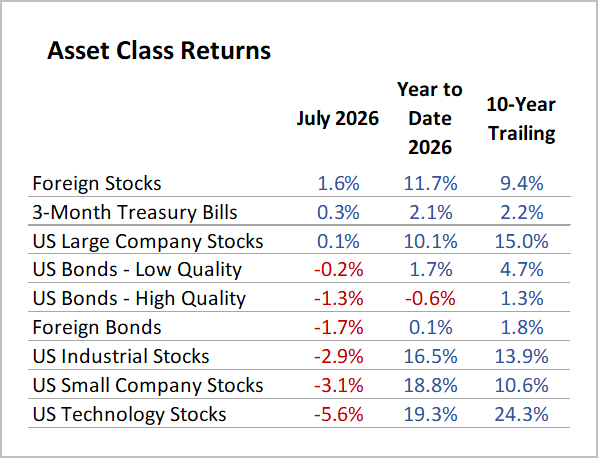
Note: YTD 2026 as of July 31; Source: Morningstar
-RK