

A common perception of the bond market is that it is a puzzling and uninteresting place. Even so, recent articles in the financial press may have grabbed your attention and might have given you the impression that the sky is falling in bond-land.
Here’s a sample of headlines focused on the bond market from the past few weeks:
- Global Bond Selloff Sends Yields to Highest Since 2008 – Bloomberg
- Why the Global Bond Yield Crisis Is Just Getting Started – Barron’s
- Europe’s Bond Markets Are Suffering a Post-Holiday Shock – The Economist
- The Treasury Market’s Coveted Status as a Safe Haven is Fading – The Wall Street Journal
- The National Debt Is Wreaking Havoc with Bonds – Barron’s
Using terms like “crisis”, “shock”, and “wreaking havoc” may grab attention and fan the flames of our inner Chicken Little anxieties.
But this type of language and financial journalism falls short of providing useful information and promoting understanding.
To address concerns related to the bond market, we’ll go through some bond market basics; address current issues affecting bond yields and prices; and explain why a bond allocation is and will continue to be an important component of most well-diversified portfolios.
Bond Market Basics
To many individual investors, stocks are straightforward.
Buying a piece of a company that we know, and being able to track the share price, connects us to our stock investment. If good things happen to the company, the share price typically goes up. And if a company’s fortunes fall, so does the stock.
Bonds, however, are much less familiar. So here are some things to know:
The US bond market, at about $58 trillion in market value, is approximately the size of the US stock market.
But the bond market is arguably more consequential to the real economy than the stock market for a few reasons:
- Funding Costs: It’s how governments and companies fund themselves. Bonds are tradable loans. When governments and companies issue bonds, they receive cash and promise to pay interest to the bond buyer for the use of that cash. The issuer also promises to return the principal to the bondholder when the bond matures.
- Risk-Free Rate: The Treasury bond yield establishes the “risk-free rate” that many financial instruments are priced against – mortgage rates, corporate borrowing cost, and even stock valuations (via discount rates) all trace back to Treasury yields.
- Economic Barometer: Institutional bond investors and Wall Street traders are constantly considering inflation, economic growth, and Federal Reserve interest rate policies when deciding what price and yield to accept when they buy and sell bonds. Shifts in bond yields often signal changing expectations before they show up elsewhere.
- Big Money: the more risk-averse, large pools of capital, such as pension funds, insurers, central banks, and foreign governments, are major holders of bonds, so instability in the bond market ripples through the global financial system in a way that declines in US stocks often don’t.
When talking about the situation in the bond market, the discussion usually centers around bond yields. A bond yield is the annual return an investor earns for holding a bond, and the yield moves inversely to the bond’s price.
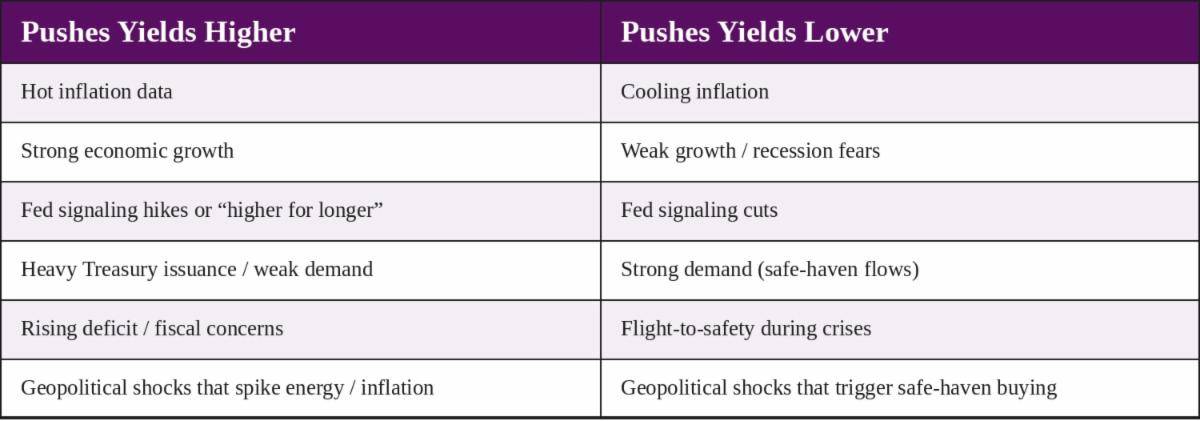
The table below presents some factors that influence the direction of Treasury bond yields.
Source: Moore Financial Advisors
Bond Market Current Issues
It is a fact that yields have pushed higher in the US, as well as in other countries, this year.
From a low point of 3.9% in early January 10-Year Treasury yields climbed nearly a percentage point, to 4.78% in early September.
Short-term Treasury Bond and Bill yields are also up by about a percentage point and currently sit at about 4.0%.
It’s also true that for many investors, returns for high quality intermediate and long-term bond funds have fallen short of expectations in 2026.
The benchmark US Bloomberg Aggregate Bond Index, which is made up of thousands of high-quality issues, including US Treasuries, guaranteed mortgage-backed securities, and corporate bonds, has produced a negative return of -0.25% year-to-date as of September 4.
Financial markets experts point to several factors behind the increase in yields, including:
- investors’ concerns that inflation is too high
- central banks around the world aren’t doing enough to contain inflation
- governments are acting in fiscally irresponsible ways by running large, successive deficits – particularly since the pandemic
These are valid concerns and could lead to more upward pressure on bond yields in the future, but do not point to imminent crisis.
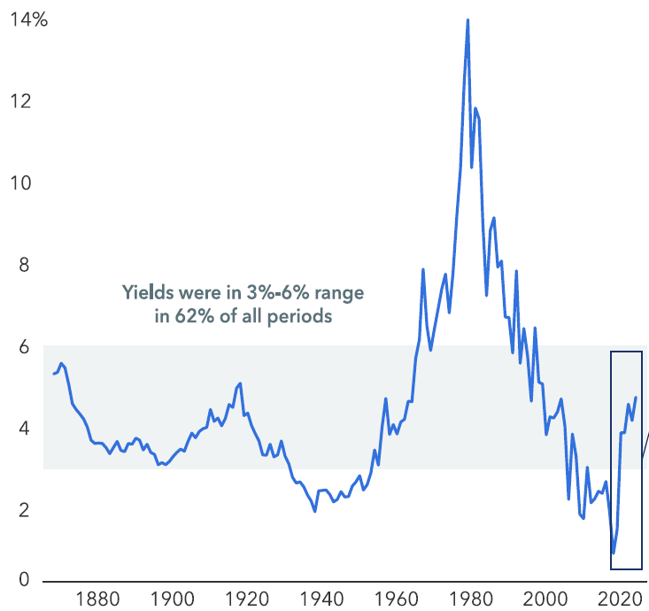
Courtesy of Capital Group, the chart below shows a 155-year history of long-term Treasury bond yields going back to 1871.
Source: Capital Group
Prior to 1962, the data represents the average long-term government bond yield; from 1962 forward, the data represents 10-Year Treasury yields as of December 31 each year within the period.
The data shows that 62% of the time, long-term Treasury bond yields fall within a range of 3% to 6%.
When bond yields move out of this range, it’s a strong possibility that something may be amiss in the economy or the financial markets.
In the 1970s and 1980s, the US economy was stressed by energy shocks, rolling recessions, and elevated inflation, which pushed interest rates well above the normal band to record high levels.
In the 15 years following 2006, the US economy was challenged by fallout from a global financial crisis (2008-2009) and a pandemic (2020) which pulled interest rates well below the normal band to record low levels.
Today’s interest rates, when viewed through a long-term historical lens, sit comfortably in the middle of the normal band.
According to analysis done by JP Morgan asset management, 10-year Treasury yields have averaged 5.7% since 1958. A 10-year yield approaching 4.8% is hardly indicative of “crisis”, “shock”, or “havoc”.
To some extent, modestly higher yields can be considered good news for bondholders.
With stock markets at record highs, the rise in yields reflects a resilient global economy that can absorb higher borrowing costs. And higher yields mean investing in bonds today will deliver more income over time.
Why Hold Bonds in Your Portfolio?
Even though the environment for bond investors has been challenging for most of 2026, the main reasons for owning high-quality bonds, including US Treasuries, remain intact:
- Bonds provide recurring, dependable income
- Investment-grade bonds with near- to intermediate-term maturities are less volatile than stocks, and can help stabilize a portfolio when financial markets become unsettled
- Shorter-maturity bonds and bond funds are typically a good source of “liquidity” and convert easily to cash when money must be withdrawn from a portfolio
The bottom line: the sky is not falling in bond-land.
The unsatisfactory returns many investors have experienced in their bond allocations year to date likely have been counterbalanced by satisfactory returns from their stock allocations.
Also, sub-par bond returns this year are coming on the heels of above-average returns for bonds last year.
This return experience is normal and indicative of a generally healthy economic and financial market environment.
For most individual investors, an allocation to bonds is, and will continue to be, an important component of a well-diversified portfolio.
-RK