Category

Reading Recommendations

The Science and Art of Longevity

Peter Attia is a physician who focuses on longevity. In his recent book, Outlive: The Science and Art of Longevity, he explains that longevity has two components: how long you live, which is your chronological lifespan, and how well you live (the quality of your years), which is called healthspan.

His goal is to create an operating manual for the practice of longevity. His belief is that, with time and effort, individuals potentially can extend their lifespan by a decade and their healthspan possibly by two decades.

Specifically, Attia’s research focuses on actions that individuals can take to mitigate risk associated with four chronic diseases of ageing: heart disease, cancer, neurodegenerative disease, and type 2 diabetes.

Attia was recently profiled in a New York Times Magazine article: Want to Live Longer and Healthier? Peter Attia Has a Plan. He also hosts a podcast entitled The Drive, which addresses personal health and longevity topics.

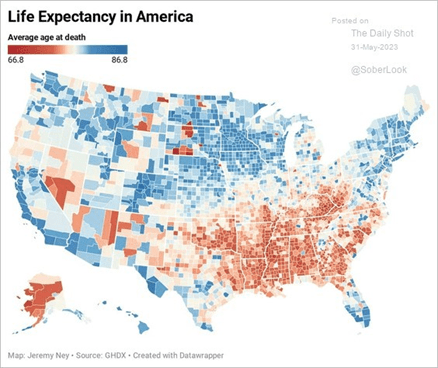
As a complement to this reading, I recently came across the map below in The Daily Shot, an economics newsletter.

I was surprised to see such a wide dispersion of life expectancies across regions of the US.

In its most recent report on life expectancy in the US, the Centers for Disease Control and Prevention (CDC) pegged life expectancy for a newborn at 76 years.

The CDC report, released in August 2022, states that US life expectancy experienced a 2.7-year decline during the 2020 – 2021 period due to the pandemic.

JP Morgan has also published additional longevity-related data that you might find interesting:

  • 65-year-old females today have an average life expectancy of 84.5 years
  • Non-smoking females in excellent health have a 1-in-3 chance of living to age 95
  • 65-year-old males today have an average life expectance of 81.9 years
  • Non-smoking males in excellent health have a 1-in-5 chance of living to age 95

Longevity is a key input to the process that we use when we build financial plans for clients, and understanding longevity trends in the US is a good starting point.

In the end, though, individual factors such as family history and lifestyle choices are likely to be more informative when responding the question: “how long do you expect to live?”

If you are interested in extending your lifespan and healthspan, it’s encouraging to know that there are concrete steps, such as the ones Attia suggests, which you can take that are likely to ‘bend the curve’ in your favor and advance the goal of a long, healthy life.

-RK

Dealing With Uncertainty

I am always interested to hear what’s capturing your attention, and what you’ve felt helpful in adding to your knowledge of personal finance. So I am thankful to a client who just this week suggested a book that seems most appropriate for today’s climate.

In The Uncertainty Solution – How to Invest With Confidence in the Face of the Unknown, author John M. Jennings offers his perspective on ways we can navigate our behavioral biases and explains the benefits of focusing on the long term.

These are topics that I address frequently in my letters and are important ingredients for investing success. You might find it helpful to hear a similar message from a different voice.

Happy Earth Day!

Every year on April 22, Earth Day marks the anniversary of the birth of the modern environmental movement in 1970.

While not an official holiday, many folks choose to celebrate their respect for the environment by participating in events that increase public awareness of environmental concerns.

One topic that I’ve chosen to learn more about is Environmental Justice.

Michael Regan, who currently heads the US Environmental Protection Agency, has articulated the concept well in saying: “every person has the right to clean air, clean water and a healthier life, no matter how much money they have in their pockets, the color of their skin, or the community they live in.”

In searching on the topic, I came across the book Environmental Justice and Resiliency in an Age of Uncertainty, published in 2022 and edited by Celeste Murphy-Greene, a faculty member at UVA who focuses on Sustainability and Environmental Justice.

Murphy-Greene provides a framework for thinking about environmental issues by approaching them through a social justice lens. Topics of the book include an overview of Environmental Justice, Climate Justice, Health Equity, Smart Cities, Local Clean Energy, and the role that Public Works and Public Procurement can play in promoting Environmental Justice.

Murphy-Greene says her interest in environmental issues began as a college student when she was lifeguarding in Falmouth, Massachusetts and witnessed a large amount of medical waste wash ashore after a New York City-based barge dumped its contents.

On a different pedagogical note, I recently enjoyed watching My Octopus Teacher, an Academy Award winner from 2021 for Best Documentary Feature, which provides a personal account of filmmaker Craig Foster’s interactions with an octopus.

Foster was inspired to found Sea Change Project, which is dedicated to helping people understand human inter-connectedness with the natural world and to raising awareness for the Great African Seaforest.

You can see a trailer for the film and learn more about Foster’s initiatives at Sea Change Project website.

Happy Earth Day!

37 Words: Title IX and Fifty Years of Fighting Sex Discrimination

March is the month for celebrating women’s history. Some key events that have occurred in March over time:

  • March 1857: Female textile workers in New York City marched in protest of unfair working conditions and unequal rights for women
  • March 1908:  Women workers marched in NYC to protest child labor, sweatshop working conditions, and to demand women’s suffrage
  • March 1911: First International Women’s Day marked by gatherings in Austria, Denmark, Germany, and Switzerland
  • March 1913: Women’s Suffrage Parade in Washington, DC where more than 8,000 women gathered to demand a constitutional amendment guaranteeing their right to vote
  • 1975: United Nations began celebrating March 8 as International Women’s Day
  • 1978: Women’s History Week started in US
  • 1987: National Women’s History Project successfully petitioned Congress to include all of March as a celebration of the economic, political, and social contributions of women

In recognition of this, I expanded my reading horizon this month and landed on 37 Words: Title IX and Fifty Years of Fighting Sex Discrimination by Sherry Boschert.

An author, journalist activist, and environmentalist, Boschert posts frequently on sherryboschert.com

Gettin’ Chatty: Artificial Intelligence Gets Real

If you were lost in space, having artificial intelligence by your side would be helpful. Will Robinson’s robot, B9, was a form of chatty artificial intelligence imagined in the middle of the last century. B9 was a fiction brought to life by actor Bob May in the Lost in Space sitcom.

Artificial intelligence (AI) in the 21st century is real. For the analogue -inclined, developments in AI can be mind-bending. AI might seem worlds away and you might feel ‘lost in space’ if you’re trying to understand what it’s about.

ChatGPT, which went mainstream in December, provides a window into the world of AI – and is an application that’s available for anyone to use today.

McKInsey’s recent blog post What Is Generative AI? Is a helpful explainer. It describes AI through the lens of content creation, and the disruptive effects it’s likely to have.

Also the New York Times sponsored podcast Hard Fork provides an engaging discussion of the new technology in Can ChatGPT Make This Podcast?

Of course, seeing is believing. You might consider setting up a ChatGPT account and giving it a whirl. I was impressed by the amount of content the application generates in response to questions, as well as with its accuracy and speed.

If you decide to ChatGPT, or have other AI-related experiences, I’m interested to hear your impressions.

21 Lessons for the 21st Century

In my reading selection for this month, I go deep. That is, the author raises challenging questions. Having deep, distraction-free time to contemplate what he is saying is beneficial.

In 21 Lessons for the 21st Century, author Yuval Noah Harari says in his introduction: “I want to zoom in on the here and now, but without losing the long-term perspective.”

Harari then asks: “How can insights about the distant past and distant future help us make sense of current affairs and of the immediate dilemmas of human societies? What are today’s greatest challenges and most important choices?”

Chapter titles include: work, equality, nationalism, immigration, ignorance, justice and education.

Harari is an Israeli historian and professor in the Department of History at the Hebrew University in Jerusalem. Other books include Sapiens: A Brief History of Humankind and Homo Deus: A Brief History of Tomorrow.