

In our August 2025 letter, MFA founder Susan Moore provided an in-depth overview of Social Security’s financial outlook — including the projected timeline for trust fund depletion, what it could mean for your benefits, and what proposals were circulating in Washington.
Much has happened since then. This month, we bring you up to date on the latest official projections and the new policy developments that are reshaping the Social Security picture.
The 2026 Trustees Report: A Closer Look at the New Numbers
On June 9, 2026, the Social Security Board of Trustees released its annual report on the financial health of the program. The headline finding: the retirement trust fund is running out faster than previously thought.
The Old-Age and Survivors Insurance (OASI) Trust Fund — the fund that pays retirement and survivor benefits — is now projected to be depleted in the fourth quarter of 2032. That is one year earlier than the 2033 estimate we reported last August.
At that point, if Congress has not acted, the Social Security Administration would be able to pay only 78% of scheduled retirement benefits — an automatic, across-the-board cut of 22%.
The broader Social Security system — which includes disability benefits — tells a somewhat more nuanced story. The Disability Insurance (DI) Trust Fund remains healthy and is projected to be able to pay full benefits through at least 2100.
If Congress were to allow the retirement and disability funds to share reserves (as it has done in the past), the combined depletion date would extend to 2034, at which point 83% of combined benefits would be payable.
Why Did the Outlook Get Worse?
Three factors drove the worsened projections this year:
- Lower fertility rates. The trustees lowered their estimate of the long-run fertility rate to 1.75 children per woman, down from 1.9 in last year’s report. Fewer births today mean fewer workers paying into the system decades from now.
- Reduced immigration. The projections also reflect lower assumed levels of net immigration going forward. Immigrants make up a meaningful portion of the workforce paying Social Security payroll taxes, so fewer workers coming into the country translates directly into less revenue for the program.
- The “One Big Beautiful Bill Act.” This legislation, enacted on July 4, 2025, made permanent the lower income tax rates from the 2017 Tax Cuts and Jobs Act and added a new deduction of up to $6,000 for taxpayers age 65 and older who meet certain income thresholds. While these provisions benefit many retirees in the short term by reducing their tax bills, they also reduce the revenue flowing into the Social Security trust fund from the income taxation of benefits. The Committee for a Responsible Federal Budget estimates that the legislation alone accounts for roughly one-quarter of the worsened 75-year actuarial shortfall.
Taken together, these factors pushed Social Security’s projected 75-year shortfall to approximately $30 trillion, up from $26 trillion last year — a 16% deterioration in a single year.
What Would a 22% Benefit Cut Actually Mean?
For context, here is how a 22% reduction would translate for beneficiaries across different income levels. These are generalized examples; actual amounts depend on individual earnings history and claiming age.
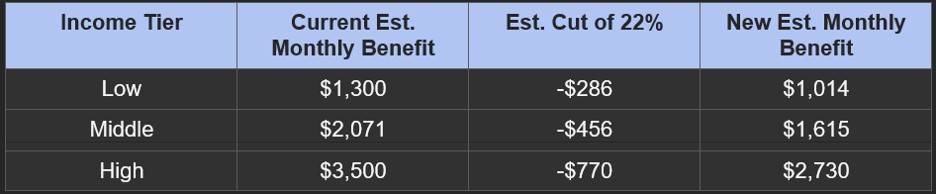
For married couples, the impact would be even more pronounced. A couple where both spouses receive average benefits could see their combined Social Security income drop by roughly $10,600 per year.
What About Current Retirees?
This remains the question we hear most often. The short answer is: current retirees are not immune, but they remain the least likely to be affected by any deliberate policy change.
Here is the important distinction to keep in mind. There are two ways benefits could be reduced:
- An automatic cut triggered by trust fund depletion — which, under current law, would affect all beneficiaries, current and future alike, starting in 2032.
- A deliberate legislative change — which historically has protected current retirees. Congress has never reduced benefits for people already collecting, and most reform proposals continue to focus changes on future retirees or phase them in gradually over many years.
So the risk facing current retirees is not primarily that Congress will cut their benefits on purpose. The risk is that Congress will fail to act at all, allowing the automatic trust fund depletion mechanism to take effect.
What Is Being Proposed to Address This?
Despite the urgency, Congress has not yet passed any Social Security reform legislation. The political obstacles remain formidable: meaningful fixes require either higher taxes, lower benefits, or some combination of both — none of which is easy to sell to voters. That said, the debate is becoming more active.
Some of the ideas being discussed include:
- Raising the Full Retirement Age (FRA) from the current 67 to as high as 69. This would effectively reduce lifetime benefits, particularly for those with shorter life expectancies, even without an explicit benefit “cut.”
- Lifting the payroll tax cap. Currently, wages above $184,500 (2026) are not subject to Social Security payroll taxes. Raising or eliminating this cap is one of the most commonly cited ways to improve the program’s finances.
- Means-testing and income-based reductions. Some proposals would reduce benefits or slow cost-of-living adjustments for higher-income retirees while preserving or increasing them for lower earners.
- Supplemental investment funds. Senators Bill Cassidy (R-LA) and Tim Kaine (D-VA) have put forward a bipartisan proposal that would create a new parallel investment fund, seeded with approximately $1.5 trillion in federal borrowing, to supplement payroll taxes over a 75-year horizon.
No plan has been signed into law. But there is growing acknowledgment on both sides of the aisle that action cannot be deferred indefinitely.
As one analyst at the Brookings Institution noted recently, the window for solutions is narrowing: every year of inaction reduces the available options and leaves less time to phase in changes in a way that gives workers and retirees adequate time to prepare.
Should I Change My Claiming Strategy?
For those of you who have been delaying benefits to maximize your age-70 payout, the question of whether to claim early — to “lock in” benefits before any potential cuts — continues to come up.
Our guidance remains consistent with what we shared in August:
- There is no clear reason to change course yet. The rules are unchanged, and delayed claiming still earns you an 8% annual increase in benefits between Full Retirement Age and age 70.
- Claiming early does not protect you from an automatic trust fund cut, which would affect all beneficiaries regardless of when they started collecting.
- Any deliberate legislative change is still most likely to be structured to protect current beneficiaries, or at minimum to phase in changes gradually.
- We continue to recommend basing your claiming decision on your individual circumstances — longevity, tax situation, income needs, and overall financial plan — rather than speculation about policy outcomes.
If there is a sudden, significant policy change that alters this calculus, we will be in touch promptly.
What This Means for Your Financial Plan
The 2026 Trustees Report confirms what prudent financial planning has already accounted for: Social Security’s future is uncertain, and a degree of conservatism is warranted.
Here is how we are thinking about this for our clients:
- For clients currently receiving benefits, we do not recommend making immediate changes to your plan. We are monitoring the situation closely.
- For clients approaching retirement, we continue to model your plan with a margin of safety that factors in the possibility of modest benefit reductions over time.
- For younger clients, Social Security remains part of our planning picture — but not the whole picture. We generally assume a conservative benefit level in projections, which means your portfolio and other savings carry more weight.
-SM