Monthly Archives

August 2026

Earnings Bonanza

A note on corporate profits, the outlook for stocks – and the risk posed by higher interest rates

Markets have had a lot to digest this year — a shaky spring, a war in the Middle East, and now a swirl of headlines about tariffs, AI spending, and inflation.

With all of that noise, I wanted to step back to discuss the data that typically matters most for the direction of stock prices: company profits.

What Moves Stock Prices?

Over short stretches — a week, a month, even a year — stock prices can be driven by reactions to all kinds of things: headlines, interest rate movements, electoral outcomes, geopolitics, changes in tax law.

But zoom out to longer stretches of time, and one relationship stands out above all the rest: stock prices move with company earnings.

Looking back over the last 25-plus years, S&P 500 company profits and the index’s share price have moved in the same direction over nearly every long stretch, and no other single factor comes as close to explaining where stocks end up over time.

Other things cause bumps along the way, but earnings are a road unto themselves.

Why is that?

A share of stock is simply a small ownership stake in a company’s future profits — the same way owning a piece of a local business entitles you to a slice of what it earns. When you buy that business, you’re generally willing to pay some multiple of its current profits, based on how much you expect those profits to grow.

If the business’s profits then grow by 20%, and buyers are still willing to pay roughly that same multiple, the business itself is now worth about 20% more.

Publicly traded companies work the same way, just with a price you can check every day: as long as investors keep valuing companies at roughly similar multiples of their profits, growing profits should translate into a rising share price.

That’s why, when we think about the market’s prospects, we start with a simple question: are company profits healthy, and are they likely to stay that way?

Right now, my answer is yes — with one thing to watch, which I’ll get to below.

This year’s earnings season has been one of the best in recent memory. As David Kelly, Chief Global Strategist at J.P. Morgan Asset Management, put it in a July 2026 research note, this earnings season “has started with a blast”:

  • Second-quarter 2026 results have come in well ahead of expectations, with roughly 86% of companies beating Wall Street analysts’ estimates — a noticeably higher hit rate than the historical average.
  • For the full year 2026, analysts now expect company profits to grow by roughly a quarter over 2025 levels — building on solid gains of about 10% in 2024 and 13% in 2025. This isn’t a one-quarter blip; it’s the continuation of a multi-year upswing.
  • Profit margins — essentially, how many cents of profit a company keeps out of every dollar of sales — are near their highest levels in decades. Companies aren’t just selling more; they’re keeping more of what they sell.
  • Looking further out, analysts expect profit growth to continue into 2027, albeit at a somewhat more moderate pace than this year’s exceptional gains. In other words, this isn’t expected to be a one-year sugar high.

The Bigger Picture: a Decades-Long Climb

Zooming out even further helps put this year in context.

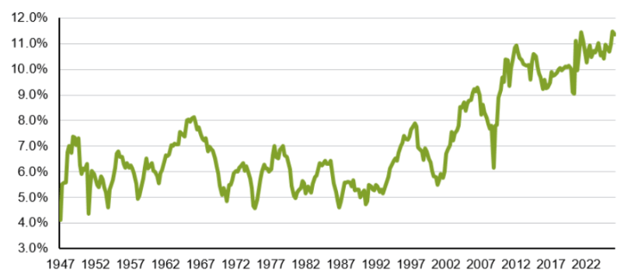
The chart below shows corporate America’s after-tax profits as a percentage of the entire U.S. economy, going back to 1947.

Source: JP Morgan Asset Management

For nearly 50 years, that share hovered in a narrow band around 6%. Since the mid-1990s, it has climbed steadily, reaching roughly 11.4% in early 2026 — essentially double its historical norm.

As Kelly at JP Morgan notes, this reflects a combination of businesses controlling labor costs more effectively and a more favorable corporate tax environment over the past three decades — durable, structural forces rather than a one-year phenomenon.

Watch Out for Interest Rates

Earnings are the foundation for the stock market, but interest rates can be a wildcard.

Here’s the simple version of why interest rates matter: when the Federal Reserve raises interest rates quickly, it makes borrowing more expensive and makes other investments (like bonds) relatively more attractive compared to stocks — which can pull stock prices down even when company profits are perfectly healthy.

We saw this play out a few years ago. In 2022, company earnings and the job market were both in good shape, yet stocks still fell nearly 20%, because the Fed was raising rates aggressively and rapidly (seven times in less than a year) to fight inflation.

It was a reminder that strong profits alone aren’t a guarantee of a rising market if the Fed is working against you at the same time.

So could that happen again? For now, a repeat of 2022 seems unlikely for two reasons:

  1. We’re not starting from an artificially low base. Going into 2022, interest rates had been held near zero for years, which meant the Fed had a long way to climb, in a hurry, to catch up with inflation. Today, the 10-year Treasury yield sits around 4.7% — already close to its long-run historical average of roughly 5.7% going back to the late 1950s. There simply isn’t the same “room” for a shock of similar size.
  2. This year’s inflation uptick has a different cause. Much of the recent rise in inflation traces back to a spike in oil and energy prices tied to the conflict with Iran, rather than a broad-based, self-reinforcing wage-and-price spiral working through the whole economy. Core inflation (which strips out food and energy) was actually cooling coming into this year, before the conflict began. An energy-price shock is a different animal than embedded inflation, and it tends to fade as the underlying disruption resolves rather than requiring an extended period of aggressive rate hikes to stamp out.

To be candid: the Fed has held rates steady at its last several meetings, but it’s possible that we see an interest rate increase or two before year-end if energy-driven inflation stays elevated — a few Fed officials have recently pushed for exactly that.

My expectation is that this would look nothing like 2022’s rapid-fire string of hikes — at most a few adjustments over the course of the next year, rather than a sustained tightening campaign.

But higher interest rates, even if the increases are moderate and reinforce the Fed’s inflation-fighting credibility, may unsettle the stock market.

The Bottom Line

The fundamentals supporting this market are genuinely strong: company profits are growing and margins are near record levels. That growth is expected to continue into next year — and historically earnings growth has been a reliable predictor of a healthy stock market over time.

Interest rates remain the variable most capable of disrupting that picture in the near term, but the setup today looks different from 2022: rates have already adjusted up from post-pandemic lows, and the current inflation pressure looks more like an energy shock than a deep-seated structural problem.

We’re watching both sides closely and will keep you posted if anything changes our thinking.

-RK

July 2026 Market Recap: Financial Markets Update: Trés Amusant

In July, I visited Old Orchard Beach, Maine. The cottage where I stayed with extended family is a short walk from Palace Playland, an amusement park, which first opened in 1902.

My style of ride is the Merry-Go-Round: old-fashioned, somewhat whimsical – and most importantly, one directional. My 12-year-old niece has a different vibe.

Attempting to curry favor, I accompanied her on HyperJump, which Palace Playland’s website describes as: “feel your heart race as you spin around and defy gravity with bursts of speed that send you soaring up and down.”

The HyperJump description is accurate; I may have scored a point with my niece; and two minutes of terror reaffirmed my amusement park ride preferences.

July’s market activity encompassed elements of both Carousel and HyperJump.

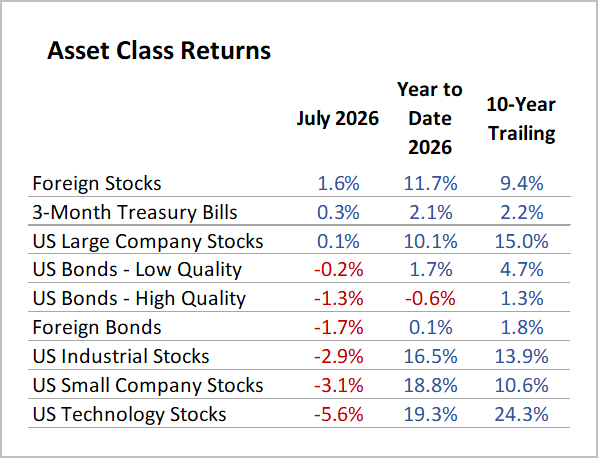
Performance for a good portion of the stock and bond markets was Carousel-like. Foreign stocks (+1.6%), US Treasury Bills (+0.3%) and US Large Company Stocks (+0.1%) all recorded modest positive performance in July.

Other segments of the financial markets, including US Bonds (-1.3%) and Foreign Bonds (-1.7%), registered modest negative performance. Small company stocks declined a bit more (-3.1%), but results were far from stomach-turning.

HyperJump activity was concentrated mainly in the technology sector (-5.6%), and the gyrations were more obvious by looking at individual stock performance for the month.

As the chart below indicates, stock prices of major tech companies ranged from +25% to -35%. Several companies involved in cloud computing and data management soared, while semiconductor manufacturers, which had done very well in the first half of 2027, fell particularly hard.

Source: Morningstar

Away from technology sector, oil prices increased by more than 20% in July, pushed higher by increased hostilities in the Middle East, which helped boost Energy sector stocks by 12%.

In sum, I concur with sentiment shared recently in a note by Jeremy Siegel, Emeritus Professor of Finance at Wharton and Senior Economist at WisdomTree: “The recent rotation away from the market’s most speculative leadership, while uncomfortable for some investors, strengthens rather than weakens the foundation of this bull market.”

Another way of framing this: prices for some technology stocks had come too far, too fast. The downward adjustment in their share prices in July, without a broad-based stock sell-off, is a healthy sign for the market as a whole.

Here are results for July and 2026 Year-to-Date, compared to longer-term annualized returns (10-Year Trailing):

Note: YTD 2026 as of July 31; Source: Morningstar

-RK