For the past three years, developments related to Artificial Intelligence (AI) have captivated investors. Stocks of large technology companies associated with AI have done very well, and the biggest of the bunch have generally performed best.
Recently, however, stock market sentiment has shifted from AI excitement to AI anxiety.
The source of this anxiety is twofold, stemming from:
- Costs of Building AI: Developing AI infrastructure is costly; it will crimp the near-term profits of the companies building it; and it raises questions about profit margins for the AI infrastructure builders over the long term
- Results from Deploying AI: Expanded AI usage may be disruptive for jobs, companies, and the stock market
The Costs of Building AI
The term “hyperscalers” is being used to refer to the tech company giants that are building and operating massive cloud-based computing infrastructure that supports the training and deployment of Artificial Intelligence models.
In the United States, the hyperscalers are Alphabet (Google), Amazon, Meta Platforms (Facebook), Microsoft, and Oracle. Collectively, these five companies account for 17% of the S&P 500 index of large company US stocks.
In 2023, the year after ChatGPT emerged on the scene, hyperscalers’ capital expenditures (money spent for acquiring long-lived assets) was about $150 billion. In 2026, it’s expected to be about $650 billion.
For comparison, US federal government defense spending in 2026 is expected to come in at about $900 billion. And, $600 billion is about the size of the economies of Singapore and Sweden (measured by Gross Domestic Product, or GDP).
The sums being spent on AI infrastructure are enormous, and the acceleration of the spending is breathtaking. So, investors are questioning whether the capital commitments will be worth it.
Profitability has been high for the hyperscalers in recent years, but large-scale AI investment is expected to pull down profit margins in the near term. Investors understandably do not like seeing margins decline, even for companies with long-term track records of operational success.
Perhaps AI investment will pay off and returns will start trending higher next year and beyond. Or, perhaps the anticipated demand for the compute capacity will be less than expected, and profit margins will be lower for longer.
Here’s how hyperscaler stock prices have performed over the past three years, and so far in 2026, compared to the broad market for US large company stocks as represented by the S&P 500:
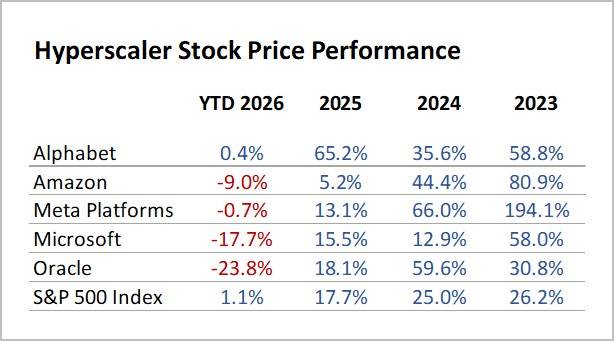
Note: YTD 2026 as of 2/20/2026; Source: Morningstar
The hyperscaler stock price stall is telling us that investors are less sure that today’s spending will translate to outsized profits in the future.
The Results from Deploying AI
It really is far too early to know what the effects of AI availability and AI usage will be.
But predictions affected stock prices in various areas of the market in the first part of February. Here are some examples:
- AI developer Anthropic announced it was adding new legal tools to its Cowork assistant to help automate some legal drafting and research tasks. On February 3, shares of companies that provide legal tools and research databases dropped, as did other “software as a service” companies: Examples: Legalzoom dropped 20%; Thomson Reuters declined by 16%; Salesforce fell 7%.
- OpenAI (maker of ChatGPT) said it was adding an app for homeowner insurance quotes. Shares of insurance brokers proceeded to decline. Example: Marsh & McLennan dropped 8% on February 9.
- Financial custodian Altruist said its AI assistant could handle some tax-related tasks. Shares of brokers and financial custodians dropped. Example: Charles Schwab lost 7% on February 10.
- A Florida-based firm said it could use AI to improve efficiency in the trucking business. Shares of airlines, railroads, and trucking firms slid. Example: C.H. Robinson shares lost 15% on February 12.
- The CEO of Anthropic recently claimed that AI would wipe out half of all entry level white-collar jobs in the next one to five years, and Microsoft’s head of AI said that “most if not all” professional tasks would be automated within 18 months.
Some investors are inclined to shoot first before asking questions and seeing the results of AI deployment and utilization.
Other investors who hear about new technologies and see wild price swings in some stocks of established companies may be unsettled.
In his recent Weekly Commentary from February 17, professor and long-time market practitioner Jeremy Siegel offered these observations:
- Technological change will continue to disrupt industries, and some business models will be impaired
- Productivity growth is ultimately deflationary and wealth-enhancing
- We may even see the long-discussed four-day workweek become viable over time as output per hour accelerates; that is not a recessionary signal, that is a prosperity signal
- Anxiety is part of every technological transition
- Today’s data tell us the economy is stabilizing, inflation is receding, and real incomes are rising
- This is not a backdrop for derailing a bull market; it is a backdrop for its expansion
While it is worth having some perspective on what’s going on underneath the surface of a stock market, trying to pick winners and avoid losers as new technologies emerge is unadvisable.
A better, time-tested approach to investing is to maintain a diversified portfolio with exposure across sectors and markets, and to enjoy a rising tide that lifts many boats over the long term.
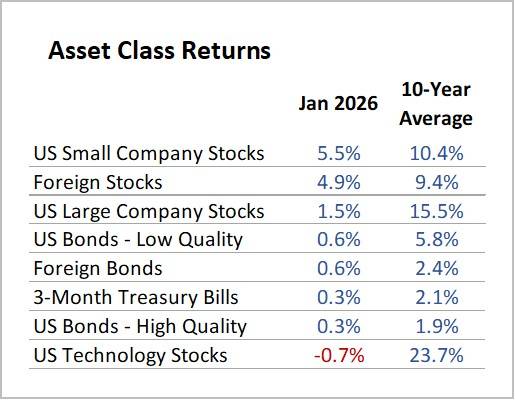
The financial markets got off to a satisfactory start for the first month of 2026. Here are results for January: