

Tech Tremors
Enthusiasm for companies developing artificial intelligence (AI) models and building infrastructure that will support greater AI use has helped to keep the wind in the sails of the stock market for the past several years.
But the stock market entered some choppy water in October as investors focused more on the risks that they are being asked to bear.
One of the bigger risks is that many technology companies are taking on more debt to fund AI-related expansion, which is raising questions about the ability of these companies to produce ever-stronger financial results, especially in the near term.
In October, investors weren’t shy about expressing their skepticism.
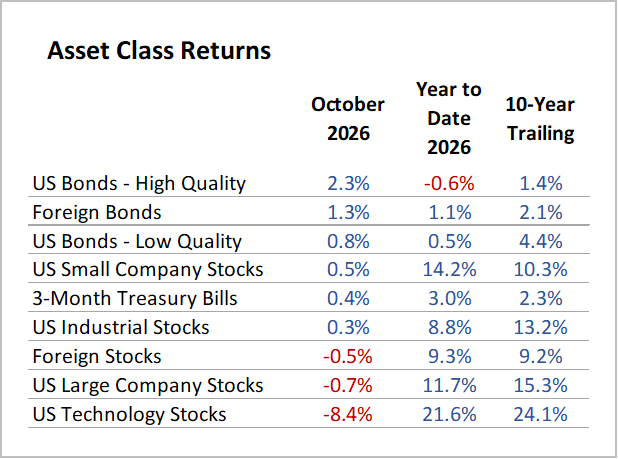
The technology sector declined by 8.4% last month, and by Monday, November 2 tech had entered “correction” territory, having declined by more than 10% from the recent peak.
In my view, after a decade of extraordinary share price performance from the tech giants, some skepticism is a healthy development.
As investors, we must be aware of emerging risks and proceed with a measure of caution as risks evolve, especially as bull markets extend out farther in time (as of late October, we entered the fifth year of the current bull market).
Away from the tech sector, the financial markets held up reasonably well in October.
Nine of the eleven broad sectors in the S&P 500 had positive returns last month. It was the poor performance from the tech sector that pulled the large-stock index down to -0.7% for the month. US small company stocks registered a modest gain of 0.5% for October.
And after facing particularly unforgiving seas in September, bonds came about as the trend to higher yields that began in March reversed. For example, 10-Year Treasury yields, which began October at 5.29% fell 0.36 percentage points, ending the month at 4.93%.
Yield declines in the US and across the globe translated to a gain of 2.3% for US high quality bonds and 1.3% for foreign bonds.
Here are results for October and 2026 Year-to-Date, compared to longer-term annualized returns (10-Year Trailing):
Source: Morningstar
Remaining diversified and sticking to asset allocation targets are two of the best ways to achieve consistent results and prepare for inclement conditions in the financial markets and to ride out frequent choppy seas as well as less frequent, but more intense, severe squalls.
Midterm Election Results
A blue wave washed through the capitol as Democrats won majorities in the House and Senate on November 3, 2026.
At the time of publishing this letter, 33 of 35 races were called in the Senate, with Democrats holding 54 seats overall. In the House, 360 of 435 races were called, with Democrats holding 228 seats.
Despite the shift in control of the legislature, the midterm election is unlikely to bring a new era of progressive policymaking, because Democrats will lack the votes to override presidential vetoes.
But the results are a type of litmus test for the Republicans’ approach to governing, and the calculus on what will resonate with the American people in the next presidential election cycle has shifted meaningfully.
The initial read from the stock market: thumbs up. Stock market futures were in the green on Wednesday morning, November 4.
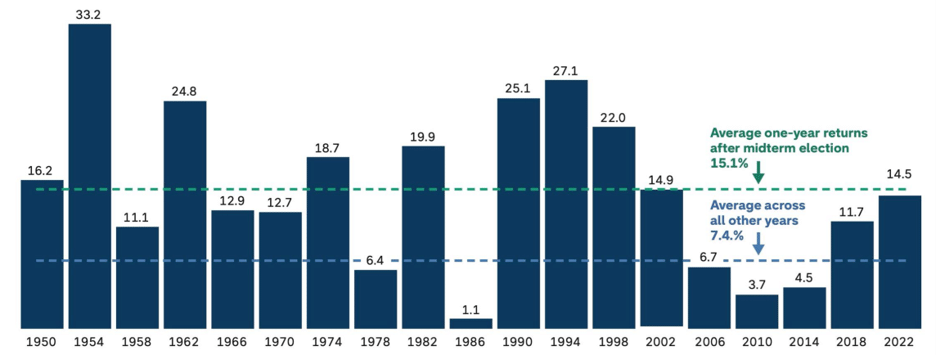
And if we use history as a guide, we might expect the bull market in stocks to continue into 2027. The chart below, courtesy of Capital Group, maps out the stock market returns in the year following each midterm election since 1950.
Source: Capital Group
Past results have been encouraging, with an average one-year return after midterms at just over 15%. This compares quite favorably to a long-term average stock market return of about 10% (all years), and to a 7.4% average across all non-midterm years.
-RK