Monthly Archives

October 2025

Keys to a Successful Retirement

In Keys to a Successful Retirement: Staying Happy, Active, and Productive in Your Retirement Years, author Fritz Gilbert offers a comprehensive and practical guide to navigating the transition into retirement with purpose and fulfillment.

Using the metaphor of baking a cake, Gilbert emphasizes that a successful retirement requires thoughtful preparation, the right “ingredients” (such as financial security, mental well-being, and meaningful activities), and a step-by-step plan.

He addresses both the financial and emotional aspects of retired life, including managing savings, healthcare, and the psychological challenges like aimlessness or depression.

Gilbert’s book encourages readers to define their own vision of retirement, stay socially connected, and pursue passions that bring joy and meaning, ultimately helping retirees craft a vibrant and satisfying new chapter of life.

-RK

Fall College Planning Checklist for Every High Schooler

Fall is a fantastic season and thoroughly enjoyed by many people. Especially here in New England we enjoy beautiful foliage, crisp cool air, bright sun, pumpkin spice, and football games.

It is also one of the most important times of the year for college planning.

Whether your student is just starting high school, or in the throes of senior year applications and decisions, autumn is the season when key milestones and deadlines come into focus.

To help you (and your student) stay organized and focused, here is a grade-specific checklist of what to prioritize this Fall.

Freshmen (9th Grade): Build the Foundation 

The first year of high school is all about building strong habits and exploring new opportunities

  • Get involved: Clubs, sports, and community service are great ways to explore interests and build a future activities list.
  • Focus on academics: A strong GPA begins now. Encourage good study routines and time management.
  • Meet your high school counselor: A quick introduction helps your student start building a relationship that will matter later, which you can build on.
  • Explore interests: Spark curiosity about future careers or colleges without pressure.

Sophomores (10th Grade): Explore & Prepare 

Sophomore year is about exploration and light preparation for what’s ahead

  • Try the PSAT (practice): Some schools allow sophomores to take it—it’s low-stakes and helps them get comfortable with the format.
  • Challenge yourself academically: If available, honors or AP courses show readiness for rigorous work.
  • Start tracking and keep an activity log: Document leadership roles, service hours, or new achievements.
  • Career exploration: Attend a career fair, shadow a professional, or use online career tools to discover potential pathways. Or talk to your relatives that have a job you find interesting.

Juniors (11th Grade): The Planning Year 

This is the most critical year for college preparation 

  • Take the PSAT/NMSQT: It counts for National Merit scholarships and provides insight for SAT prep.
  • Visit colleges: Many colleges have open-house events in the fall—if you can, go in person to the top schools on your list. This is the time to start forming impressions.
  • Discuss and Decide on Testing: Decide whether the SAT, ACT, or test-optional route makes sense for your student.
  • Research scholarships: Some awards are open to juniors—starting now gives you a head start and possibly an advantage.
  • Keep grades strong: Junior year GPA is a major focus of colleges and is weighed very heavily.

Seniors (12th Grade): Application Season 

For seniors, fall is crunch time: deadlines and forms come quickly, so staying on track is essential

  • Finalize your college list: Narrow down choices to a list that fits your academic and social interests, school size, geographical location and environment, and overall costs.
  • Meet early deadlines: Early Action and Early Decision applications are often due in November.
  • Complete financial aid forms: The FAFSA and CSS Profile open in October—apply early to maximize your eligibility.
  • Fine-tune your essays: Have a trusted teacher, counselor, or mentor provide feedback before submission.
  • Request recommendations: Teachers need plenty of time to write thoughtful letters.
  • Stay organized: Use a calendar, spreadsheet, or app to track deadlines and requirements.

Final Thoughts

With each fall season, students have new opportunities to move one step closer to their college goals. By approaching the process by each high school year, students and families can stay on top of priorities without feeling overwhelmed.

Here is another reminder: Don’t forget to take time to enjoy this beautiful season as well! Get out among the colorful trees and grab a hot cider and apple cider donut along the way to the pumpkin patch.

-DC

Medicare: Reviewing Your Options After Age 65

Each year from mid-October through early December, Medicare enrollees have a window to make changes to their coverage. This article provides a guide for reviewing your Medicare and supplemental coverage.

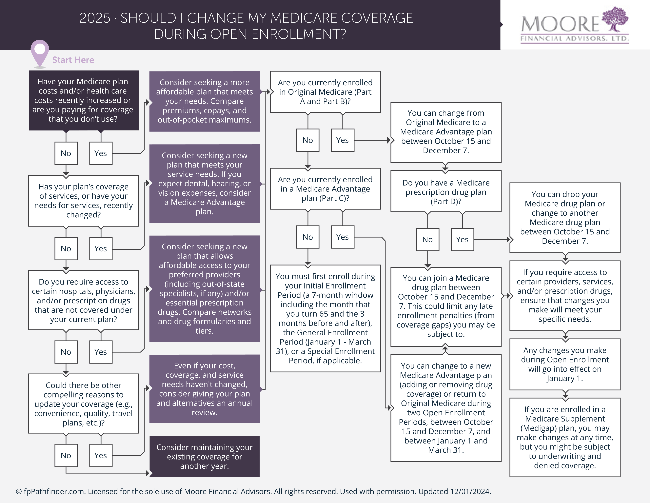
At the end of this article, we provide a helpful “Should I Change My Medicare Coverage?” flowchart which you can download.

For plan year 2026, the Annual Open Enrollment Period (AEP) runs October 15 through December 7.

During this time, you can:

  • Switch from Original Medicare + Part D to a Medicare Advantage plan
  • Switch from one Medicare Advantage plan to another
  • Drop Medicare Advantage and go back to Original Medicare (although in most states – except MA, CT, ME, and NY – Medigap insurers are not required to sell you a policy after your first year on Medicare if you don’t meet the medical underwriting requirements)
  • Enroll in or change a Part D (prescription drug) plan

If you already have Medicare, this is your annual chance to reassess whether your coverage still meets your needs.

What Original Medicare Enrollees Should Review 

If you are enrolled in Original Medicare (Parts A & B), here’s what your annual review should focus on:

Part D Drug Coverage

  • Setting up and reviewing your account at www.medicare.gov can be very helpful in comparing plans.
  • Are your current medications still covered?
  • Do the copays, coinsurances, and coverage tiers change for next year?
  • Is your preferred pharmacy network still included?

Medigap / Supplement Policy Changes 

  • Some insurers may raise premiums or adjust rate classes.
  • In most states (except MA, CT, ME, and NY,) once your Medigap enrollment period is over, you may not be able to switch without medical underwriting, so changes are harder later.
  • If your plan offers rate “community-rated” options or age-based rates, check how your premium may change.

Part B / Cost Increases & IRMAA 

  • Expect the standard Part B monthly premium to rise to approximately $206.50 in 2026; higher-income beneficiaries may face steeper surcharges (in Medicare-speak, IRMAA: Income-Related Monthly Adjustment Amount)
  • Also review the Part B deductible and coinsurance changes in your 2026 “Medicare & You” handbook.

Providers & Networks 

  • Even though Original Medicare generally allows you to see any provider who accepts Medicare, certain supplemental or supplemental plan services (e.g. preventive benefits) may change coverage rules.
  • Ensure your preferred physicians and hospitals still accept Medicare under the same terms.

Total Cost Projection

Your Medicare.gov account can help you:

  • Add up your premiums (Parts B, Part D, Medigap) + estimated out-of-pocket (copays, deductibles) + travel/foreign care exposure.
  • Compare competing Part D or Medigap policies in your area for cost savings.

What Medicare Advantage Enrollees Should Review 

If you currently have a Medicare Advantage (MA / Part C) plan, here’s a checklist:

Annual Notice of Change (ANOC) & Evidence of Coverage (EOC) 

  • These notices typically arrive in September. They list changes in premiums, drug formularies, cost sharing, provider networks, and benefits.
  • Review them carefully. If your plan’s changes make it worse for you (higher costs, your doctors dropped, drugs removed), consider switching.

Doctor / Hospital Network 

  • Confirm that your preferred providers remain in-network under the plan for 2026.
  • If your doctors shift networks, your costs could increase substantially.

Drug Coverage / Formulary Changes 

  • Some drugs may be removed, moved to higher tiers (more costly), or require step therapy or prior authorization.
  • Check whether your current pharmacy is still a “preferred” or in-network pharmacy.

Premiums, Deductibles, and Maximum Out-of-Pocket

  • Even if your monthly premium stays low, changes elsewhere (higher outpatient copays, specialist costs, or hospital deductibles) can change your financial outcome.
  • Also watch for plan design changes (e.g. shifting benefits to coinsurance vs fixed copays).

Supplemental / Extra Benefits 

  • Many Medicare Advantage plans include extras (dental, vision, hearing, wellness, transportation). However, insurers are under budget pressure and may reduce or eliminate some supplemental benefits.
  • Verify whether extras that matter to you remain part of the plan.

What’s Changing in 2026 (What to Watch For) 

Looking ahead to plan year 2026 for Medicare, here are some of the major shifts and pressures to be aware of:

Insurer Exits / Plan Reductions

  • Several major carriers (Aetna, Elevance, UnitedHealthcare) are scaling back their Medicare Advantage or prescription drug plan presence in some markets.
  • When a plan you’re enrolled in is discontinued, you’ll get a Special Enrollment Period (SEP) to choose a new plan. Some states also allow guaranteed issue rights to enroll in Medigap in that scenario.
  • This website is one way to search for a new plan: medicareresources.org

Changes to Drug Pricing and Part D 

  • The Inflation Reduction Act allows Medicare to negotiate certain prices for certain high-cost prescription drugs (Eliquis, Enbrel, Entresto, Farxiga, Imbruvica, Januvia, Jardiance, Flasp/Novolog, Stelara, Xarelto) starting in 2026.
  • The out-of-pocket cap for Part D will increase (e.g., from $2,000 to $2,100) in 2026.
  • Some insurers may face lower federal subsidy support, leading to premium increases or tighter formularies.

Premium Changes 

  • While average MA plan premiums are expected to decline (or remain stable) in many areas, other costs may still rise (Part B premium increases, drug or service cost sharing).
  • Part B premium increases are expected; some sources project it could reach ~$206.50 in 2026 (though that’s not yet final).

Benefit Reductions & Tighter Coverage

  • Some insurers may reduce supplemental benefits (transportation, over-the-counter allowances, meal delivery) to preserve margins.
  • Expect more restrictive prior authorization or utilization management in some plans.

You can find more information through this link: 10 Major Medicare Changes Coming in 2026

Tips for Choosing Wisely During Open Enrollment

  • Start early — don’t wait until December. Review your ANOC/EOC as soon as you receive them.
  • Use the Medicare Plan Finder at www.medicare.gov to compare all available plans in your ZIP code, using your actual drug list and preferred providers.
  • Contact your State Health Insurance Assistance Program (SHIP) — free local counseling. In Massachusetts, this program is known as SHINE.
  • Create a short “must-have list” for coverage (e.g. your physicians’ network, essential drugs, maximum acceptable cost increases) and screen plans against that list.
  • Don’t just look at the monthly premium — total cost matters: premiums + cost sharing (copays, coinsurance, deductibles) + network adequacy.
  • If your current plan is being discontinued, act quickly in the Open Enrollment period to select a new plan before coverage gaps arise.
  • Document all your enrollment decisions, take screenshots, or save confirmation numbers — mistakes happen.

The flowchart below is a guide that helps you determine if you should change your Medicare coverage during open enrollment. Click on the image to download or print the chart.

-SM

Medicare: Preparing to Enroll at Age 65

If you’re approaching 65, now is the perfect time to understand the Medicare rules and options so you don’t miss important deadlines. This article walks you through what you need to know as you prepare to enroll.

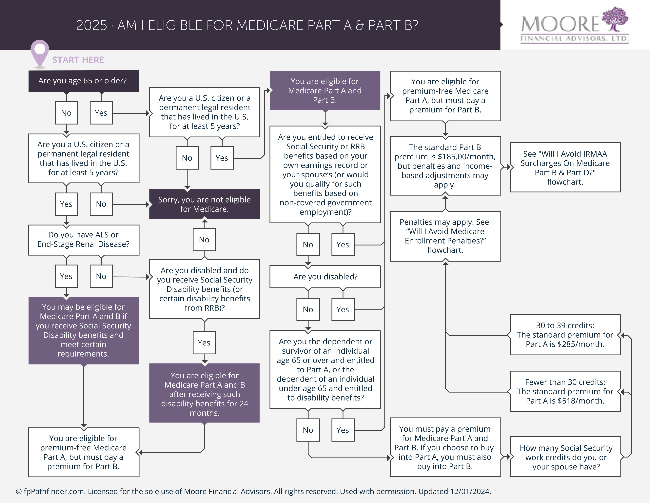
At the end of this article, we provide an “Am I Eligible for Medicare?” flowchart which you can download.

Who Needs to Sign Up for Medicare? 

  • Most people become eligible for Medicare at age 65.
  • If you are retired and not covered by an employer health plan, you’ll need to enroll in both Medicare Part A (hospital coverage) and Part B (medical/outpatient coverage) during your initial enrollment window.
  • If you are still working at age 65, you should enroll in premium-free Medicare Part A while you have employer coverage, as it won’t affect your job-based insurance and can offer secondary coverage without a penalty.
  • If you are 65, working, and covered by your (or your spouse’s) large employer health plan (20+ employees), you can delay Part B without penalty until you leave that employer coverage. You’ll have a Special Enrollment Period (SEP) for Part B that lasts until 8 months after your or your spouse’s employment or employer coverage ends.
  • If your employer is smaller (fewer than 20 employees), Medicare generally becomes your primary insurance at 65, and you’ll need to sign up for both Medicare A and B to avoid gaps in coverage.

When Should You Sign Up? 

  • Your initial enrollment period is a 7-month window around your 65th birthday: the three months before your 65th birthday, the month of your birthday, and the three months after.
  • Signing up before your birthday month ensures coverage starts as soon as you’re eligible.
  • If you delay and don’t have other qualifying coverage, you may face late enrollment penalties that last for life. 

What Will Medicare Cost in 2026?

  • Part A (Hospital Insurance): Generally premium-free if you or your spouse worked 10+ years.
  • Part B (Medical Insurance): The standard premium is projected to be $206.50/month in 2026 (up 11% from the 2025 premium of $185/month.)
  • Higher-income households may pay more due to IRMAA surcharges. With rising healthcare costs, it’s wise to budget for increases over time.

Original Medicare vs. Medicare Advantage 

Medicare Parts A (hospital) & B (outpatient) generally cover about 80% of health care charges in these two categories of care. Most people buy additional insurance to cover the remaining costs of care.

You will need to make a choice between two ways to get benefits to supplement Medicare A & B when you sign up. Below are more details on the two categories of Medicare.

Original Medicare

Original Medicare with a Medigap (supplement) policy offers the widest choice of doctors and hospitals since you can see any provider nationwide who accepts Medicare.

It works especially well if you travel frequently, are a “snowbird”, or want the flexibility to see specialists without referrals.

Pairing Original Medicare with a Medigap policy can help cover deductibles, coinsurance, and copays, giving more predictable out-of-pocket costs.

Most people also need to buy a separate Part D prescription plan, and total monthly premiums (Medicare + Medigap + Part D) can be higher than Medicare Advantage.

Medicare Advantage

Medicare Advantage plans, offered by private insurers, often bundle hospital, medical, and prescription coverage into one plan.

Many include extras like dental, vision, or gym memberships, and premiums can be lower than Original Medicare with a supplement.

However, Advantage plans typically use provider networks (HMO or PPO), which may limit your choice of doctors and hospitals.

Out-of-pocket costs can be less predictable because of deductibles, copays, and coinsurance, especially if you need specialized or out-of-network care.

There’s no one “best” option—it depends on your health, budget, and provider preferences.

Where to Get Help

  • www.medicare.gov – The official Medicare website with enrollment and plan comparison tools. You can compare costs and coverage in your area for Medigap and for Medicare Advantage plans. If you set up your account and enter the drugs that you take, you can also compare the total cost of Part D insurers available to you.
  • SHIP (State Health Insurance Assistance Program): Free counseling in every state.
  • Generally, these services are available by calling your local senior center.
  • In Massachusetts, this is called SHINE (Serving the Health Insurance Needs of Everyone).
  • Your financial planner – We can help you evaluate Medicare choices in the context of your retirement income, taxes, and long-term health planning.

If you’re approaching age 65, don’t wait. Understanding when and how to enroll in Medicare—and what it will cost—can help you avoid penalties and find coverage that fits your needs.

The flowchart below is a guide that helps you determine if you’re eligible for Medicare Part A & Part B. Click on the image to download or print the chart.

-SM

September 2025 Market Recap: Good Times, Continued

September delivered another month of positive returns for investors:

  • Russell 2000 Index of small company stocks returned 5.5%
  • MSCI EAFE Index of foreign stocks returned 4.8%
  • S&P 500 Index of large company US stocks returned 4.2%
  • Bloomberg Aggregate Bond Index, the benchmark for US bonds, rose by 1.3%

US stocks reached new highs eight more times in September, bringing the tally in 2025 to twenty-eight new “all-time highs” for large company US stocks.

When viewed through a broader lens of the quarter (last three months):

  • US small company stocks were the top performer, returning 10.5%
  • US large company stock returns of 7.3% edged out foreign stock returns of 6.2%
  • Bonds delivered a more muted return of 2.8%

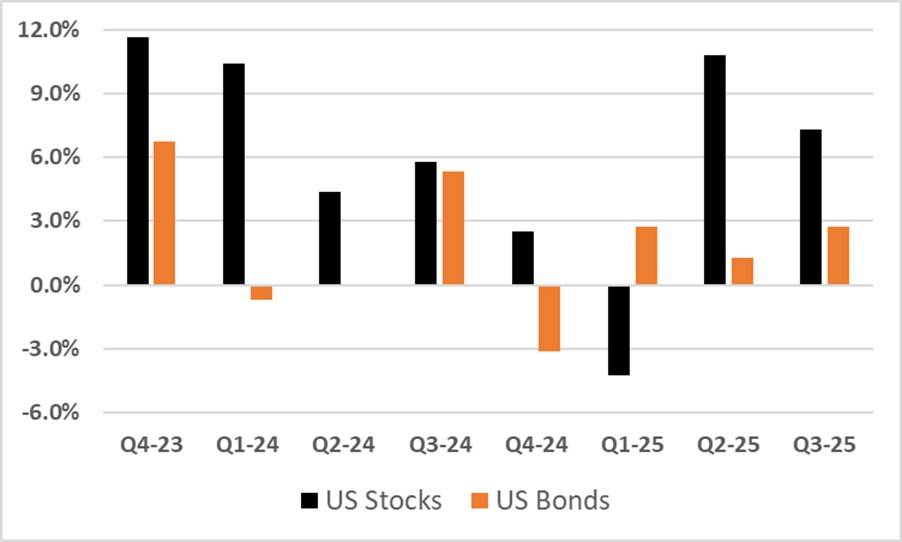
Widening the aperture further still, the chart below shows US financial market returns by quarter for the last two years.

Source: MFA & Morningstar

Large company US stock returns are shown in black, US bond returns are shown in orange.

This picture illustrates a pleasing run of positive performance: only one quarter in the past eight has been negative for stocks, with quarterly average stock performance at 6%.

Bonds haven’t fared as well, but still the outcome still has been constructive for investors. With two quarters of negative returns and one of essentially zero return, quarterly bond performance has averaged 2%.

One of the questions at the front of mind for many investors is: will the positive trends persist?

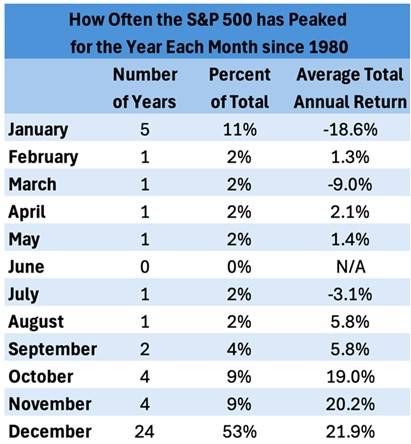
Here’s some historical perspective: according to research from Jessica Rabe at DataTrek (an independent research firm), the odds are greater for returns to reach their high point for the year in the 4th quarter when the stock market is having a good year.

DataTrek looked at annual returns each year since 1980 and catalogued the month in which the stock market peaked each year.

The table below shows stock market peaks by month; percent of time since 1980 that the stock market peaked for the year in that month; and average annual return when stock market peaked in a given month.

Source: DataTrek

Here are two key take-aways from DataTrek’s research:

  • the S&P 500 has tended to reach its high point for the year in December when returns for the full year were strongly positive (this happened in 24 of the 45 years since 1980, or 53% of the time – bottom of the chart)
  • the stock market has tended to reach its high point for the year in January when returns for the full year were strongly negative (5 times in 45 years, or 11% of the time – bottom of the chart)

As of Friday, October 3, US stocks had returned 15% year-to-date.

Applying her research to today’s market environment, Rabe at DataTrek concludes: “based on historical seasonal returns over the last 45 years, the S&P has significantly higher odds of peaking in the final quarter of this year rather than in September.”

It’s important to recognize that past performance doesn’t guarantee future results. But we can use history as a guide and as a way of informing our thinking about how things may unfold in the future.

While we avoid using terms such as “with certainty” and “without doubt”, the current environment of economic expansion, strong company earnings, and a Federal Reserve predisposed to bring down short-term interest rates seems conducive to a continuation of positive financial market trends, both for stocks and bonds.

That said, one area of emerging weakness which we’re watching closely is the US labor market.

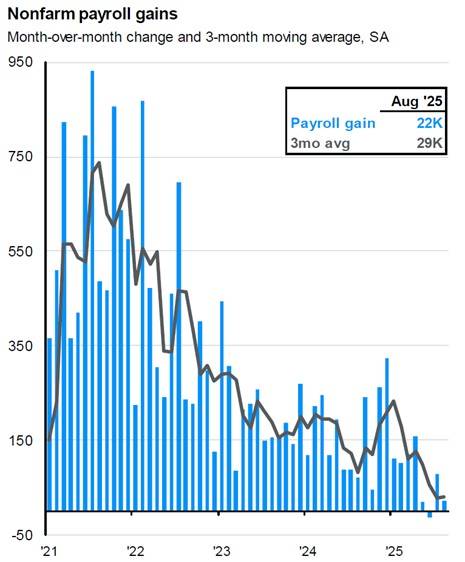
The chart below from JP Morgan Asset Management presents monthly jobs gains using data from the Bureau of Labor Statistics. It shows that job growth slowed meaningfully over the summer of 2025.

Source: JP Morgan Asset Management.

Monthly jobs gains had been inflated because of “pandemic catch up” in 2021 and 2022 but still averaged over 200,000 jobs per month in the last couple of years through spring 2025.

This trend moved down to an average of 29,000 new jobs per month this summer.

If the employment situation downshifts further into persistent net job losses (yet to be determined) this could put downward pressure on US economic growth and put the stock market “good times” at risk.

And a new source of uncertainly stems from the shutdown of the US federal government. More information on that situation in next week’s upcoming blog “Government Shutdown Briefing”.

-RK

Government Shutdown Briefing

At a time when financial markets are experiencing good cheer, many government employees are not.

At 12:01 AM on October 1st, the US government shut down. Many people on Main Street are unsure of what this means. In the following article, we try to bring some clarity to the situation.

Politics Behind the Shutdown

The current dispute revolves around a Republican bill to continue funding the federal government for the next seven weeks while a full-year spending bill is worked out.

Senate Democrats have refused to advance the so-called “continuing resolution” (short-term funding bill) unless Republicans agree to extend certain health care subsidies under the Affordable Care Act that are due to expire soon, and to reverse Medicaid cuts made earlier this year.

Republicans have proposed a clean extension of government spending authority with no strings attached, which runs through the middle of November. Democrats have pushed back on this proposal due to the expiration of healthcare subsidies at year-end.

At least eight Democrats would need to join Senate Republicans to pass a spending bill. So far, three have.

Employment Impact

The shutdown could suspend the work of at least 600,000 government workers out of a total 2.1 million government employees, according to the New York Times. The majority of affected workers come from the Department of Defense.

Federal government employees who are furloughed during a shutdown are guaranteed to receive back pay once the government reopens.

Statements from Trump Administration officials indicate that some non-essential workers could be permanently let go. This would be different from previous shutdowns, and if followed, could have more lasting effects on the US labor market.

Economic Impact

Economists at Goldman Sachs calculate that each week of a government shutdown will shave 0.15 percentage points off quarterly annualized Gross Domestic Product (GDP).

Based on this analysis, it would take about one and a half months of shutdown to shave a full percentage point off quarterly output.

Currently, the quarterly annualized GDP growth rate is about 3%.

Goldman economists are quick to point out that a similar boost to growth in the following quarter (after the government re-opens) is likely, ultimately reversing the negative economic impact.

One concern for retirees likely is: what happens to Social Security payments?

Despite the budget impasse, Social Security recipients will continue getting their monthly payments.

Social Security benefits fall under the category of “mandatory spending.” They have a dedicated, permanent funding source (primarily payroll taxes) and are unaffected by the federal appropriations process.

The staff of the Social Security Administration, however, will be affected.

According to AARP, 88% of the SSA’s 45,600 workforce will remain on the job without pay to maintain essential functions and services. About 6,200 staff are being furloughed.

What the Opinion Polls Say

Recent polling on the topic has consistently shown (according to Goldman Sachs) that more voters are blaming Republicans over Democrats for the shutdown, which thus far has emboldened Democrats to hold their ground and not compromise on their healthcare demands.

Inflection Point

October 15th is a military pay date; if the shutdown goes beyond this day, active-duty military personnel will miss their entire paycheck, which has not happened in past shutdowns.

There is likely little appetite from both parties for this to happen, so 10/15 may end up being a forcing event for both sides to come to an agreement which would end the shutdown.

The chart below maps out the nine government shutdowns since 1981 by date and number of days (courtesy of Capital Group).

Source: Capital Group

Shutdowns tend to be brief, but the time until reopening has gotten longer in recent years. And previous shutdowns have had little effect on financial markets and the US economy.

According to Capital Group, “historically risk assets dip slightly during a shutdown’s immediate aftermath, but these moves are often small and tend to reverse once the government resumes normal operations.”

The wildcard in the current shutdown is the degree to which the Trump Administration turns furloughs into permanent layoffs.

-RK