Monthly Archives

July 2026

When Your Kid Still Can’t Decide – And It’s Almost Senior Year

This is not a topic you will hear much about when the college discussion comes up, or when reading college planning articles, but it is one worth exploring. You may feel like you are all supposed to have everything figured out, the school, the finances, and the major.

However, some high school kids have not figured out what they want to do with their life yet. And that is OK.

Summer is supposed to feel like a break. But if you’re the parent of a rising senior who still has no idea where — or even whether — they want to go to college, this particular summer probably doesn’t feel much like one.

I hear this a lot: “My kid is interested in everything and committed to nothing.” Or the flip side — “They have no idea what they want to do, so they don’t see the point of any of it.”

Here’s the truth: this is more common than you think, and it doesn’t have to derail the process. But it does require a different approach — because pushing harder on a kid who’s already shut down rarely ends well.

First, Separate Their Indecision from Your Timeline

Think about this — the college application process was designed around deadlines, not around human development. Some 17-year-olds genuinely don’t know what they want yet, and that’s not a failure. It’s actually pretty normal.

What is a problem is letting their uncertainty become a reason to do nothing — because the financial and logistical decisions don’t wait for clarity. Deposits, financial aid packages, scholarship deadlines — these have hard stops.

So, the first move is to separate two things:

  • What your child needs to figure out (direction, interest, fit)
  • What you need to drive forward (the financial strategy, the list, the paperwork)

You can do your job even while they’re still working on theirs.

Give Them a Smaller Question to Answer

One of the most common mistakes I see — in conversations with clients’ kids — is someone asking too big a question too soon. “What do you want to do with your life?” is paralyzing. No wonder they go quiet.

Try a smaller focus:

  • What don’t you want? Sometimes elimination is easier than selection. A kid who can’t name a dream school can often rattle off everything they don’t want — huge lecture halls, a campus in the middle of nowhere, a school that feels like an extension of high school.
  • What lights you up, even a little? It doesn’t have to be a major or a career. A flicker of interest in food science, environmental policy, or film is enough to start building a list around.
  • What kind of experience do you want? Big campus energy vs. small community? Urban vs. rural? Close to home or far away? These aren’t career questions — they’re easier to answer, and they narrow the field considerably.

The goal isn’t a five-year plan. The goal is to have enough direction to build a working college list.

Build the List Anyway — With a Financial Safety Built In

Here’s where I push back a little with families: don’t wait for your child to fall in love with a school before you start building the list. Build it around them.

I watched literally hundreds of families fall in love with the university where I worked while on tour, and heard parents say repeatedly, “Well, they love it here, I guess this is it”, without any acknowledgement of price. (It was a beautiful campus on the ocean.)

Which is part of my point here, money has to enter the conversation.

Consider this — every list needs at least one school where:

  1. Your child would genuinely attend if accepted
  2. Acceptance is very likely given their academic profile
  3. The cost is manageable without merit aid — or where merit aid is highly likely

Item #3 is the financial safety, and it’s the one most families forget. I’ve worked with families who built a great, balanced academic list and ended up with no good financial options when the merit scholarship and financial aid letters came in.

That’s a painful place to be in April of senior year.

An undecided kid is actually a good candidate for schools with strong exploratory or undecided tracks — many excellent schools make it easy to start broad and declare later. That’s a selling point, not a compromise.

Have the Money Conversation Now — Not in April

If your child is lukewarm on the whole college idea, the last thing you want is a financial surprise making the decision harder. Or better yet, committing to a school with a high cost of attendance. Before senior year starts, have an honest conversation about what you can afford — and what you’re willing to spend.

That means knowing:

  • Your student aid index (what FAFSA will calculate for financial aid eligibility)
  • What a realistic merit aid scenario looks like at different types of schools
  • Whether there’s a ceiling on what you’ll borrow or co-sign, or pay monthly
  • What a gap year looks like financially if it comes to that

In my experience, kids who “can’t decide” sometimes can’t decide because they’re sensing — correctly — that the adults around them haven’t fully worked it out either.

When you can have a clear, calm money conversation, it often takes pressure off the whole thing.

What If They’re Genuinely Resistant?

Some kids aren’t undecided — they’re resistant. They don’t want to go, or they’re not ready, and no amount of campus tours is going to change that this summer.

If that’s your situation, here’s what I’d suggest:

  • Don’t force it. A reluctant freshman who isn’t ready is an expensive mistake — both financially and emotionally.
  • Explore alternatives openly. Gap years, community college, certificate programs, and work experience are legitimate options. Treating them as such (rather than as failures) often reduces the pressure enough that kids can think.
  • Keep the financial strategy moving anyway. Even if college is deferred a year, your savings, your tax picture, and your aid eligibility will all benefit from planning now.

The Bottom Line

An undecided kid in the summer before senior year is not a crisis — it’s a signal to adjust your approach. Lead with smaller questions, build the financial picture regardless, and make sure the list includes at least one option that works for your family no matter what.

The goal isn’t to manufacture enthusiasm your child doesn’t feel yet. It’s to make sure that when they do get there — and most of them do — you’ve kept the door open and the options real.

That’s what good planning looks like.

-DC

Protecting Your Personal & Financial Information

Identity theft and financial fraud can happen to anyone — and recovering from them is stressful, time-consuming, and costly. Fraud is no longer a distant threat: the FBI logged more than one million online financial crime complaints in 2025, with losses totaling nearly $21 billion, a 26% increase from the prior year.

A June 2026 survey by the CFP Board found that 3 in 5 Americans have either personally encountered financial fraud or know someone who has in the past three years.

Today’s scammers aren’t just sending clumsy emails full of typos. They use artificial intelligence to:

  • Clone voices
  • Generate convincing video calls, and
  • Create personalized messages that include your real name and account details

At the same time, some of the oldest tricks — like stealing a check from your mailbox — remain very much alive. The good news is that many of the most effective protections are simple, free, and take only a few minutes to put in place.

1.  Place a Credit Freeze

A Credit Freeze credit freeze – also called a security freeze – prevents lenders from accessing your credit report, which stops new accounts from being opened in your name. This is the single most effective step you can take to prevent identity theft. It is free, does not affect your credit score, and can be temporarily lifted whenever you need to apply for credit.

Freeze your credit at all four major bureaus:

•        Equifax — equifax.com | 1-800-685-1111

•        Experian — experian.com | 1-888-397-3742

•        TransUnion — transunion.com | 1-888-909-8872

•        Innovis — innovis.com | 1-800-540-2505

2.  Never Share Sensitive Information by Email

Email is not secure. An email account can be compromised in several ways. Emails can be intercepted, forwarded without your knowledge, stored indefinitely, and accessed if either your account or the recipient’s account is ever breached.

For these reasons, email should never be used to transmit sensitive personal or financial information.

Never include any of the following in an email:

  • Bank or investment account numbers — including routing numbers, brokerage account numbers, or wire transfer instructions
  • Social Security numbers — yours, your spouse’s, or your dependents’
  • Passwords, PINs, or security codes — for any account, device, or online service
  • Credit or debit card numbers — including expiration dates and CVV security codes
  • Driver’s license, passport, or Medicare/insurance ID numbers — these are high-value targets for medical and government identity fraud

What to do instead:

  • Call instead of emailing: when an institution needs sensitive information, provide it over the phone using their official published number.
  • Use secure portals: banks, brokerages, and financial advisors use encrypted client portals specifically for sharing sensitive documents. Always use these rather than email attachments.
  • If emailing documents is unavoidable: password-protect the file and communicate the password through a separate channel (such as a phone call), never in the same email.

3.  Use a Password Manager

Weak or reused passwords are one of the most common ways criminals gain access to financial accounts. The good news is that newer, more secure methods are often more convenient than traditional passwords.

Use a Password Manager

  • A password manager (such as Bitwarden, Apple Passwords, or 1Password) generates and stores strong, unique passwords for every account. It will also refuse to fill in credentials on a fake website — a powerful protection against phishing.
  • Never reuse passwords across different accounts. If one site is breached, criminals will try that same password everywhere else.
  • Use fake answers to security questions (e.g., “Mother’s maiden name: k7#mQzT9”) and store them in your password manager. Real answers to these questions are often findable online.

Use Passkeys When Available

Passkeys are a newer sign-in technology that replaces passwords entirely. When a website supports passkeys, use them — you cannot be tricked into giving a criminal your passkey the way you can with a password, because passkeys never leave your device.

Strengthen Two-Factor Authentication (2FA)

  • Enable 2FA on every financial, email, and social media account. Two-factor authentication requires a second form of verification before allowing access, making it significantly harder for someone who has obtained your password to get into your account.
  • Use a hardware security key (like a YubiKey) when available — it is the most secure 2FA option and cannot be intercepted.
  • Use an authenticator app (like Google Authenticator or Authy) as your next-best option. It is significantly safer than receiving codes by text message.
  • Avoid SMS text codes as your 2FA method whenever possible. Text-based codes can be intercepted through SIM-swap attacks.

4.  Protect Your Social Security Number

Your Social Security number (SSN) is the master key to your financial identity — guard it carefully.

  • Never carry your Social Security card in your wallet. Store it in a locked, secure location at home.
  • Do not provide your SSN unless absolutely required. Ask why it is needed and how it will be protected before sharing it.
  • Create a “my Social Security” account at ssa.gov/myaccount to prevent someone else from creating one in your name.
  • Activate SIM-swap protection with your mobile carrier. SIM swapping is a fraud technique where a criminal convinces your carrier to transfer your phone number to their device, giving them access to text-based verification codes. Call your carrier and ask them to add a PIN or passcode requirement before any changes can be made to your account.

5.  Monitor Your Credit & Financial Accounts

Early detection is critical. The CFP Board survey found that more than 2 in 5 fraud victims discovered the fraud within 24 hours — and acting quickly in that window significantly improves the odds of limiting losses and recovering funds.

  • Review your free credit reports at AnnualCreditReport.com — you are entitled to one free report per bureau per year. Review all three.
  • Sign up for free credit monitoring through your bank, credit card issuer, or a service like Credit Karma or Experian.
  • Set up account alerts through your bank and brokerage. Most institutions let you receive a notification for transactions above a threshold you set, login activity from new devices, and password or contact information changes.
  • Review your Social Security earnings record annually at ssa.gov/myaccount to check for fraudulent employment reported in your name.
  • If a data breach occurs at any institution where you have an account, change your login credentials immediately — even if you have not been directly notified by that institution.

6.  Watch Out for Phishing & Scams

Most identity theft does not involve sophisticated hacking — it involves tricking you. According to the CFP Board survey, fraud arrives most commonly through text message (57% of victims reported this channel), email (55%), and phone calls (54%). No single channel is safe; the fact that a message arrives through a channel you use every day does not make it legitimate.

The Golden Rule: You Initiate Contact

  • Do not reply to suspicious emails, texts, or calls
  • Do not click links from unrecognized sources
  • Do not provide any information to someone who has contacted you
  • Instead, contact the institution yourself using a trusted method: type their URL directly into your browser, use a saved bookmark, call the number on the back of your card, or use their official mobile app. Caller ID can be spoofed, so the name on your screen is not proof of identity.

Watch for Urgency — It’s the Biggest Red Flag

A sense of urgency — “your account will be closed,” “act within 24 hours,” “your grandson is in jail and needs bail money now” — is one of the most reliable warning signs of a scam. Legitimate organizations do not pressure you to act immediately. Pause before acting on any message that creates urgency.

Common Scam Types

  • Phishing (email) and smishing (text): these were the two most commonly reported forms of fraud in the CFP Board survey. Suspicious messages urge urgent action — verifying your account, claiming a package is stuck, or warning of a breach. Go directly to the company’s website rather than clicking any link.
  • Vishing (phone) and imposter scams: someone poses as a trusted organization — the IRS, Social Security, Medicare, your bank, or tech support. Hang up on unsolicited callers requesting account numbers, Social Security numbers, or passwords.
  • AI-driven impersonation: scammers increasingly use AI-generated voices and deepfake video to convincingly impersonate a family member or someone you trust. A call that sounds exactly like a loved one in distress is not proof that it is them.
  • Investment fraud: be skeptical of any unsolicited investment opportunity, particularly those involving cryptocurrency, offshore accounts, or promises of guaranteed or unusually high returns. If someone you don’t know well is enthusiastically steering you toward an investment, that is a red flag.
  • Romance and relationship scams: someone builds rapport with you online over time, then eventually asks for money.
  • Lottery and sweepstakes scams: you’ve supposedly won a prize but must pay a fee or taxes first to claim it.
  • Family impersonation scams: if you receive a call or message from someone claiming to be a family member in trouble and asking for money, hang up. Reach out directly to that person using the contact information already saved in your phone.

Be Careful What You Share on Social Media

Scammers routinely mine public profiles for personal details — your birthday, your hometown, family members’ names, recent travel — that make their impersonation attempts more convincing. The less publicly available information a scammer has about you, the harder it is for them to sound credible.

7.  Secure – or Shred – Your Mail & Physical Documents

Physical mail and paper documents remain a surprisingly common source of identity theft, and check theft in particular has been making a quiet comeback.

Thieves steal checks directly from mailboxes and USPS collection boxes — sometimes using long tools with adhesive tips to fish envelopes out of drop boxes. Once they have a check, they use a chemical process called “check washing” to erase the payee’s name and replace it with their own, often increasing the dollar amount as well.

General Mail & Document Security

  • Retrieve mail promptly and consider a USPS PO box or mail hold when traveling.
  • Sign up for USPS Informed Delivery (informeddelivery.usps.com) to preview scanned images of your incoming mail each day.
  • Shred — don’t just discard — all documents containing your name, address, account numbers, or Social Security number. Use a cross-cut or micro-cut shredder.
  • Opt for paperless statements for bank, investment, and credit card accounts to reduce mail-based exposure.

Protecting Against Check Fraud

  • Avoid mailing checks whenever a digital alternative exists. Most banks offer free online bill pay, and most government agencies — including the IRS and state tax authorities — accept electronic payment. Zelle, wire transfers, and cashier’s checks are also safer alternatives for larger payments.
  • If you must write and mail a check, use a gel ink pen, which is significantly more resistant to chemical washing than ballpoint ink. Fill in the entire payee line completely, leaving no blank space a thief could alter.
  • Drop checks inside a post office rather than in a curbside collection box, a free-standing drop box, or your own mailbox. The USPS has acknowledged that blue collection boxes have been targeted by thieves in many communities.
  • Review your bank statements promptly each month, and look at the actual check images — not just the dollar amounts — for anything unfamiliar. Pay attention to the handwriting on the payee line; check washing often results in a change in ink or penmanship.
  • If you are expecting a mailed check to be cashed (for a tax payment, a charitable donation, or any other purpose), follow up within a few weeks if you haven’t received confirmation. Don’t wait months to verify.
  • Consider switching recurring payments entirely to electronic methods. Automatic bill pay through your bank eliminates the need to write checks for regular expenses like utilities, insurance premiums, and charitable giving.

8.  Protect Your Family, Too

Fraud is a family issue, not just an individual one. A CFP Board survey found that older Americans are notably less confident in their ability to detect fraud than younger Americans, and report encountering phishing and smishing at higher rates.

Grandparents and children under 18 are the least likely family members to successfully detect a fraud attempt — yet only 6% of Americans report having spoken with a grandparent about fraud in the past year.

  • Talk to your adult children and grandchildren about fraud — both the digital variety and check fraud. Ask them to flag anything unusual in your accounts or communications, and offer to do the same for them. Younger people face their own risks, particularly investment scams and fraud encountered on social media.
  • Establish a family code word that anyone can use to verify an urgent request for money, by phone, text, or email. If a caller cannot produce the code word, treat the request as fraudulent until proven otherwise — this is a simple but effective defense against AI voice-cloning scams.
  • Ask about designating a trusted contact on your financial accounts. This is a person — typically an adult child or close family member — whom your advisor or institution is authorized to reach out to if something raises concern. It is not a power of attorney and does not give that person authority over your accounts; it simply provides a way to loop in someone you trust when needed.
  • If you have an aging parent or grandparent, consider helping them set up account alerts, review statements with them periodically, and gently encourage them to call you before responding to any financial request they’re unsure about.
  • Watch for warning signs that a family member may already be a victim: unusual withdrawals, new “friends” unusually interested in their finances, confusion about recent transactions, or reluctance to discuss their accounts.

9.  If You Suspect Fraud, Act Fast – and Don’t Be Embarrassed

Speed matters enormously. If you suspect fraud, your first call should be to the relevant bank or credit card company. From there, contact law enforcement and, if appropriate, file a complaint with the FTC at ReportFraud.ftc.gov or the FBI’s Internet Crime Complaint Center at IC3.gov.

One barrier that keeps many victims from acting is shame. The CFP Board survey found that 1 in 4 fraud victims who did not report the fraud stayed silent because they felt embarrassed. Being targeted by fraud is not a reflection of your intelligence or judgment — these are professional criminals using sophisticated tools. The only real mistake is not reporting it promptly.

Treat your financial advisor as a first call, not a last resort, whenever something feels off. If you receive an unsolicited investment offer, hear about a “too good to be true” opportunity, or are simply uncertain whether a communication is legitimate, call us before you act.

-SM

Sources include the CFP Board of Standards (“Don’t Fall For It: Guarding Against Financial Fraud,” June 2026), the FBI Internet Crime Report 2025, and The New York Times.

The Outlook for Social Security – An Update

In our August 2025 letter, MFA founder Susan Moore provided an in-depth overview of Social Security’s financial outlook — including the projected timeline for trust fund depletion, what it could mean for your benefits, and what proposals were circulating in Washington.

Much has happened since then. This month, we bring you up to date on the latest official projections and the new policy developments that are reshaping the Social Security picture.

The 2026 Trustees Report: A Closer Look at the New Numbers

On June 9, 2026, the Social Security Board of Trustees released its annual report on the financial health of the program. The headline finding: the retirement trust fund is running out faster than previously thought.

The Old-Age and Survivors Insurance (OASI) Trust Fund — the fund that pays retirement and survivor benefits — is now projected to be depleted in the fourth quarter of 2032. That is one year earlier than the 2033 estimate we reported last August.

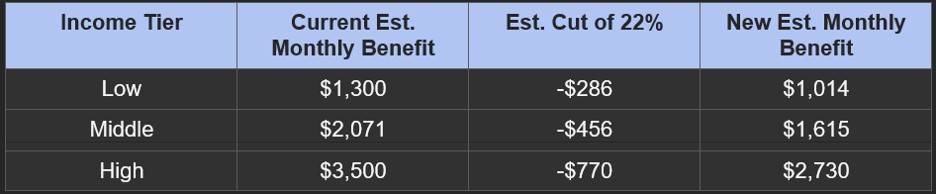
At that point, if Congress has not acted, the Social Security Administration would be able to pay only 78% of scheduled retirement benefits — an automatic, across-the-board cut of 22%.

The broader Social Security system — which includes disability benefits — tells a somewhat more nuanced story. The Disability Insurance (DI) Trust Fund remains healthy and is projected to be able to pay full benefits through at least 2100.

If Congress were to allow the retirement and disability funds to share reserves (as it has done in the past), the combined depletion date would extend to 2034, at which point 83% of combined benefits would be payable.

Why Did the Outlook Get Worse?

Three factors drove the worsened projections this year:

  1. Lower fertility rates. The trustees lowered their estimate of the long-run fertility rate to 1.75 children per woman, down from 1.9 in last year’s report. Fewer births today mean fewer workers paying into the system decades from now.
  2. Reduced immigration. The projections also reflect lower assumed levels of net immigration going forward. Immigrants make up a meaningful portion of the workforce paying Social Security payroll taxes, so fewer workers coming into the country translates directly into less revenue for the program.
  3. The “One Big Beautiful Bill Act.” This legislation, enacted on July 4, 2025, made permanent the lower income tax rates from the 2017 Tax Cuts and Jobs Act and added a new deduction of up to $6,000 for taxpayers age 65 and older who meet certain income thresholds. While these provisions benefit many retirees in the short term by reducing their tax bills, they also reduce the revenue flowing into the Social Security trust fund from the income taxation of benefits. The Committee for a Responsible Federal Budget estimates that the legislation alone accounts for roughly one-quarter of the worsened 75-year actuarial shortfall.

Taken together, these factors pushed Social Security’s projected 75-year shortfall to approximately $30 trillion, up from $26 trillion last year — a 16% deterioration in a single year.

What Would a 22% Benefit Cut Actually Mean?

For context, here is how a 22% reduction would translate for beneficiaries across different income levels. These are generalized examples; actual amounts depend on individual earnings history and claiming age.

For married couples, the impact would be even more pronounced. A couple where both spouses receive average benefits could see their combined Social Security income drop by roughly $10,600 per year.

What About Current Retirees?

This remains the question we hear most often. The short answer is: current retirees are not immune, but they remain the least likely to be affected by any deliberate policy change.

Here is the important distinction to keep in mind. There are two ways benefits could be reduced:

  • An automatic cut triggered by trust fund depletion — which, under current law, would affect all beneficiaries, current and future alike, starting in 2032.
  • A deliberate legislative change — which historically has protected current retirees. Congress has never reduced benefits for people already collecting, and most reform proposals continue to focus changes on future retirees or phase them in gradually over many years.

So the risk facing current retirees is not primarily that Congress will cut their benefits on purpose. The risk is that Congress will fail to act at all, allowing the automatic trust fund depletion mechanism to take effect.

What Is Being Proposed to Address This?

Despite the urgency, Congress has not yet passed any Social Security reform legislation. The political obstacles remain formidable: meaningful fixes require either higher taxes, lower benefits, or some combination of both — none of which is easy to sell to voters. That said, the debate is becoming more active.

Some of the ideas being discussed include:

  • Raising the Full Retirement Age (FRA) from the current 67 to as high as 69. This would effectively reduce lifetime benefits, particularly for those with shorter life expectancies, even without an explicit benefit “cut.”
  • Lifting the payroll tax cap. Currently, wages above $184,500 (2026) are not subject to Social Security payroll taxes. Raising or eliminating this cap is one of the most commonly cited ways to improve the program’s finances.
  • Means-testing and income-based reductions. Some proposals would reduce benefits or slow cost-of-living adjustments for higher-income retirees while preserving or increasing them for lower earners.
  • Supplemental investment funds. Senators Bill Cassidy (R-LA) and Tim Kaine (D-VA) have put forward a bipartisan proposal that would create a new parallel investment fund, seeded with approximately $1.5 trillion in federal borrowing, to supplement payroll taxes over a 75-year horizon.

No plan has been signed into law. But there is growing acknowledgment on both sides of the aisle that action cannot be deferred indefinitely.

As one analyst at the Brookings Institution noted recently, the window for solutions is narrowing: every year of inaction reduces the available options and leaves less time to phase in changes in a way that gives workers and retirees adequate time to prepare.

Should I Change My Claiming Strategy?

For those of you who have been delaying benefits to maximize your age-70 payout, the question of whether to claim early — to “lock in” benefits before any potential cuts — continues to come up.

Our guidance remains consistent with what we shared in August:

  • There is no clear reason to change course yet. The rules are unchanged, and delayed claiming still earns you an 8% annual increase in benefits between Full Retirement Age and age 70.
  • Claiming early does not protect you from an automatic trust fund cut, which would affect all beneficiaries regardless of when they started collecting.
  • Any deliberate legislative change is still most likely to be structured to protect current beneficiaries, or at minimum to phase in changes gradually.
  • We continue to recommend basing your claiming decision on your individual circumstances — longevity, tax situation, income needs, and overall financial plan — rather than speculation about policy outcomes.

If there is a sudden, significant policy change that alters this calculus, we will be in touch promptly.

What This Means for Your Financial Plan

The 2026 Trustees Report confirms what prudent financial planning has already accounted for: Social Security’s future is uncertain, and a degree of conservatism is warranted.

Here is how we are thinking about this for our clients:

  • For clients currently receiving benefits, we do not recommend making immediate changes to your plan. We are monitoring the situation closely.
  • For clients approaching retirement, we continue to model your plan with a margin of safety that factors in the possibility of modest benefit reductions over time.
  • For younger clients, Social Security remains part of our planning picture — but not the whole picture. We generally assume a conservative benefit level in projections, which means your portfolio and other savings carry more weight.

-SM

Market Update June 2026: Halftime in Football & Finance

To my gridiron-wired mind, aspects of the “other football” are curious and bemusing.

For example:

  • The clock counts up, not down, and keeps running during stoppages, resulting in time mysteriously tacked on at the end of the game
  • Ties are allowed, considered normal – and often celebrated
  • Flopping appears to be a legitimate tactic
  • Offside: a player can be offside without touching the ball: simply interfering with an opponent’s ability to play – blocking their line of sight, for example – while in an offside position can be deemed a violation
  • Cards: penalty cards accumulate across games: get two yellow cards in separate matches and a player can be suspended for the next match
  • Advantage Rule: a referee can see a clear foul happen and simply not blow the whistle, waving play on because the fouled team already has the ball in a good position
  • Substituted players can’t return: once you’re subbed off, you’re done for the match

Fortunately, World Cup games include a break that allows for reflection, discussion with more soccer-savvy acquaintances, and, if necessary, online search to figure out what transpired during the past 45 minutes of play.

Thank goodness for halftime.

Since we’ve reached the halfway point of the calendar year, it’s appropriate to reflect on some of the key developments in the financial markets so far in 2026:

  • AI: Enthusiasm for Artificial Intelligence (AI) and the ecosystem that supports its development has been a driving force behind demand for technology stocks
  • Earnings: Strong first-quarter earnings reports from large US companies, along with upward revisions to earnings forecasts, have also helped to buoy stocks
  • War: US-Iran conflict caused severe dislocation in the oil trade, but the geopolitical shock was short-lived for US investors
  • Inflation: It has remained sticker than hoped – well above the Federal Reserve’s 2% target – keeping bond yields elevated
  • The Fed: Leadership change at the Federal Reserve has shifted the interest rate policy outlook – new Fed Chair Kevin Warsh has signaled a firm commitment to bringing inflation back to 2%, raising the odds of Fed rate hikes later in the year
  • SpaceX: The company’s Initial Public Offering (IPO) created a major market event – it was the biggest IPO in history. The rocket-satellite-AI company became the sixth largest firm globally and it demonstrated investor interest for new, tech focused companies.
  • Stock market leadership is broadening beyond technology: after years of tech stock dominance, industrials, financial institutions, healthcare, and small-company stocks began participating more meaningfully in June, a sign often associated with a healthier bull market.

The phenomenon mentioned in the last bullet point has been labelled “The Great Rotation” by some Wall Street commentators.

For more than a decade, a highly concentrated group of very large technology-oriented

companies has driven positive stock market performance.

However, the massive amounts of spending tech companies are now undertaking to actualize their AI-related plans is coming under greater scrutiny by investors.

If the pundits are correct in their characterization of this emerging “rotation” situation, investors have started pulling money out of the “expensive” tech stocks and redeploying that cash into less expensive areas of the market.

The result of a typical rotation is that money stays in the stock market, leadership changes, and positive overall stock market performance continues.

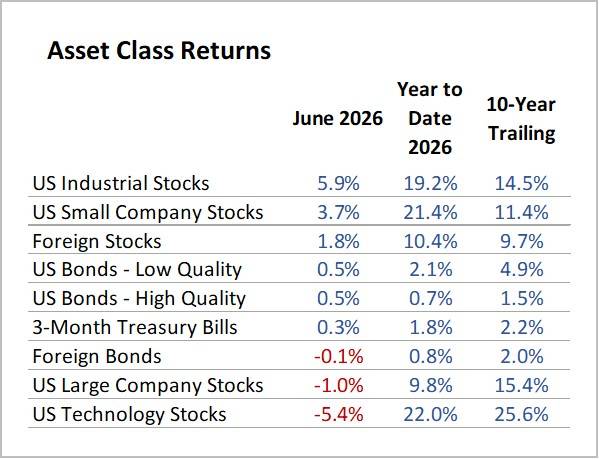
Thus far in 2026, stocks of all shapes and stripes are having another good year, as the middle column in the table below indicates.

But take a closer look at the June data in the left-hand column. US Industrial stocks top the list in performance of the Asset Class Returns table.

The Industrials index, made up mostly of “old economy stocks” – companies such as Caterpillar, Boeing, Union Pacific (railroads), and Eaton (electrical equipment) – outpaced the Technology index (which includes Nvidia, Broadcom, and Meta) by more than 10 percentage points last month.

Note: YTD 2026 as of 6/30/2026; Source: Morningstar

And two other non-tech sectors, Healthcare (+11.5%) and Financials (+9.7%) had even stronger performance in June than Industrials.

One month of old economy stocks outperforming new economy stocks fails to indicate a true “Great Rotation”.

But the shifting of preferences and performance displayed in June are noteworthy and may be a positive sign for the stock market as a whole – and for investors who maintain broadly diversified portfolios.

-RK