Category

Clichés for Investing

I love a good cliché. So, let’s not beat around the bush. Let’s bite the bullet, cut to the chase, and talk turkey: some investors are really worried that we’re in the calm before the storm.

In conversations with clients during the past month, I’ve detected a higher than usual level of anxiety.

Perceived pernicious policy priorities pursued by the current administration, along with highly polarized politics and debased social dialogue are amping up concerns about what comes next.

The propensity to extrapolate is natural. If part of the picture (political-social) seems out of focus or out of whack, shouldn’t that eventually affect other parts (economic-financial) of the landscape? Possibly, but also neither necessarily nor probably.

But looking at the horizon through economic and financial market lenses, the outlook appears to be fairly constructive as we approach 2026.

For inveterate worrywarts (a group of which I am a card-carrying member), here are some recent economic and financial observations to keep in mind:

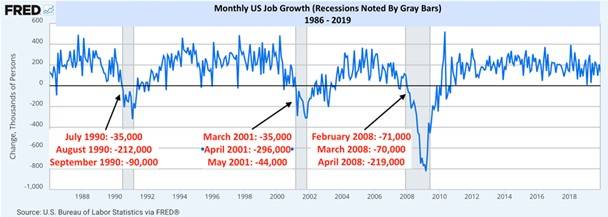
  • Jobs: the labor market is healthy; the Department of Labor’s weekly jobless claims data signals a labor market that is neither cracking or overheating; some economists describe the current situation as “no-fire, no-hire” and “softer”, which, though different from the exceptionally strong demand for labor situation after the pandemic, still remains supportive for the economy
  • Income: wage gains for workers are expected to continue in 2026 according to surveys conducted by groups like Payscale and Mercer, likely in the range of 3.0% – 3.5%, down slightly from 2025 (but outpacing inflation); Goldman Sachs expects real disposable personal income (a broader measure of spending power than wage gains) to grow more than 4% in 2026
  • Loan Delinquencies: about 5% of the US population is experiencing third-party collections (being pursued by an independent agency to recover overdue debts) which quite low by historical standards and an indication of consumer health
  • Trade: the US-led trade war started in March and accelerated in April; but trade deals were signed with different countries over the summer and into the fall, stabilizing trade relationships and improving prospects for economic growth
  • Demand: a recent study by the San Francisco Fed shows that strong economic activity and strong demand for goods and services accounts for the majority of price growth in the economy; this is an improvement over the post-pandemic situation, where inflation was primarily a function of supply chain issues and supply shocks
  • Taxes: The nonpartisan Congressional Budget Office estimates that changes in tax law are likely to boost economic growth by nearly one percentage point in 2026.
  • Profitability: US companies, in aggregate, remain very profitable; in Q3-2025, large US companies grew earnings by 12% compared to a year ago; the delayed impact of lower interest rates will be supportive for company profits in 2026; and high profitability is generally supportive of stock prices

Regarding investments, many asset prices are unquestionably high. We’ve experienced three strong years of stock market returns: 26% in 2023, 25% in 2024, and 18% year-to-date in 2025.

While lofty stock market levels present some potential vulnerability for portfolios, it’s important to keep in mind that pullbacks and corrections are a normal part of investing.

In Q1 2023, stocks dropped by 9%. From mid-July to mid-August 2024, stocks declined by 8.5%. In 2025, stocks hit a new all-time high in February and then proceeded to fall 19% by early April.

Crises that lead to deep bear markets and long-term asset impairments thankfully occur once in a blue moon.

Part of my approach as a financial advisor is to keep my ear to the ground for behavior, developments, and situations that may sow the seeds of the next crisis.

There are a few situations that I am keeping my eye on, including:

  • outsized borrowing by giant technology companies to fund AI-related investments
  • the push by large investment firms to “democratize” access to private investments
  • recent appearance of fraudulent activity (including at Tricolor and First Brands) that have resulted in sizable corporate bankruptcies

But for now, investors likely will be well-served to continue to go with the flow, and there is a reasonably good chance that in December 2026 we’ll be able to say, “all’s well that ends well”.

Gift Ideas for College Planning Families

This time of year, many of us are trying our best to be thoughtful and giving to both to our own families and those in need. This is a wonderful thing!

In the article that follows, our colleague Donna Cournoyer shares some ideas about what parents can give to college-bound children, and what college-preparing high schoolers might consider for their parents.

Hint: It’s not what you think.

Your first thoughts might be: 529 contributions, cash, a new laptop, a university sweatshirt, money for books, dorm supplies, part-time job earnings, and more.

While all these items are important for both college students and their parents, I have something other things in mind—and they are free.

Time

The gift of time is a wonderful thing, always.

For college planning families, making the time to sit down together and focus on your college plan during this busy holiday season is truly valuable.

It is usually a time when both parents and students have a bit of time off from their regular work and school commitments and the world slows down to celebrate. (After the hectic lead up to your holiday schedule!)

Midway through the school year is also a good point for students to refocus on what is coming up in spring; SAT/ACT, college visits, creating the college list, and much more.

Making the effort to set a time for a detailed discussion as a family, rather than hope to be able to fit some time in this season, can be very beneficial to preparing for upcoming college planning items to be sure you stay focused and on track, and less stressed.

Consideration

When you are making your way through the college planning process, be sure to consider other points of view.

Students: Your parents are doing their best to provide a college education for you that comes at a cost. It is not easy to save and navigate both financing and finding the right fit for you at a college where you will connect and flourish. While it is often stressful to plan for college, try to be considerate of the commitment your parents are making to set you up for success.

Parents: Your students are likely as stressed as you, but in a different way. We all know the pressures related to what peers are doing; to getting good grades; to getting accepted; and generally to performing well in high school.

Your students will have ups and downs and may need a bit of a break or extra consideration at times as they try to do their best.

Perfection is not usually necessary to be a good candidate for college admission. Being considerate of your approach as you work together will go a long way toward facilitating this long-term process and having it unfold as smoothly as possible.

Dedication

Showing up for the process is key. Doing your best amid the emotional and complex process of college planning helps you both in the long run.

Parents and Students should commit to items that need to be taken care of, including:

  • researching colleges
  • estimating costs
  • finding a college with the right “fit”
  • scheduling open-house visits
  • contacting admissions reps
  • putting in study time
  • attending college fairs
  • getting involved
  • working on college essays
  • beginning and completing college applications
  • considering majors
  • thinking about post-college study or work

This is just a sample of what goes into college planning, and it can seem like a lot!

Start early and break down your planning into small, digestible steps and dedicate yourself to keeping up with the plan, within reason. Again, this will go a long way in the long run.

Patience

Finally, patience. We all know by now that this college process is one of the biggest investments and life events for families.

The more you find ways to stay calm, and be consistent in your preparation and approach, the more you can enjoy the excitement of this hard-earned and well-deserved milestone!

High school years are packed with more activities and events than ever before. Combine that with the fast-paced, news-bombarded world we live in, and it is important to take a breath. Literally.

Do whatever works best for you to gain peace of mind and remain calm – and keep it going.

Students and parents: You are both doing your best. Try to keep that in mind when unexpected things come up or when pressure builds. It is inevitable, but not unsurmountable.

Keeping a peaceful approach may seem optimistic, but if you try your best to keep your patience with each other and remember not to aim for perfection, or sweat the small stuff, you do have a perfect chance of making it to and through your college years!

Medicare & Retirement Plans Roundup

Information about Medicare premiums and retirement plan contribution limits for 2026 was recently determined by the Centers for Medicare & Medicaid Services and the Internal Revenue Service.

The bottom line is that Medicare recipients will pay more for their benefits next year, and those saving for retirement will be able to set aside more in tax deferred savings. The following roundup provides the updated information.

Medicare

The basic Medicare Part B (medical insurance) monthly premiums will rise to $202.90 for 2026, up from $185 for 2025.

But upper-income seniors will have to pay even higher Part B and Part D (prescription drug coverage) premiums if their modified adjusted gross income for 2024 exceeded $218,000 for joint filers and $109,000 for single filers.

For Part B coverage, seniors pay the $202.90 basic monthly premium plus a surcharge, depending on income.

For Part D coverage, the average monthly premium lands somewhere between $40 – $45 (costs vary significantly by plan) plus a surcharge, depending on income.

The tables below summarize the impact for upper income Medicare premiums.

Source: Centers for Medicare & Medicaid Services (cms.gov)

Some individuals may qualify for a Medicare premium surcharge waiver.

People whose financial circumstances have changed since 2024 because of divorce, retirement, death of a spouse, or other major life-changing event may apply for relief.

You can request relief by filing Form SSA-44 with the Social Security Administration.

Retirement Plans

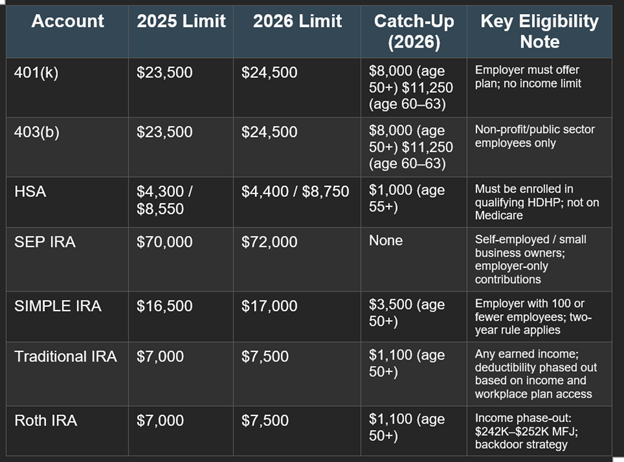
Key dollar limitations on retirement plans and accounts are rising in 2026; summary points are provided below.

401(k) Plans

  • Contribution limit increases to $24,500, up $1,000 from 2025
  • People born before 1977 can put in an additional $8,000 “catch up” contribution
  • For people ages 60-63, the catch-up amount is $11,250
  • Change for catch-up contributions: starting in 2026, if you are age 50 or older and your income exceeds $150,000 in 2025, your catch-up contributions must be made post-tax to a Roth 401(k)

SIMPLEs

  • Contribution cap on most SIMPLEs rises to $17,000
  • People born before 1977 can put in an additional $4,000 “catch up” contribution
  • For people ages 60-63, the catch-up amount is $5,250

IRAs

  • Contribution limit for traditional IRAs and Roth IRAs increases to $7,500, up $500 from 2025
  • People born before 1977 can put in an additional $1,100 “catch up” contribution
  • Income ceilings on Roth IRAs go up: contributions phase out for 2026 at adjusted gross incomes of $242,000 to $252,000 for couples filing jointly, and $153,000 to $168,000 for single filers and heads-of-households
  • Tax deduction phaseouts for traditional IRAs are at higher income levels in 2026: from AGIs of $129,000 to $149,000 for couples covered by workplace retirement plans; $81,000 to $91,000 for single filers and household heads covered by such plans; if only one spouse is covered by a plan, the phaseout for deducting contributions for the uncovered spouse starts at $242,000 of AGI and ends at $252,000 of AGI
  • The Qualified Charitable Distribution (QCD) cap is $111,000, up $3,000 from 2025; people 70 ½ and older can transfer up to $111,000 from an IRA directly to charity; QCDs count as part or all of your yearly Required Minimum Distribution (RMD), but they are not taxable and are not added to your AGI or modified AGI

November 2025 Market Recap: Silver Lining Ahead

November started out looking like a month not to remember, as the government shutdown continued, concerns mounted about the Federal Reserve backing away from interest rate reductions, technology stocks sank, and crypto prices cratered.

By mid-month asset price declines were mounting: US large company stocks were down by 4%; technology stocks had fallen by 9%; and Bitcoin had dropped by 23%.

However, the mood in the market became more positive as the month lengthened, perhaps helped by a holiday hiatus and the arrival of year-ahead forecasting season.

Wall Street research departments are delivering their best guesses for what might happen in the next twelve months. And many forecasters look for another year of double-digit returns for stocks in 2026.

By the time November drew to a close, many asset classes had posted modestly positive returns.

Here’s a snapshot of financial market performance for the month of November and Year-to-Date (YTD):

Source: Moore Financial Advisors & Morningstar

How (and Why) to Talk to Strangers

In The Power of Strangers: The Benefits of Connecting in a Suspicious World, journalist Joe Keohane explores a simple idea: that talking to strangers can make us happier, healthier, and more connected.

Keohane conducted his research through a combination of immersive personal experience and extensive academic investigation.

As a journalist, he embarked on a self-described “quest to master talking to strangers,” which involved actively engaging with people in a wide variety of settings—from cross-country train rides to international seminars.

In addition to his fieldwork, Keohane drew on a body of interdisciplinary research.

He consulted studies from psychology, sociology, anthropology, biology, and even theology to understand the roots of our fear of strangers and the benefits of overcoming it.

He explored how social interaction affects mental health, happiness, and cognitive function, and he incorporated insights from leading experts in these fields to support his findings.

In the prologue, Keohane asks the questions: “Why don’t we talk to strangers? When will we? What happens when we do?”

And he answers: “we become better, smarter, and happier people, and strangers—and by extension, the world—become less scary to us.”

Keohane quotes the philosopher Kwame Anthony Appiah: “When a stranger is no longer imaginary, but real and present, sharing a human social life, you may like or dislike him, you may agree or disagree; but if it is what you both want, you can make sense of each other in the end.”

Ultimately The Power of Strangers is an uplifting reminder of our shared humanity.

In an era marked by division and digital echo chambers, Keohane’s message is clear: reaching out to those we don’t know isn’t just good for our society, it’s good for our souls.

-RK

Understanding Merit Scholarships

As a college and financial planner, one of the most common questions I hear from families is, “What exactly is a merit scholarship — and how do we get one?”

Let’s clear up the confusion.

Merit scholarships are scholarships given by colleges to attract strong students, and are not necessarily based on financial need.

Unlike need-based aid, which depends on your family’s income and assets, merit scholarships award qualities such as academic achievement, leadership, artistic talent, or community involvement.

What Merit Scholarships Really Are

Think of merit scholarships as a college’s way of saying, “We want you on our campus.”

They’re funded directly by the school, and they can significantly reduce the “sticker price” of attendance. These scholarships might cover a few thousand dollars per year or — in some cases — a lot more.

What many families don’t realize is that merit awards are also a strategic enrollment tool.

Colleges use them to attract students who raise the school’s academic profile or fill certain institutional goals. That means strong grades, test scores, or special skills can translate directly into financial savings.

How Merit Scholarships Differ from Need-Based Aid

  • Merit Scholarships: Based on student achievements and potential.
  • Need-Based Aid: Based on family financial situation, as shown on the FAFSA and sometimes the CSS Profile.
  • A student from a high-income family can still qualify for merit scholarships, even if they don’t qualify for need-based assistance.

Which Schools Do Not Offer Merit Scholarships

Many of the elite and highly selective colleges do not offer merit scholarships at all, focusing solely on need-based financial aid. Examples include:

  • Harvard
  • Princeton
  • Amherst
  • Brown
  • Bates College
  • Bowdoin College

These schools often state explicitly that all financial aid is need-based, and merit scholarships are not available.

Although many of these schools fill 100% of need based on the financial aid applications (FAFSA and CSS Profile).

Where to Find Merit Scholarships

If a school does not offer merit aid, it may not explicitly say so. However, language such as “all aid is need-based” is a sign that merit scholarships are not part of the financial aid package.

Careful investigation of a school’s website should reveal if merit scholarships are available.

Most merit scholarships come directly from colleges themselves, not from outside organizations.

Many private universities often have more generous merit programs than elite Ivy-type schools (which focus mostly on need-based aid).

Many public universities also offer strong merit packages to attract out-of-state students.

Families can use tools like the Net Price Calculator (NPC) on a college’s website to estimate whether a student might qualify for a merit scholarship based on GPA and test scores.

There simply is not a lot of transparency from schools about whether merit scholarships are offered, how much is offered, and how they are awarded.

Also, there is no single resource to help families find merit scholarships.

While comprehensive data that includes all U.S. colleges is hard to come by, based on available information we can say:

  • significant minority of colleges (especially elite private institutions) do not offer merit scholarships.
  • Estimates suggest that roughly 15–20% of accredited colleges and universities do not offer any form of merit-based scholarships, though this varies by year and data source.

Using school-specific NPCs is a good starting point. Here are a few additional resources to help determine which colleges offer merit scholarships:

  • BigFuture by the College Board- Offers a Scholarship search, including merit scholarships that you can search based on the criteria you select.
  • The Princeton Review will tell you if a college offers “non-need-based scholarship or grant aid” is available if you click on “financial aid” for a specific school.
  • Collegedata.com Search for a specific college from the “College Search” tab at the top of the page. When the school appears in results, click on the school name to see all information. You will see a lot of data on this page. If you click on the “Financials” tab in the school profile, you can scroll down to see the percentage of students who receive merit scholarships labeled “Merit-Based Gift”.

Planning Tips for Families

  1. Build a smart college list. Include schools where your student’s academic profile places them in the top 25% of applicants — that’s where merit money is most likely.
  2. Keep grades strong through senior year. Some awards are renewable only if a certain GPA is maintained.
  3. Submit applications early. Some merit scholarships are automatic, while others require separate applications or early deadlines.
  4. Ask directly. Admissions or financial aid offices can clarify whether merit awards are stackable with need-based aid or limited to tuition.
  5. Complete the FAFSA. Especially in year one, as some colleges require it for the student to be considered for merit scholarships even though they are not based on financial need.

The Big Picture

Merit scholarships are not just “bonuses” — they’re part of a smart financial strategy for college.

For many families, it is possible to bring down the $70,000 cost of a private college closer to the $30,000 cost of a state school.

As a financial planner, I encourage families to think of merit aid as both an academic goal and a financial opportunity.

By understanding how colleges use merit awards — and positioning students strategically — families can turn achievement into affordability.

In short: merit scholarships reward effort, strategy, and fit. The earlier you start planning, the better your student’s chances of earning one — and the more manageable college costs can become.

-DC

Charitable Giving Under the New Tax Law

Charitable giving is a meaningful way to support causes you care about, and many charitably minded people decide to give for reasons above and beyond personal financial considerations.

However, it is worth knowing how donations can help reduce your tax bill.

With the One Big Beautiful Bill Act (OBBBA) signed in 2025, the rules for charitable deductions are changing significantly in 2026.

Understanding these changes, and planning ahead, can help you maximize both your generosity and your tax benefits.

The following article:

  • discusses key changes in the tax law related to charitable giving
  • lists some tax-smart strategies to keep in mind
  • explains how Medicare costs can be impacted by Qualified Charitable Distributions (QCDs)
  • provides “optimization scenarios” designed to show how charitable giving can reduce your tax liability

Key Changes in the Tax Law – Summary

Detailed Explanation of Key Tax Law Changes

Universal Deduction

Starting in 2026, taxpayers who do not itemize can still claim a deduction for charitable giving.

This universal deduction allows $1,000 for single filers and $2,000 for married couples filing jointly. It applies only to cash donations to qualified operating charities (not donor-advised funds or private foundations).

This deduction is not subject to the new 0.5% AGI floor for itemized deductions of charitable contributions.

This change broadens access to tax benefits for middle-income households who typically take the standard deduction.

Itemized Deduction

In 2025, itemizers can deduct all qualified charitable contributions without restriction.

In 2026, itemized deductions for charitable giving are allowed only for amounts that exceed 0.5% of Adjusted Gross Income (AGI).

This may discourage smaller donations from itemizers who do not exceed the income floor.

Income Floor

The 0.5% AGI floor introduced in 2026 means that only charitable contributions above this threshold are deductible for itemizers.

For example, a taxpayer with $200,000 AGI must donate more than $1,000 before any of the donation becomes deductible.

This rule is intended to limit deductions to more substantial charitable contributions.

Taxpayers may choose to make larger charitable contributions in 2025 to avoid the floor when it goes into effect in 2026.

High-Income Deduction Rate

In 2025, high-income donors in the top tax bracket (37%) receive the full benefit of their charitable deductions.

In 2026, the value of these deductions is capped at 35%, even if the donor is in a higher bracket.

This reduces the tax incentive for large donations from wealthy individuals and may affect overall giving levels.

Tax-Smart Strategies for Charitable Giving

Universal Deduction

Starting in 2026, non-itemizers can deduct up to $1,000 (single) or $2,000 (married) for cash donations to qualified operating charities.

Bunching Donations

Combine multiple years of giving into one tax year to exceed the standard deduction and itemize.

Example: Instead of $5,000 annually for three years and claiming the standard deduction each year, accelerate giving plans: donate $15,000 in year one; itemize in year one to reduce tax liability; claim standard deduction in years two and three.

Giving Appreciated Assets

Individuals and couples with large brokerage (non-retirement) accounts can donate stocks, bonds, mutual funds, and exchange-traded funds that have increased in value directly to charitable organizations.

This approach avoids capital gains tax and allows donors to deduct the full fair market value of the donated securities, up to 30% of their AGI if the asset was held longer than one year.

If the asset was held less than one year, the deduction is limited to the cost basis of the asset.

Qualified Charitable Distributions (QCDs)

Individuals who are age 70½ or older can make donations directly from their IRAs. This approach is called a Qualified Charitable Distribution.

For those age 73 and older, the QCD counts toward the annual Required Minimum Distribution (RMD).

Also, the QCD is excluded from taxable income, so there is no need to itemize when utilizing this giving approach.

This strategy also helps lower the balance of the IRA, which could reduce RMDs (and taxable income) in future years.

QCDs are limited to $100,000 per person annually, and QCDs are not subject to the 0.5% “income floor” for those who itemize.

Why IRMAA Matters When Planning QCDs

If you’re on Medicare—or approaching eligibility—giving through Qualified Charitable Distributions (QCDs) can do more than reduce your tax bill.

It can also help you manage Medicare (Income-Related Monthly Adjustment Amount (IRMAA) surcharges.

IRMAA is an extra premium added to Medicare Part B and Part D for higher-income beneficiaries. It’s based on Modified Adjusted Gross Income (MAGI) from your tax return two years prior.

Crossing into a higher IRMAA bracket can increase your monthly premiums by hundreds of dollars per person.

QCDs from your IRA can lower your MAGI, and lower Modified Adjusted Gross Income may keep you below an IRMAA threshold, reducing or avoiding surcharges.

Note that giving away appreciated assets from an Individual or Joint brokerage account won’t have the same effect on IRMAA as donating from your IRA, because itemized deductions from charitable contributions are subtracted after AGI (and MAGI) is calculated.

Example: How Charitable Giving Can Lower IRMAA Costs

The example below presents typical Medicare costs for an individual with current income of $174,000, and with reduced income of $154,000 after completing a QCD from their retirement account.

In this example, the individual saved $1,570 because the $20,000 QCD is excluded from taxable income, reducing federal tax liability.

Optimization Scenarios

Below we present four scenarios designed to show how charitable giving can reduce tax liabilities and possibly lower Medicare premiums at different levels of income for individuals and couples.

Couple, Ages 45, Income $200,000

A charitably minded couple typically takes the standard deduction.

Strategy: Use bunching—donate $30,000 every three years instead of $10,000 annually.

Benefit: In the bunching year, they itemize and deduct the full $30,000, saving roughly $7,400 in taxes.

Individual, Age 55, Income $400,000

A high-income donor faces the deduction cap in 2026.

Strategy: Accelerate large gifts in 2025 to get full 37% deduction and donate appreciated stock.

Benefit: A $50,000 gift in 2025 saves $18,500 in taxes vs. $17,500 in 2026 while avoiding capital gains tax.

Couple, Ages 65, Income $250,000

A couple near retirement with a large balance in a Joint brokerage account wants to increase their charitable giving.

Strategy: Combine bunching with appreciated asset donations.

Benefit: Donate $40,000 in one year using appreciated securities, deduct full value, and avoid capital gains tax—potentially saving $10,000+ in taxes.

Individual, Age 73, Income $300,000

A charitably inclined individual will face a higher tax bill because Required Minimum Distributions will increase their taxable income.

Strategy: Use Qualified Charitable Distributions to donate $20,000 directly from IRA.

Benefit: Satisfies RMD, excludes $20,000 from taxable income, reduces AGI and possibly lowers Medicare premiums.

-SM

October 2025 Market Recap: Another Month, Another Record

The stock market got fresh fuel during the last week of October in the form of positive earnings reports from large technology companies, which helped push stock indexes to a new all-time high.

Apple, Amazon, and Alphabet (Google) all posted revenues and profits that exceeded expectations and telegraphed solid outlooks for 2026. These three stocks combined make up 16% of the S&P 500 Index.

Thus far in 2025, the large company US stock index has closed at record levels on thirty six occasions – most recently on October 28.

The government shutdown, which persisted throughout the month and carried on into November, thus far seems to have had little impact on financial markets.

But the Federal Reserve’s decision to reduce interest rates has contributed to constructive market sentiment.

The Fed cut the Federal Funds Rate for the second time in 2025 on October 29, bringing the official target for short-term interest rates to a range of 3.75% – 4.0%.

Lower interest rates are generally viewed as supportive for stocks because when the Fed cuts rates, it often becomes less expensive for many companies to borrow money.

Cheaper loans can lead to increased investment in growth-related activities (like research, hiring, and expansion) which can boost company earnings in the future.

The Fed committee that determines interest rate policy meets again for the final time in 2025 next month.

Expectations are for another rate cut on December 10, which would bring the short-term interest rate target below 4% for the first time since 2022.

October was a positive month across the board for broad-based stock and bond market indexes, as the chart below shows.

Source: Moore Financial Advisors & Morningstar

And with ten months now behind us, 2025 is likely to be another strong year for financial market returns.

In fact, the last extended period of tough sledding for stocks happened more than three years ago. That bear market ended in October 2022, and stock returns have been stellar since then.

After three years of very strong returns, it’s natural to wonder: have stocks come too far, too fast? And, if so, is it time to sell risky stocks and move to the safety of cash before the tide turns and the next bear market arrives?

This type of inquiry centers around the idea of market timing: making buy or sell decisions based on predictions of future market movements.

If you can accurately predict what will happen tomorrow, making big moves with your money to “lock in gains” and “avoid losses” today is logical.

However, we’re unaware of anyone who can accurately and consistently predict what will happen in financial markets and to stock prices, especially over the near term.

Rather than trying to guess what will happen in financial markets tomorrow, or next week, or next month, taking a long-term approach to investing is a far better approach.

Building expectations for financial market returns, establishing asset allocation targets that support your financial plan, and ensuring that your portfolio reflects those targets are important elements of successful investing over the long term.

Attempting to “get ahead of the market” introduces the possibility of failing to capture future gains by not having enough stock market exposure, and falling short of the long-term returns required by your financial plan.

The well-regarded investor and author Peter Lynch has said: “Far more money has been lost by investors preparing for corrections, or trying to anticipate corrections, than has been lost in corrections.”

These words of investment wisdom are worth paying attention to, particularly during extended periods of strong stock market returns.

-RK

Keys to a Successful Retirement

In Keys to a Successful Retirement: Staying Happy, Active, and Productive in Your Retirement Years, author Fritz Gilbert offers a comprehensive and practical guide to navigating the transition into retirement with purpose and fulfillment.

Using the metaphor of baking a cake, Gilbert emphasizes that a successful retirement requires thoughtful preparation, the right “ingredients” (such as financial security, mental well-being, and meaningful activities), and a step-by-step plan.

He addresses both the financial and emotional aspects of retired life, including managing savings, healthcare, and the psychological challenges like aimlessness or depression.

Gilbert’s book encourages readers to define their own vision of retirement, stay socially connected, and pursue passions that bring joy and meaning, ultimately helping retirees craft a vibrant and satisfying new chapter of life.

-RK

Fall College Planning Checklist for Every High Schooler

Fall is a fantastic season and thoroughly enjoyed by many people. Especially here in New England we enjoy beautiful foliage, crisp cool air, bright sun, pumpkin spice, and football games.

It is also one of the most important times of the year for college planning.

Whether your student is just starting high school, or in the throes of senior year applications and decisions, autumn is the season when key milestones and deadlines come into focus.

To help you (and your student) stay organized and focused, here is a grade-specific checklist of what to prioritize this Fall.

Freshmen (9th Grade): Build the Foundation 

The first year of high school is all about building strong habits and exploring new opportunities

  • Get involved: Clubs, sports, and community service are great ways to explore interests and build a future activities list.
  • Focus on academics: A strong GPA begins now. Encourage good study routines and time management.
  • Meet your high school counselor: A quick introduction helps your student start building a relationship that will matter later, which you can build on.
  • Explore interests: Spark curiosity about future careers or colleges without pressure.

Sophomores (10th Grade): Explore & Prepare 

Sophomore year is about exploration and light preparation for what’s ahead

  • Try the PSAT (practice): Some schools allow sophomores to take it—it’s low-stakes and helps them get comfortable with the format.
  • Challenge yourself academically: If available, honors or AP courses show readiness for rigorous work.
  • Start tracking and keep an activity log: Document leadership roles, service hours, or new achievements.
  • Career exploration: Attend a career fair, shadow a professional, or use online career tools to discover potential pathways. Or talk to your relatives that have a job you find interesting.

Juniors (11th Grade): The Planning Year 

This is the most critical year for college preparation 

  • Take the PSAT/NMSQT: It counts for National Merit scholarships and provides insight for SAT prep.
  • Visit colleges: Many colleges have open-house events in the fall—if you can, go in person to the top schools on your list. This is the time to start forming impressions.
  • Discuss and Decide on Testing: Decide whether the SAT, ACT, or test-optional route makes sense for your student.
  • Research scholarships: Some awards are open to juniors—starting now gives you a head start and possibly an advantage.
  • Keep grades strong: Junior year GPA is a major focus of colleges and is weighed very heavily.

Seniors (12th Grade): Application Season 

For seniors, fall is crunch time: deadlines and forms come quickly, so staying on track is essential

  • Finalize your college list: Narrow down choices to a list that fits your academic and social interests, school size, geographical location and environment, and overall costs.
  • Meet early deadlines: Early Action and Early Decision applications are often due in November.
  • Complete financial aid forms: The FAFSA and CSS Profile open in October—apply early to maximize your eligibility.
  • Fine-tune your essays: Have a trusted teacher, counselor, or mentor provide feedback before submission.
  • Request recommendations: Teachers need plenty of time to write thoughtful letters.
  • Stay organized: Use a calendar, spreadsheet, or app to track deadlines and requirements.

Final Thoughts

With each fall season, students have new opportunities to move one step closer to their college goals. By approaching the process by each high school year, students and families can stay on top of priorities without feeling overwhelmed.

Here is another reminder: Don’t forget to take time to enjoy this beautiful season as well! Get out among the colorful trees and grab a hot cider and apple cider donut along the way to the pumpkin patch.

-DC