As we absorb the events unfolding since the United States and Israel launched joint military operations against Iran on February 28, I want to begin by acknowledging what I suspect many of you are feeling. For those of us who believe in diplomacy, value restraint, and care deeply about the human costs of armed conflict, the current trajectory of U.S. foreign policy is profoundly troubling — and I share those concerns.
However, a fuller discussion of the moral and humanitarian dimensions of this conflict falls outside the scope of this letter. My purpose here is a narrower one: to examine the military and political landscape as it stands now and to assess the risks this conflict may pose to the economy, the financial markets, and your financial plans.
This letter focuses on:
1. An assessment of the current situation
2. What to monitor going forward
3. Recent financial market and economic developments
4. Geopolitical uncertainty and stocks
5. What this means for your financial plan
1: Current Situation Assessed – The Convoluted Case For War
One source that I found particularly helpful was the March 6 podcast of The Dispatch entitled “The Convoluted Case for War with Iran.” The Dispatch is a non-partisan but conservatively oriented show covering US politics, policy, and culture.
Host Steve Hayes was former editor-in-chief of The Weekly Standard. Co-host Jonah Goldberg is a conservative journalist and fellow at the American Enterprise Institute. Guests Mike Nelson and David French are both ex-US military officers.
All commentators offered context for and criticism of US actions in Iran. Below is a summary of the podcast.
Core Questions About the Conflict
The conversation is organized around two central questions: (1) Why is the United States engaging in military action against Iran at all? and (2) Why did the administration choose to act at this specific moment?
A secondary theme throughout the episode is whether the administration has adequately explained its strategy and end goals to Congress and the public.
Substantive Case for Action (“Why?”)
The panel broadly agrees that, on substance, a case for military action against Iran is not difficult to articulate. Iran is described as a long-standing adversary of the United States, engaged for decades in hostile activity through proxies, regional destabilization, and attacks that have resulted in American casualties.
Participants emphasize that Iran’s ideological hostility toward the U.S. and Israel, combined with nuclear ambitions, has long placed it in a distinct category among U.S. adversaries. On this point, there is general consensus among the panelists that Iran’s behavior over many years provides a plausible justification for the use of force.
Timing of the Conflict (“Why Now?”)
The more contested issue is timing. Participants argue that the current moment presents a strategic window: Iran’s regional proxy network has been weakened, its air defenses and military infrastructure have been degraded, and traditional deterrence mechanisms appear less effective than in prior years.
From this perspective, acting now may be less costly than acting later, when Iran could rebuild capabilities or enhance deterrence. However, while the panel finds this reasoning coherent, they repeatedly note that it has not been clearly or consistently articulated by the administration itself.
Messaging and Public Explanation
A major theme of the episode is criticism of the US Administration’s messaging. Participants express concern that multiple, shifting explanations have been offered for the war, sometimes inconsistently and retroactively.
This, they argue, undermines public confidence even where valid strategic reasons exist. The discussion highlights the risk that unclear or contradictory explanations make it harder for the public to understand the objectives of the campaign or assess its success.
Tactical Success vs. Strategic Outcome
The panel generally agrees that, from a tactical and operational standpoint, early military actions appear effective in degrading Iranian capabilities. However, they stress that tactical success does not automatically translate into strategic success.
A recurring concern is the absence of clearly defined end goals. Without explicit criteria for success — such as regime change, deterrence, or long-term containment — the administration retains broad flexibility to declare victory, but at the cost of strategic clarity.
Long-Term Risks and Historical Analogies
One participant raises concern that the campaign resembles a strategy of periodically weakening an adversary without fundamentally resolving the underlying conflict. Historical analogies are drawn to past situations where temporary degradation of hostile regimes delayed, rather than prevented, future retaliation.
The panel cautions that Iran’s willingness to absorb losses and respond asymmetrically could mean that consequences emerge months or years later, potentially through terrorism or proxy activity rather than direct confrontation.
Constitutional and Governance Considerations
Beyond military strategy, participants emphasize that bypassing Congress and failing to prepare the public is not merely procedural. They argue that democratic legitimacy and public understanding are essential for sustaining military action and managing long-term consequences.
The 4–5 Week Policy Outlook
The episode concludes with host Stephen Hayes noting that President Trump has suggested the operation could last four to five weeks and posing a forward-looking question: what outcomes would be encouraging, and what warning signs might indicate escalation or failure?
A more optimistic outlook would feature a short-duration operation, limited regional escalation, sustained degradation of Iranian capabilities, and a clear conclusion to hostilities.
A more concerning outlook would involve unclear objectives, prolonged engagement, retaliatory attacks beyond the immediate conflict, or a cycle of repeated military action without durable resolution.
Overall Takeaway
From a markets and policy-risk perspective, the episode suggests that uncertainty and clarity matter at least as much as military outcomes. Tactical success alone does not eliminate risk; how policymakers define objectives, communicate progress, and conclude operations will likely shape market responses more than any single military development.
2: What To Monitor Going Forward
This checklist identifies indicators we may monitor to help contextualize events as they unfold, as well as the related risks and uncertainties.
- Duration and Scope of Military Operations – Why it matters: Duration clarity often affects markets and prices more than initial military action.
- U.S. Policy Clarity and Governance Signals – Why it matters: Policy predictability and institutional process influence confidence and risk assessment.
- Regional Escalation Indicators – Why it matters: Indirect escalation can affect markets even without direct U.S.–Iran confrontation
- Energy Market Sensitivities – Why it matters: Energy prices can influence inflation expectations and broader macro assumptions.
- Retaliatory or Asymmetric Risk Signals – Why it matters: These risks often emerge later and are harder for markets to price in advance.
- Market Behavior vs. Headlines – Why it matters: Differentiating noise from signal helps assess whether risk is being repriced by financial assets or absorbed.
- International Diplomatic Activity – Why it matters: Diplomatic engagement can materially alter risk trajectories without military change.
- Domestic Political Spillovers – Why it matters: Domestic politics can influence policy durability and future decision-making.
3: Recent Financial Market and Economic Developments
The initial market reaction to Operation Epic Fury was surprisingly muted. On the first trading day after the February 28 strikes, the S&P 500 closed essentially flat. That composure didn’t last.
As the conflict expanded through the week — with Iranian retaliatory strikes hitting Gulf state infrastructure, the Strait of Hormuz effectively closing to commercial shipping, and oil storage facilities coming under attack — investor sentiment shifted considerably.
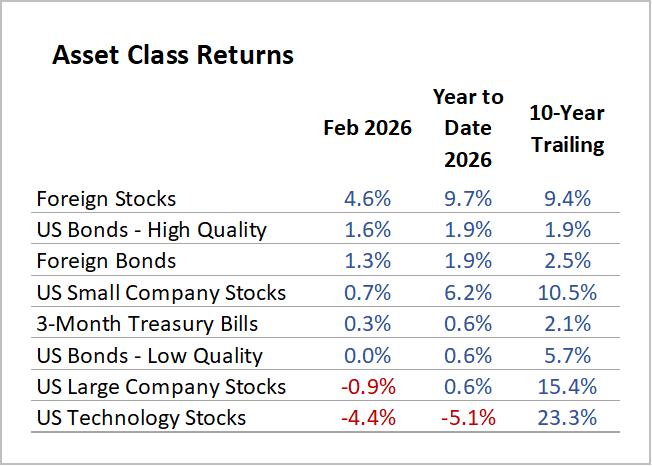
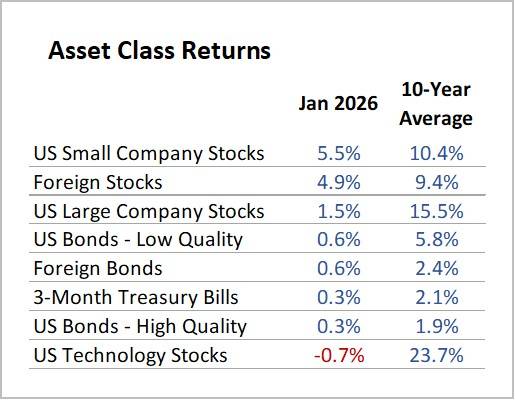
By week’s end, market participants were no longer treating this as a brief geopolitical tremor but were instead pricing in the possibility of sustained economic disruption. US large company stocks declined by 2% in the first week of March; foreign stocks slid by nearly 7%; and US investment grade bonds were down by about 1%.
Oil and Energy: The Central Transmission Mechanism
Oil prices have been the most direct channel through which the conflict is affecting markets. Brent crude had risen roughly 27% since the strikes began, and traded around $93 per barrel as of Friday, March 6. The oil price rise continued on Monday, with Brent crude moving above $100 per barrel.
The concern extends well beyond Iran’s own output of approximately 3 million barrels per day (roughly 4–5% of global supply). The Strait of Hormuz, through which passes about a fifth of the world’s oil and liquefied natural gas, has been effectively closed due to threats and the withdrawal of cargo insurers.
Approximately 20 million barrels per day flow through the region — representing about 20% of global demand — and there is simply no way to replace that volume from other sources if the disruption persists.
The scenario analysis matters here. According to JP Morgan’s energy research team, current oil prices reflect markets pricing in a Strait of Hormuz closure lasting 3–4 weeks, but not longer.
If the strait were to reopen tomorrow, oil would likely fall back to around $65 per barrel, since the market was well supplied before the war.
If hostilities extend beyond a month and the strait remains closed, the price of oil could stay well above $100 per barrel for some time. Each $10 increase in crude oil prices adds an estimated 0.2 to 0.4 percentage points to the inflation rate.
Goldman Sachs has warned that prices could reach $150 per barrel — all-time highs — if the conflict continues through the end of March.
The disruption extends beyond crude oil. Natural gas facilities in the Gulf, such as those in Qatar, have been taking gas out of their systems to limit damage from potential strikes. Even after hostilities end, it will take time for these facilities to ramp back up, creating inflationary pressure particularly for Asian markets that depend on Middle Eastern gas.
Refinery activity in some Gulf states has been reduced by 20–30%. Shipping rates have skyrocketed: the daily charter rate for a very large crude carrier, which normally runs around $50,000, reached $430,000 per day at the start of the week. These lag effects mean that even a swift resolution to the conflict would not immediately normalize energy markets.
For U.S. consumers, the most visible effect is at the gas pump. The average price of gasoline rose to approximately $3.25 per gallon as of March 6, up $0.27 in a single week. (The average price of gasoline moved even higher on Monday, March 9 – toward $3.50 per gallon).
If gasoline prices climb to $3.50 or $4.00 per gallon and stay there, it will squeeze lower- and moderate-income consumers and weigh on consumer spending — not enough to push the economy into recession on its own, but enough to be felt.
A Structural Difference: The U.S. as Energy Exporter
One important distinction from prior oil shocks — and a reason for cautious optimism — is that the United States is now a net energy exporter and the world’s largest oil producer.
In previous conflicts (1979, 1990, 2008), every additional dollar spent on oil was flowing overseas to foreign producers. Today, much of that spending stays in the domestic economy, benefiting U.S. producers.
This is a meaningful structural change that limits the drag on U.S. growth relative to prior energy shocks, though it does not eliminate the inflationary impact.
Winners and Losers: Rotation Accelerates
The war has reinforced and accelerated a rotation in market leadership that was already underway.
Value and dividend-oriented stocks have continued to outperform growth stocks, a pattern consistent with historical precedent: Morgan Stanley research has found that value and dividend yield tend to outperform in the month following geopolitical shocks that push oil prices higher. Energy companies and defense contractors, which populate both categories, have benefited directly.
Internationally, the damage has been more severe. Energy-importing economies — Europe, Japan, and South Korea — have been hit hard.
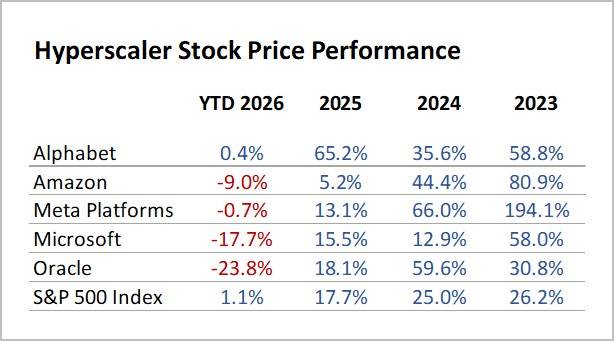
South Korea’s market fell 16% in the past week, and international stocks broadly have declined roughly 6–7% from their pre-war highs, a pattern similar to the early days of Russia’s 2022 invasion of Ukraine. The dollar has strengthened as the U.S., with its energy exporter status, is relatively better positioned than major importers.
Within the U.S. market, a notable pattern has emerged: the stocks that had risen the most before the war started have fallen the most since, while previous laggards have held up better or even gained ground. This reflects both a reassessment of economic winners and losers and a reduction in borrowing by institutional investors.
The Economic Outlook
Before the strikes, the global economy was accelerating and expanding faster than in 2025. The U.S. economy entered this period on relatively solid footing: consumer and business spending had been robust, asset prices had boosted household wealth, and there were early signs that the long manufacturing slump might be easing.
JP Morgan’s base case for U.S. GDP growth is approximately 2% for 2026, though the quarterly path is uneven: a softer first quarter (around 1% annualized, reflecting weather effects and delayed tax refunds) followed by a pickup to 2–3% growth in the second and third quarters, then moderating again in the fourth quarter. This base case assumes a relatively short conflict.
On inflation, the picture is more nuanced. JP Morgan expects inflation to rise above 3% by June, driven primarily by energy prices, then to decline as oil prices moderate — potentially returning to 2% by year-end and below 2% by 2027. But this path depends heavily on the duration and scope of the conflict. A prolonged disruption to energy markets would make this trajectory considerably less favorable.
The Fed’s Dilemma
The conflict complicates the Federal Reserve’s path forward. Before the war, markets expected multiple short-term interest rate reductions (cuts) in 2026. Now, betting markets show the odds of multiple cuts falling, with one cut or no cuts becoming more likely.
The concern is straightforward: rising oil prices feed into inflation, and the Fed may feel it cannot cut rates into an inflationary environment — even if the economy softens. This creates a potential stagflationary dynamic that, while not the base case, is now being actively discussed by economic forecasters.
The Fiscal Backdrop
This conflict arrives against a fiscal backdrop that offers less cushion than in prior military engagements. U.S. national debt stands at approximately $33 trillion — more than $250,000 per household.
The Congressional Budget Office projected a $1.9 trillion deficit for 2026 before accounting for war costs, which are currently estimated at $50–100 billion but subject to revision.
How the war will be funded remains an open question. All of this adds to overall government borrowing and creates a headwind for fixed income markets – which reduces the likelihood that Treasury bond yields will decline.
What This Means for Investors Today
As JP Morgan’s chief global strategist David Kelly put it on a recent client call: the message in this environment is to diversify against unknown risks. The underlying U.S. economy is not in danger of recession from this conflict alone, and markets so far have reflected more caution than panic.
But the range of possible outcomes is wide, and tail risks — whether from a prolonged conflict, an escalation beyond the current theater, or unexpected second-order effects — are elevated.
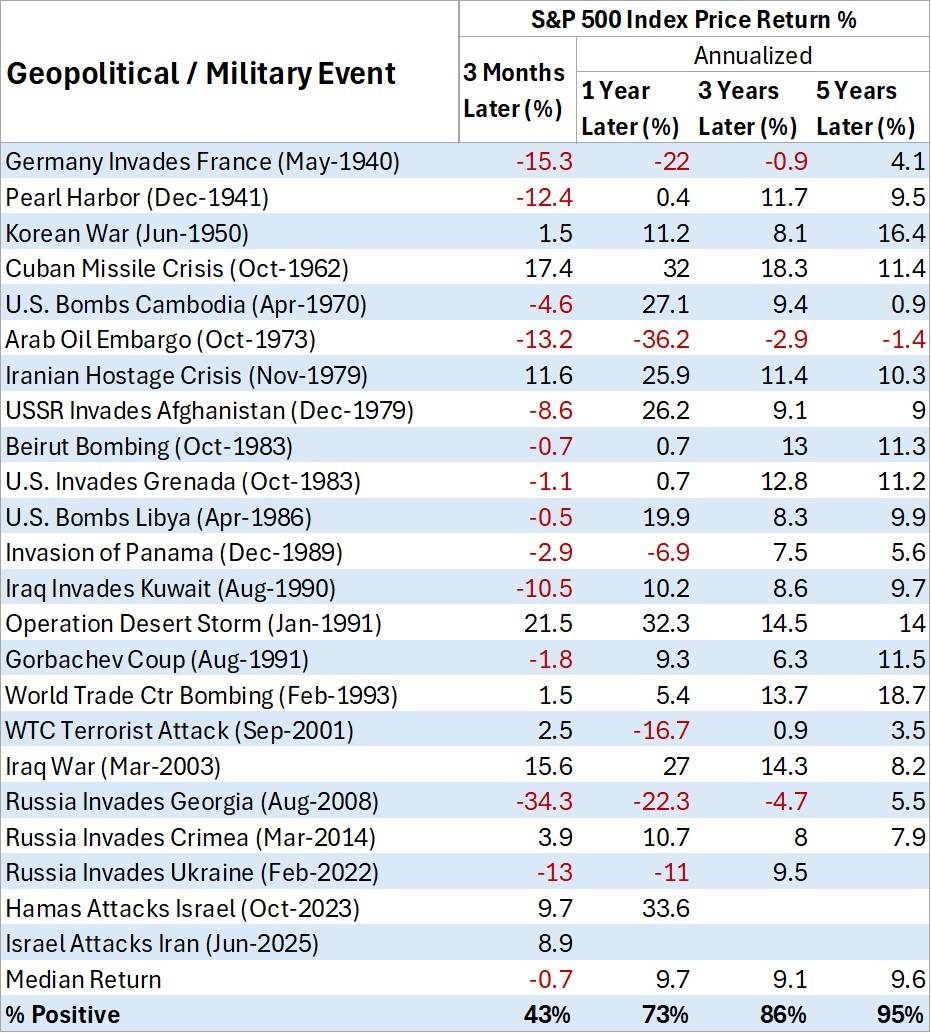
As discussed in the next section, geopolitical shocks have historically been poor reasons to abandon a long-term investment strategy. The S&P 500 has a median return of 9.7% in the year following major geopolitical disruptions, according to research by the Hartford Funds (see table below).
But the key variables are duration and scope: a contained, short-duration conflict is far more manageable for markets than a prolonged engagement with escalating regional consequences. This is precisely why the signposts outlined in Section 2 matter so much — and why we will continue to monitor them closely on your behalf.
4: What Geopolitical Uncertainty Means for the Stock Market
Geopolitical uncertainty can cause short-term market volatility, but when faced with disruptive episodes in the past, the stock market has been resilient.
In fact, as the table below shows, stocks generated positive performance one year after a geopolitical / military event 73% of the time, considering twenty-two instances since World War II.