Category

Summer Reading Series: Abundance

Summer Reading Series: Non-Fiction

Abundance by Ezra Klein and Derek Thompson

Coming from a Gen Z’er, I can confidently say that the average young person’s thoughts about the future are bleak.

Climate change poses an existential threat to our planet and way of life as we know it, the prospect of owning a home – traditionally the foundation of building personal wealth – now seems like a far-fetched luxury, and the increasingly competitive job market paired with the rising cost of higher education make for a triple threat of uncertainty.

Throw on top of this our most formative years spent on Zoom and unprecedented political turmoil and divisiveness and no wonder you’ve got a discontented, unsettled, and frankly pessimistic generation.

However, all is not lost.

In fact, as Ezra Klein and Derek Thompson point out in Abundance, there is the world to be gained. We are currently at humanity’s zenith of technological innovation.

In the past 50 years green energy has reduced drastically in price, the internet and now artificial intelligence has transformed our access to information and each other, and advances in biotech have pushed some diseases into obsolescence.

Abundance makes it clear that the future we want is in our control.

The book points to the fact that well-intentioned regulations passed in the later-half of the 20th century have actually hindered the government’s ability to implement radical projects.

The private sector’s ultimate goal is to make a profit. Klein and Thompson argue that the government, if wielded correctly, can account for externalities and can afford to pursue projects that don’t have an immediate profit incentive.

Abundance provides a refreshing new identity to political change that has, for me at least, sparked hope for the future.

-Greg

Summer Reading Series: Circe

Sumer Reading Series: Fiction

Circe by Madeline Miller

This book is a reimagination of the life of a minor Greek goddess from Homer’s Odyssey.

The protagonist is portrayed as a complex, deeply human character who is exiled by the Titans to an island, where she hones her skills in witchcraft and encounters legendary figures like Odysseus, the Minotaur, and Medea.

Miller weaves together multiple Greek myths into one cohesive narrative while exploring timeless themes of family trauma, self-discovery, and what it means to choose mortality over immortality.

The most intriguing aspect may be how Circe grapples with her divine nature.

She’s portrayed not as an all-powerful deity, but as someone learning to navigate relationships, motherhood, and her own agency in a world dominated by capricious male gods, while she gradually transforms from a marginalized immortal into a powerful, self-aware woman.

-Susan

Bitcoin Pizza Day

Pizza Day is recognized every year on May 22 to commemorate the first real-world transaction in which Bitcoin was used as a currency. This article highlights the most expensive pizza purchase of all time; discusses cryptocurrencies, including stablecoins; and highlight’s Zeke Faux’s book Number Go Up.

On May 22, 2010, Laszlo Hanyecz, a programmer from Florida, paid 10,000 Bitcoins for two pizzas, marking Bitcoin’s first commercial use.

The Bitcoin for Pizza transaction translated to $41 fifteen years ago. Today, with the price of one Bitcoin at about $111,000, the transaction would be worth about $1.1 billion. That’s some dough!

Cryptocurrency captured the popular imagination in 2021 and during much of 2022, as we were emerging from the pandemic and as Bitcoin prices were surging.

But the collapse of the FTX cryptocurrency exchange in late 2022, and the unfolding of the misdeeds of the company’s CEO, Sam Bankman-Fried, served as a reminder of the speculative nature of cryptocurrency.

Investigative reporter for Bloomberg News Zeke Faux’s Number Go Up: Inside Crypto’s Wild Rise and Staggering Fall takes a critical look at FTX and Bankman-Fried.

The FTX situation proved to be a Bernie Madoff-like Ponzi scheme, and having a refresher course on situations like this, from time to time, can keep investors grounded.

For those less interested in technicalities but curious about the personalities behind a new phenomenon, this story incorporates business, technology, and crypto counterculture narratives, along with themes of greed, hubris, and the impact of technology on finance.

While the crypto space may have fallen off the radar for many traditional investors, recent developments might be garnering some attention for the following reasons:

  • The development and growth of Bitcoin ETFs
  • Bitcoin reaching a new all-time high in May 2025
  • Each house of Congress currently debating bills that aim to put guardrails around a branch of crypto called “stablecoins”, which may take these digital assets more into the mainstream
  • The First Family’s active commercial interests in cryptocurrencies, including the stablecoin USD1

Stablecoins are digital assets designed to hold a steady value, in contrast to the price fluctuations seen in most cryptocurrencies, including Bitcoin.

Crypto enthusiasts currently use stablecoins to move US dollars into and out of the crypto ecosystem. The evolution of stablecoins holds the potential for vast sums of money to change hands without touching the formal banking system.

For those curious about following developments in the digital asset space, the House bill is The Genius Act of 2025, and the corresponding Senate bill is The STABLE Act of 2025.

In part, the new legislation, if enacted, would allow regulators to police issuers of stablecoins and apply rules to how stablecoin reserves are managed, similar to the rules that govern how banks manage their reserves.

Debate in the Senate on The STABLE Act has been contentious, because some lawmakers are questioning whether the bill goes far enough to combat the conflict of interest that USD1 might pose for the president.

Readers of Faux’s book will learn more about stablecoins and get a critical account of Tether, which is currently the world’s largest stablecoin.

-RK

Federal Funding Cuts: Consequences for Higher Education

This article, by College Financial Planner Donna Cournoyer, discusses the consequences of the federal funding cuts for US college undergraduate and graduate students.

Graduate Student Challenges

Reduction of Programs, Reduced Admissions

Some of the most severe funding cuts so far have been in the area if graduate research.

The NIH (National Institute of Health) funding is relied upon heavily by top research universities throughout the country for their advanced programs.

This research impacts both the US and global advances in medicine, science, technology, and engineering.

Regarding the consequences of reduced research funding, take Massachusetts Institute of Technology, for example.

MIT announced in May that graduate enrollment will be reduced by 8% (about 100 students) due to federal funding cuts.

Also, the House of Representatives passed a bill increasing the excise tax on college endowments from the current 1.4% to a potential of 21% for the highest endowments. This bill is now in the Senate for approval.

See President of MIT Sally Kornbluth’s letter from the Office of the President on May 20, 2025 warning of the consequences of these challenges being faced across America.

Loss of Assistantships and Research Funding

With agencies like the National Science Foundation (NSF) and the National Institutes of Health (NIH) facing budget cuts, numerous research projects have been scaled back or canceled altogether.

Many graduate students rely on federal grants for their stipends as well. Graduate students are losing opportunities and needing to shift their education paths.

This also limits some of our best and brightest students from the ability to contribute to advancements in science, engineering, and medicine.

Effects on the “Innovation Edge”

These cuts in federal research funding are pushing some students out of research altogether. Some students are considering international opportunities in countries with a more stable environment for research.

There are also some experts who have expressed a long-term fear of “brain drain,” with the potential for the US to lose its standing as a global leader in innovation and scientific excellence.

It is possible that the changes in funding may have the long term effect of dulling the edge the US has as a global leader in innovation.

Undergraduate Student Challenges

Potential Cuts to Federal Student Aid

The federal Pell Grant Program projects a $2.7 Billion shortfall for the 2025 fiscal year. This could mean cuts to the program in 2026. The federal Work Study program could also be facing cuts.

This is especially hard on students from first-generation and low-income backgrounds. With federal cuts, many schools will not be able to increase their grants to make up the loss of federal aid for these students.

This may mean some of these students will not be able to attend college at all.

Budget Cuts, Declining Campus Services, Hiring Freezes & Layoffs

The federal funding cuts are causing schools to face tough decisions on budget cuts, layoffs and hiring freezes. This impacts a broad range of services and support available to students.

Public universities are facing budget cuts that are resulting in larger class sizes, fewer course offerings and halted facilities improvements. This can hinder academic success for students.

Increased Costs & Delayed Graduation

Some students may not be able to afford full-time enrollment, and may have to extend their studies, incurring more debt and delaying graduation and employment.

Federal Policies on International Students

Proposed bans on certain categories of foreign students and visa restrictions are hindering admissions for both undergraduate and graduate programs.

Many universities rely on international students for cultural diversity and for funding, as most international students receive no aid and pay tuition in full.

Without these full-paying students, endowments and budgets will be more stressed.

The Road Ahead for Institutions

Without policy reversals and sustained federal investment, institutions are responding in a variety of ways.

Universities are looking at reallocating endowment funds, which is not always easily done, as these funds are closely linked to budgets and donors are often very specific on the use of funds given.

Some institutions are seeking additional private funding and philanthropic partnerships.

And there are several universities seeking policy reversals.

Conclusion

Federal funding cuts in 2025 mark a pivotal moment in American higher education.

Without restoration of federal funding, both undergraduates and graduate students are at risk of losing affordable, high-quality education and research opportunities that benefit their educational goals and their future.

Reduced federal funding also bodes ill for the future of US innovation across a variety of fields and may well have negative effects for the future path of US economic growth.

Right now, our policymakers, educators, and the public are faced with confronting the long-term risks of underfunding the very systems that cultivate the nation’s intellectual and professional capital.

-DC

America: You’re Downgraded!

Just like consumers, countries get credit scores. On Friday, May 16, the USA’s rating took it on the chin, when Moody’s said: “You’re Downgraded!”. This article puts the ratings downgrade into perspective.

Losing its status as a AAA-rated credit wasn’t a great look for our country.

Moody’s had the following to say about the US credit situation:

  • Successive US administrations and Congress have failed to agree on measures to reverse the trend of large annual fiscal deficits and growing interest costs
  • Persistent large fiscal deficits will drive the government’s debt and interest burden higher
  • The US’ fiscal performance is likely to deteriorate relative to its own past and compared to other highly-rated sovereigns

The US national debt is currently about $36 trillion, which is the equivalent of about $106,100 for every person in the country. And Moody’s said federal interest payments are likely to absorb around 30% of revenues by 2035, up from about 18% in 2024 and 9% in 2021.

Moody’s recent action moved the US credit rating down one notch, to Aa1 from AAA.

Moody’s describes Aa1-rated debt as high quality and subject to “very low risk”, compared with its highest-quality Aaa rating, which has “minimal risk”.

The USA is now rated one notch below the top tier AAA by all three major credit rating agencies: Moody’s, Standard and Poor’s, and Fitch. These organizations provide credit ratings to bond issuers – larger companies and countries of all shapes and sizes.

S&P was the first to act on the US’ deteriorating financial situation over a decade ago: the agency downgraded the US in August 2011. Fitch downgraded the US in 2013.

The “Sovereign AAA Club”, composed of countries that hold the top tier rating, is now more rarified, with only 10 countries maintaining the gold standard: Australia, Canada, Denmark, Germany, Luxembourg, Netherlands, Norway, Singapore, Sweden, and Switzerland.

However, the downgrade isn’t a death knell for America’s access to credit, or the country’s ability to borrow at relatively attractive rates. US Treasury bond and bill yields (the cost of borrowing for the US government) barely budged on the news.

As of Friday, May 30, the interest rate at which the US government borrows in large quantities, by issuing Treasury bonds and bills, was 4.4%.

Borrowing rates today for the AAA-rated countries are generally lower by about 2 percentage points, on average, than the US. However, this “yield gap” has persisted for some time.

Here’s a chart of the US 10-Year Treasury bond yield from 2006 to the present, showing how interest rates have evolved over the past two decades, with the country’s credit rating across this timeframe, noted in green and red (courtesy of DataTrek).

Source: DataTrek

It’s worth noting that long-term borrowing costs for the US were higher when all three rating agencies had the US debt rated AAA. This was in 2006 – 2007, when 10-year Treasuries often paid +5.0 percent and yields were never below 4 percent.

Fortunately, US credit rating downgrades in the past have not triggered structurally higher interest rates, recession or declining stock prices.

Even so, the Moody’s downgrade serves as a reminder that the US federal government’s debt and deficit trends are troublesome.

In a June 3 article entitled Wall Street is Sounding the Alarm on US Debt, the Wall Street Journal points to the following:

  • Annual interest on the US debt is currently above $1 trillion
  • The tax-and-spend legislation currently being debated in Congress would add about $3 trillion to the national debt over the next decade ($5 trillion if certain features were made permanent)
  • Federal interest payments this fiscal year will be more than the defense budget; or more than Medicaid, disability insurance, and food stamps combined

It’s particularly difficult for individuals who are careful and prudent when managing their own personal financial situations to imagine that such large fiscal imbalances can continue indefinitely.

As a country, we are moving closer to a point when uncomfortable actions likely will be necessary – either through significant reductions in government programs to reduce spending, or by sizable tax increases, or via some combination of spending cuts and tax hikes.

-RK

Pass the SALT, and More on Taxes

Lawmakers are considering new bills to make several provisions of the TCJA permanent and to introduce additional modifications to tax law. The following article provides an update on new tax legislation, and presents an example of how raising the SALT cap could provide a measure of tax relief.

Tax policy is now at the top of the agenda for the US Congress.

The Tax Cuts and Jobs Act (TCJA) of 2017 brought significant changes to the US tax code, including lowering income taxes for many. But much of the TCJA is set to expire at the end of 2025.

The House narrowly passed their version of a new tax bill, entitled “The One Big Beautiful Bill Act” on May 22. The Senate is now debating their version. Identical legislation must pass through both chambers before becoming law.

Here are some of the key provisions of the House version of the new tax law:

 Makes permanent the current 7 individual federal income tax brackets

  • Bumps up standard deduction by $1,500 in 2025; and $1,000 per year in future years
  • Provides an additional standard deduction of $4,000 for those over 65 until 2028; phases out for individuals earning above $75,000 and couples earning above $150,000
  • Increases child tax credit to $2,500 per year for next four years
  • Introduces new kind of child savings account (“Trump Savings Account”) designed to help parents save, where parents can contribute $5,000 annually in after-tax dollars until child reaches age 18
  • Expands estate tax exemption to $15 million per person / $30 million per couple
  • Raises cap for the State and Local Tax (SALT) deduction to $40,000 per household starting in tax year 2025 from the current $10,000

We will report more fully on the tax changes when legislation is finalized.

However, since the increase in the SALT cap, if it does pass, likely will result in more people itemizing their taxes (versus taking the standard deduction), and could yield significant tax savings, we’ve provided an example of how it may work, below.

The House bill increases the State and Local Tax (SALT) deduction cap from $10,000 to $40,000 for taxpayers earning up to $500,000. The cap and income threshold would increase by 1% annually over the next ten years under the proposed bill.

The SALT deduction allows taxpayers who itemize to deduct certain state and local taxes—such as income and property taxes—from their federal taxable income.

The $10,000 cap was introduced in 2017 under the TCJA and has been a point of contention, particularly for residents in high-tax states where state and local taxes often exceed this limit.

If enacted, this change in the SALT cap could provide substantial tax relief for taxpayers who have significant state and local tax liabilities.

Homeowners with high property taxes or individuals with substantial state income taxes could see a notable reduction in their federal taxable income, potentially lowering their overall tax burden.

As an example, let’s assume that a family with annual income of $275,000 has the following expenses:

  • Property taxes: $18,000
  • State income taxes: $10,000
  • Mortgage interest: $8,000
  • Charitable contributions: $12,000

Since their property and state income taxes are currently subject to the SALT cap of $10,000 under the current law, their deductions would total $30,000:

  • SALT: $10,000
  • Mortgage interest: $8,000
  • Charitable contributions: $12,000

Since their total itemized deductions of $30,000 would be less than the standard deduction, they would take the standard deduction of $33,200 in 2025 (assuming no change from the current law).

If the SALT cap is increased to $40,000, this same family would be able to deduct all their property and state income tax, and they would have the following deductions:

  • SALT: $28,000 ($18,000 property plus $10,000 state income tax)
  • Mortgage interest: $8,000
  • Charitable contributions: $12,000

This family would then be able to itemize $48,000 in deductions, giving them an additional $14,800 in deductions. If they are in the 24% tax bracket, the increased SALT cap would save them $3,552 in Federal taxes.

While the House has passed their bill, it still requires approval from the Senate, where the outcome is uncertain due to differing views on fiscal policy and tax equity.

Therefore, while the proposed changes could offer tax advantages for some, they are not yet law.

We will continue to monitor the progress of this legislation and assess its implications for your individual tax planning strategies.

-RK

May 2025 Market Recap: Game On

In Wayne’s World, the early 1990s cult-classic movie, protagonist Wayne and his sidekick Garth play street hockey on the neighborhood thruway. Automobiles pass frequently. Wayne and Garth don’t mind.

Street hockey provides an interesting model for thinking about financial markets. The cadence of shoot-score / shoot-miss / pause / move net off the street-move net back onto the street / restart is all part of the contest.

At times there are scores (when the market goes up). Other times, there are misses (when the market goes down). And, once in a while, external factors alter the field (for example, new and confusing government policy changes).

But the game continues under all conditions and players have an easier time if they take the changes in stride and continue to move forward.

Drawing the analogy to today’s situation, we’ve just passed through a miss / pause / net off the street phase. The net is now back in the road and the play has restarted.

And what of all the concerns about tariffs?

Some of us remain gravely concerned about tariffs, and also about unconventional (and even radical) policy approaches.

But many investors seem to think that Trump learned a lesson back in April, when the rout in stocks, bonds, and the US dollar forced a suspension of much of the global tariff rollout.

The financial market consensus reached in early May was that the final tariff plan is likely to be far more modest than the initial plan revealed on “Liberation Day” in early April, which has cleared the way for a sizable stock market rally.

Also, earnings reported by large US companies for the first quarter of 2025 were generally better than feared, and recently released economic data has exceeded expectations.

Gloom was pervasive in April, but lifted a bit in May as results haven’t been so bad.

A corollary to earnings is the confidence evidenced by company managers through their willingness to continue to spend money on current projects, and plan for new projects that will support and grow their businesses.

According to information compiled by Bloomberg, most of the largest publicly-traded companies (71%) that provided guidance after Trump’s early April bombshell have decided to maintain their capital expenditure outlook.

About 8.5% of firms have increased their spending plans, while 18% have revised them lower; 3% have withdrawn guidance. These results show that business confidence largely remains intact.

Some moderation (or at least temporary reprieve) in the tariff regime, as well as business profitability holding up and business spending plans remaining mostly intact, paved the way for “Game On” in the financial markets.

The old saying “sell in May and go away” was a dud in 2025, because last month was the best performing May in a quarter century.

The chart below shows monthly stock market performance for each May going back to 1990.

Source: Bloomberg

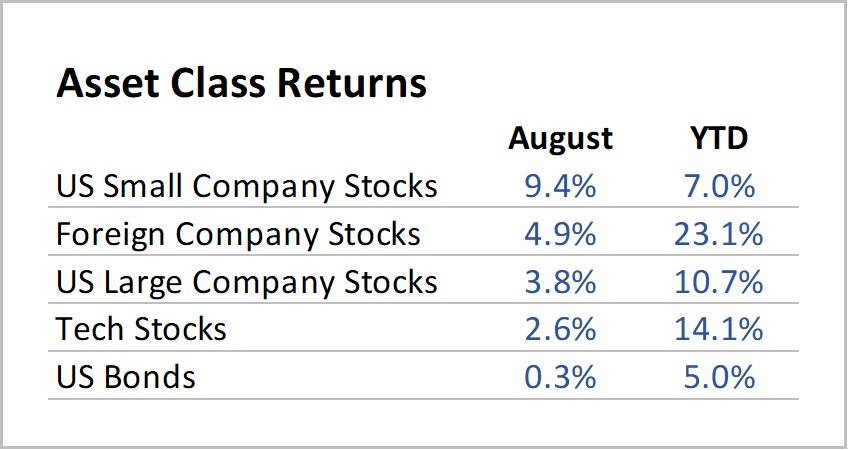
A second old saying, “markets climb a wall of worry” is holding true for 2025. Uncertainty has been outsized, but nonetheless, most asset classes at home and abroad have now registered positive returns.

Here’s how the performance of various asset classes stacked for the month of May and thus far in 2025:

Source: Moore Financial Advisors & Morningstar

-RK

Reading Room: Common Sense Investing

A cornerstone to successful investing is the application of common sense.

The founder of The Vanguard Group, John C. Bogle, believed this. The term ”common sense” appeared frequently in his writings, across twelve books and numerous essays, commentaries, and speeches.

A few of the tenants of common sense investing that Bogle espoused:

  1. Time is Your Ally: compound interest works best when paired with a long-term perspective; investors should avoid short-term noise and focus on long-term growth
  2. Diversification is Key: by owning a wide swath of the market, investors reduce the risk of being overly exposed to individual securities or sectors
  3. Don’t Try to Outguess the Markets: avoid speculative strategies and favor predicable, rules-based investing
  4. Cost Matters: try to keep costs associated with investing as low as possible
  5. Focus on What You Can Control: investors can’t control the market, but they can control how they react to market events, how they allocate their portfolio, and how long they stay invested

For those interested in diving deeper into Bogle’s work, The John C Bogle Reader is a good launching point. It combines three of Bogle’s most important books: Common Sense on Mutual FundsDon’t Count on It! and The Little Book of Common Sense Investing.

I recognize that digesting 1,874 pages of financial subject matter presents a lot of nourishment, and may be a meal enjoyed by some, but not all.

It may suffice readers to know that Bogle’s common sense approach, to which we adhere, continues to ring true: keep costs as low as possible, diversify, and stay invested.

Beyond his financial and business prowess and advocacy for the Main Street investor, Bogle was a thoughtful and empathic human being.

If you enjoy one-to-one interviews and would like to hear Bogle in his own voicecheck out this link.

Friend of the firm David Freudberg, who has a long and successful history of producing content for public radio, had the opportunity to meet with Bogle twice. The link above was from his 2014 interview at the Vanguard offices outside of Philadelphia in 2014.

For more of David’s work, which I highly recommend, check out Humanmedia.org and David’s weekly podcast Humankind.

-RK

A Message for the Class of 2025

The following article from our colleague and college financial advisor Donna Cournoyer is addressed to graduating high school seniors.

Your upcoming graduation from high school is a big deal- a REALLY big deal. Congratulations!

Now is the time when one chapter closes as you prepare for another. While it’s quite exhilarating, it can be a bit overwhelming, too. Don’t worry – you are not alone. Your future college classmates are also preparing for the transition this coming fall.

Here’s how you can get ready for college, with a few helpful tips from students who’ve been where you are:

Embrace Your Independence

College is a big step toward becoming your own person. You’ll be managing your own time, choices, and responsibilities – everything from planning your meals, your schedules, and of course your classes.

“Learning to do laundry before I moved in saved me from a lot of headaches—and colorful T-shirts,” says Emma, a sophomore at the University of Vermont. “College felt less overwhelming once I stopped waiting for someone to tell me what to do and started figuring things out for myself.”

Start with something practical this summer, like creating a budget, and managing any money you make by working a part-time job. Save what you can for spending money this fall.

Keep Your Study Habits Sharp

In college, it is likely that your classes will be moving faster and be more in-depth than high school. It is helpful to find what study methods help you most, such as group sessions, flash cards, or digital tools.

“In college, no one checks if you’ve done the reading. You’re expected to show up ready to talk about it,” says Jordan, a first-year student at a liberal arts college. “Learning how to study smarter—not longer—was a game changer.”

Start Making Connections

Start now. Don’t wait for move-in day to meet people. This helps take some of the fear of the unknown out of the equation, if you make a few new friends before you meet in fall.

Join the social media groups your school has set up for incoming freshmen. Message your roommate, attend the virtual meetings to meet some of your classmates.

“A girl I met on the college Discord server ended up being one of my best friends. We bonded over our love for Taylor Swift before classes even started,” says Aisha, a freshman at a state university.

Get Practical

From having health insurance cards to dorm shopping, there are a lot of logistics to tackle before move-in day. Make a list (or more), and don’t be afraid to ask older students what they wish they had packed- or left at home!

“I brought too many clothes and not enough extension cords,” laughs Max, a junior.

Also, know how to access your student portal and make sure your paperwork, such as immunization records, financial aid, and payment plans are squared away.

It helps to see some familiar faces when you step on campus.

Prioritize Your Well-Being

College life can be amazing, but also stressful. Make your mental health a priority. Get familiar with campus resources like counseling centers, academic support centers, student activities centers. Even wellness apps can help.

“I didn’t expect to feel homesick, but I did,” shares Leah, a second-year student. “Talking to someone—even a campus peer counselor—helped a lot.”

Remember, you are growing, you don’t need to have everything figured out! That is what college is for.

Final Thoughts

Summer this year is more than a break: it is really a launching pad. Take time to rest, plan, and dream. You are heading into one of the most impactful periods of your life. Full of life-changing experiences, discoveries and connections that will last your lifetime.

You, the Class of 2025, have already made it through a lot! Now is your time. Go out, learn, connect and experience the world around you.

“College will help you realize who YOU are. Your life will begin to take shape, and the meaning of your life will start to emerge.” -Donna

-DC

Hold ’em, Don’t Fold ’em

Kenny Rogers revealed his ideas about what to do at the poker table when he sang; “you got to know when hold ‘em, know when to fold ‘em, know when to walk away, and know when to run.”

Roger’s wisdom may ring true for gamblers, but it is much less useful for investors. John C. Bogle’s ideas and approach to investing are more apt to yield positive long-term results.

One of the four “investment giants” of the twentieth century (according to Fortune Magazine), Bogle was a founder of The Vanguard Group and was known for doing well by Main Street.

He had a strong conviction that focusing on the long term was the best approach for individual investors.

Bogle appreciated the classics, and was fond paraphrasing Shakespeare’s MacBeth, asserting: “the daily machinations of the stock market are like a tale told by an idiot, full of sound and fury, signifying nothing.”

He went on to say: “Don’t let all the noise drown out your common sense and your wisdom. Just try not to pay that much attention, because it will have no effect whatsoever, categorically, on your lifetime investment returns.”

During periods such as April, when the ebbs and flows of the financial markets are extreme, it’s important to remember Bogle’s words of wisdom.

In theory, it’s easy to get on board with what Bogle is saying.

In practice, however, it is difficult to “not to pay that much attention” when stock prices are gyrating and when you are witnessing daily declines in your portfolio’s value.

Since April’s mini-panic has subsided, investors may have an easier time considering the following, which support the “hold, don’t fold” principle:

  1. Large stock market declines are typically closely followed by large stock market rallies.
  2. Selling during today’s downswing can be detrimental, because it increases the chances that you’ll miss the benefits of tomorrow’s upswing
  3. Bear markets are infrequent (but not rare) and are typically unpredictable. Preparing for a rough ride in the near-term, while anticipating a smooth ride over the long-term, is a prudent approach.

Below are charts, with additional commentary, that illustrate these points.

Worst Days and Best Days Tend to Cluster Together

This chart shows the worst 50 days and the best 50 days in the stock market from 1997 through 2024, courtesy of Goldman Sachs Asset Management.

Source: Goldman Sachs Asset Management

GSAM says the time between the worst day in a drawdown and the best day of the subsequent recovery is often as little as 2-8 days.

If this chart were to be extended into 2025, early April would have featured prominently, when large company US stocks fell by nearly 5% on 4/3 and 6% on 4/4 – then shot up by 9% on 4/9.

If you’re tempted to sell stocks after a big market decline, keep this chart in mind. If you sell on the downswing, you’re likely to miss the upswing.

The 10 Best Days of Each Year Make All the Difference

Here’s another lens on the good days / bad days concept: since 1990, missing just the ten best trading days each year would have turned the S&P 500’s average positive return of +15.1% into an annual loss of -18.0%, on average.

Source: Goldman Sachs Asset Management

The chart above extends back to 2000, and shows actual annual returns in dark blue, paired with what annual returns would have been if investors missed the ten best trading days of the year.

The lesson: hold through the downs and the ups. Selling when the market is down means you run the risk of missing recoveries, which can be detrimental to your long-term wealth.

As hard as it may be psychologically to persevere when the outlook is gloomy and stock prices are falling, it most often is the right thing to do.

Markets Reward Long-Term Investors

The next two images show that being in the markets for the long haul is the best way to handle volatility, which is a feature of the stock market.

This table, courtesy of Capital Group, maps out the nine largest market declines during the past two decades, and puts what just occurred in April, labeled “Trump Tariff Tremor” into context.

Source: Capital Group

The events in purple font are corrections, where the stock market (S&P 500 Index of large company US stocks) has declined by between 10% to 20%.

Most of the time in instances where the market corrects, the decline is quick and sharp, and stocks recover quickly.

The “Trump Tariff Tremor” in black font a significant event, and the market activity was in line with other corrections. While stocks haven’t fully recovered to their most recent peak, the upswing from the April 8 “bottom” has been 14% as of May 2.

The events in green font are more severe bear markets, where the stock market has declined by more than 20%.

Recovery typically takes some time after the bottom of a bear market is reached. But in both types of down markets – Corrections and Bear Markets – long-term investors are rewarded for staying the course.

The last chart, also courtesy of Capital Group, is a complement to the previous table and shows the path of the S&P 500 Index of large-company US stocks for the past 20 years.

Source: Capital Group

The shaded areas map out the bear markets in green and the corrections in purple.

Through it all, the US stock market return has averaged about 9.25% per year. A $1,000 investment on January 2004, would have appreciated to approximately $5,888 over the twenty-year period.

Hopefully, this data can help you recognize the trees (short-term), enable you to see the forest (long-term), and support your resolve to stay committed to your investment strategy and your financial plan.

-RK