Category

Estate Planning Essentials

If you’ve never sat down and mapped out an estate plan — or if it’s been a while since you last looked at yours — you’re not alone.

Estate planning is one of those tasks that’s easy to keep putting off, partly because it can feel complicated, and partly because it means thinking about things we’d rather not think about.

But a good estate plan doesn’t have to be complicated, and it isn’t just for the ultra-wealthy.

It’s simply a way of making sure your wishes are carried out, your loved ones are protected, and the people you trust have clear authority to act on your behalf if you ever can’t act for yourself.

What Is an Estate Plan, and Why Does It Matter?

At its core, an estate plan is a set of legal documents that spells out two things:

  1. who makes decisions on your behalf if you become unable to make them yourself
  2. who receives your property when you pass away

That’s it. Everything else — trusts, tax strategies, beneficiary designations — exists to support those two goals.

Without a plan, state law fills the gap, and state law doesn’t know your family, your wishes, or your relationships. If you die without a will, state intestacy rules decide who inherits your assets, and the outcome may look nothing like what you intended.

If you become incapacitated without the right documents in place, your family may need to petition a court for guardianship just to pay your bills or make medical decisions — a process that costs time, money, and often adds stress at an already difficult moment.

Put simply: an estate plan isn’t about how much you have. It’s about making sure the people you love aren’t left guessing, or worse, fighting, over decisions you could have made in advance.

The Core Documents Everyone Should Have

A complete estate plan generally rests on four foundational documents:

  • Last Will and Testament: Directs how your property is distributed at death and names an executor to settle your affairs. Importantly, a will does not avoid probate — the court process of validating a will and overseeing the distribution of assets.
  • Durable Financial Power of Attorney: Names someone to handle financial matters on your behalf (paying bills, managing accounts, filing taxes) if you’re unable to.
  • Health Care Power of Attorney: Names someone to make medical decisions for you if you can’t communicate your own wishes.
  • Living Will: Documents your preferences for life-sustaining treatment (resuscitation, artificial nutrition, ventilation, etc.) if you’re terminally ill and incapacitated.

These four documents cover the essentials for nearly everyone. A trust is a common — and often valuable — addition, but it’s not a requirement for a complete plan. We’ll get into why you might (or might not) want one next.

What Is a Trust, and Why Consider One?

A trust is a legal arrangement in which one party (the trustee) holds and manages property for the benefit of another (the beneficiary), according to instructions the person creating the trust (the grantor) has laid out.

The most common version — a revocable living trust — is created while you’re alive and can be changed or revoked at any time.

The main appeal of a revocable living trust is that assets held in it bypass probate entirely. That means a faster, more private transfer of assets to your heirs, without the court filings and public record that come with probate.

Trusts can also give you more control — for example, spelling out that a beneficiary receives distributions in stages rather than all at once, which can be valuable if you’re providing for a minor, a beneficiary who struggles with money management, or a blended family with competing interests.

That said, a trust isn’t automatically necessary for everyone. If your goals can be met through straightforward beneficiary designations, joint ownership, and transfer-on-death titling, a trust may add cost and complexity without adding much benefit.

It’s worth weighing your specific situation — family structure, asset types, and privacy or control preferences — before deciding.

For those who do have a need, a few purpose-built trusts come up often, particularly for couples and larger estates:

  • Marital (“A”) and Bypass (“B”) Trusts — Used together by married couples to make full use of both spouses’ estate tax exemptions while still providing for a surviving spouse.
  • Spousal Lifetime Access Trust (SLAT) — Removes assets from one spouse’s taxable estate while still allowing the other spouse access to the trust for support.
  • Irrevocable Life Insurance Trust (ILIT) — Holds a life insurance policy outside your taxable estate, while still providing liquidity to your beneficiaries.
  • Special Needs Trust (SNT) — Provides for a beneficiary with a disability without disqualifying them from means-tested government benefits.

These are more specialized tools, and whether any of them make sense depends on the size of your estate, your family circumstances, and your goals — not something to adopt off a checklist.

Putting It Together: A Snapshot of a Comprehensive Estate Plan

Here’s how the pieces above typically fit together, along with the key people involved in carrying them out:
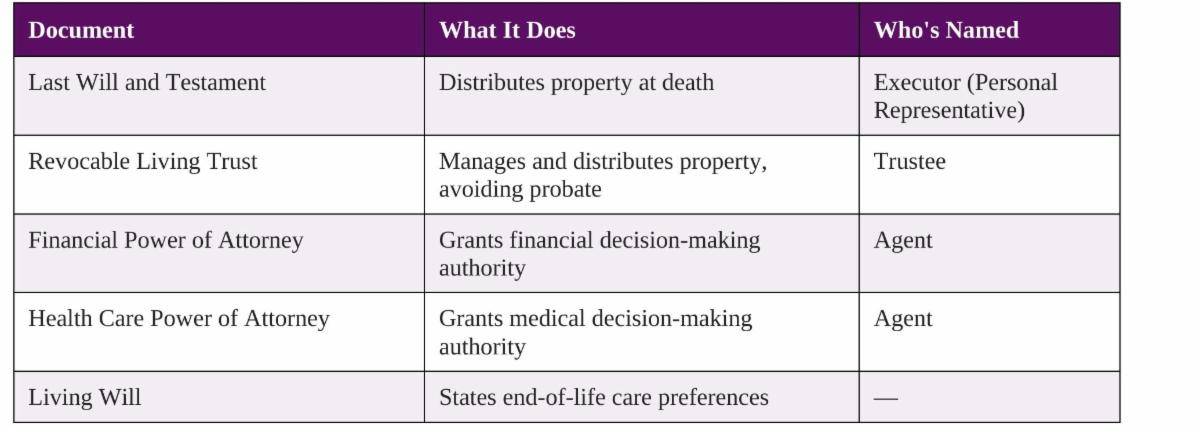
Source: Moore Financial Advisors

And a few of the people who carry out these documents:

  • Executor — Settles the estate as directed by the will (probate, debts, final taxes, distributions)
  • Trustee — Manages trust assets and carries out the trust’s instructions for beneficiaries
  • Agent (Power of Attorney) — Makes financial and/or medical decisions on your behalf
  • Guardian — Cares for minor children, typically named in the will

A note on terminology: you’ll often see the term Personal Representative used alongside — or in place of — “Executor.”

Personal Representative is the broader, more modern legal term for the person who administers an estate under the court’s supervision; many states, including Massachusetts, now use it as the official title in place of “Executor.”

In everyday conversation, the two terms are generally used interchangeably, and you may see either one depending on which state’s forms or statutes are being referenced.

Seeing it laid out this way helps clarify a point worth repeating: these documents work as a system. A gap in one (say, an outdated will or a trust that was never funded) can undercut the whole plan.

How a Will and a Trust Work Together

If you have both a will and a trust, it’s important to understand how they interact. A trust only avoids probate for assets that have actually been retitled, or “funded,” into it — a trust that owns nothing accomplishes nothing.

Because it’s common for a few assets to be missed along the way, most trust-based plans also include a pour-over will, which directs any assets left in your individual name at death into the trust. Those “poured over” assets still pass through probate, but the pour-over will acts as a safety net to make sure nothing falls outside the plan entirely.

Even with a fully funded trust, you still need a will. Wills handle things a trust doesn’t: naming guardians for minor children, addressing personal property not held in the trust, and serving as the final backstop for anything unaccounted for.

Why Reviewing Beneficiaries Matters

Here’s a detail that surprises many people: beneficiary designations on accounts like retirement plans, life insurance, and annuities override what your will or trust says. If your 401(k) still lists an ex-spouse, or your IRA names your estate instead of a person, that’s what governs — regardless of your other planning documents.

A few things worth checking periodically:

  • Do your named beneficiaries reflect your current wishes and family situation?
  • Have you listed your “estate” as a beneficiary anywhere? (This forces those assets through probate)
  • Are any beneficiaries minors? (Minors generally can’t inherit directly, which can trigger a court-appointed conservatorship)
  • If a trust is named as beneficiary, is that trust still current and appropriate?
  • A quick beneficiary review takes a few minutes and can prevent outcomes no one intended

How Often Should You Update Your Estate Plan?

There’s no fixed schedule that fits everyone, but two categories of events should prompt a review:

  • Life events: marriage, divorce, births, the death of a named executor, trustee, or agent, a move to a new state, or a significant change in your assets.
  • Law changes: federal and state estate tax rules shift periodically. As of 2026, the federal estate and gift tax exemption increased to $15 million per individual ($30 million for married couples) — a change that affects very few households directly. Massachusetts is a different story: the state estate tax exemption remains $2 million per person, and unlike the federal exemption, it is not portable between spouses.

For many Massachusetts homeowners, home equity and retirement accounts alone can approach that threshold — which is exactly the kind of gap a periodic review is meant to catch.

As a general rule of thumb, a full review every three to five years — or immediately after any major life event — is a reasonable cadence.

Why Use an Estate Planning Attorney — and Is It Worth the Cost?

It’s tempting to reach for an online template to save money, and for very simple situations that may work. But an estate planning attorney brings a few things a template can’t:

  • State-specific compliance. Estate law varies significantly by state, and a document valid in one state may not hold up in another
  • Tailored drafting. Your family situation, assets, and goals are unique; a generic template can’t anticipate the details that matter for your plan
  • Coordination. An attorney ensures your will, trust, and powers of attorney work together rather than contradicting each other
  • Accountability. Attorneys carry malpractice coverage and professional responsibility that a downloaded form does not

The cost of hiring an attorney is real, but it’s worth weighing against the alternative: a contested or invalid will, a costly and public probate process, or family conflict that a properly drafted plan could have prevented. For most families, the upfront cost of good legal work is modest compared to what’s at stake.

This is general education, not a recommendation for your specific situation — if you don’t already have a trusted estate planning attorney, we’re glad to make an introduction.

What Role Does a Financial Advisor Play in Estate Planning?

Our role is to work alongside your attorney and tax preparer, not in place of them. In practice, that means:

  • Making sure beneficiary designations on your investment and retirement accounts match your overall estate planning intentions
  • Reviewing how assets are titled (individually, jointly, or in trust) to ensure alignment with your plan
  • Keeping an eye on how life changes or new laws might affect your existing plan, and flagging when it may be time to revisit it with your attorney

We’re not attorneys, and we don’t draft legal documents or give legal advice — but we do help make sure the financial side of your plan supports the legal side.

-RK

Is the Sky Falling in Bond-Land?

A common perception of the bond market is that it is a puzzling and uninteresting place. Even so, recent articles in the financial press may have grabbed your attention and might have given you the impression that the sky is falling in bond-land.

Here’s a sample of headlines focused on the bond market from the past few weeks:

  • Global Bond Selloff Sends Yields to Highest Since 2008 – Bloomberg
  • Why the Global Bond Yield Crisis Is Just Getting Started – Barron’s
  • Europe’s Bond Markets Are Suffering a Post-Holiday Shock – The Economist
  • The Treasury Market’s Coveted Status as a Safe Haven is Fading – The Wall Street Journal
  • The National Debt Is Wreaking Havoc with Bonds – Barron’s

Using terms like “crisis”, “shock”, and “wreaking havoc” may grab attention and fan the flames of our inner Chicken Little anxieties.

But this type of language and financial journalism falls short of providing useful information and promoting understanding.

To address concerns related to the bond market, we’ll go through some bond market basics; address current issues affecting bond yields and prices; and explain why a bond allocation is and will continue to be an important component of most well-diversified portfolios.

Bond Market Basics

To many individual investors, stocks are straightforward.

Buying a piece of a company that we know, and being able to track the share price, connects us to our stock investment. If good things happen to the company, the share price typically goes up. And if a company’s fortunes fall, so does the stock.

Bonds, however, are much less familiar. So here are some things to know:

The US bond market, at about $58 trillion in market value, is approximately the size of the US stock market.

But the bond market is arguably more consequential to the real economy than the stock market for a few reasons:

  • Funding Costs: It’s how governments and companies fund themselves. Bonds are tradable loans. When governments and companies issue bonds, they receive cash and promise to pay interest to the bond buyer for the use of that cash. The issuer also promises to return the principal to the bondholder when the bond matures.
  • Risk-Free Rate: The Treasury bond yield establishes the “risk-free rate” that many financial instruments are priced against – mortgage rates, corporate borrowing cost, and even stock valuations (via discount rates) all trace back to Treasury yields.
  • Economic Barometer: Institutional bond investors and Wall Street traders are constantly considering inflation, economic growth, and Federal Reserve interest rate policies when deciding what price and yield to accept when they buy and sell bonds. Shifts in bond yields often signal changing expectations before they show up elsewhere.
  • Big Money: the more risk-averse, large pools of capital, such as pension funds, insurers, central banks, and foreign governments, are major holders of bonds, so instability in the bond market ripples through the global financial system in a way that declines in US stocks often don’t.

When talking about the situation in the bond market, the discussion usually centers around bond yields. A bond yield is the annual return an investor earns for holding a bond, and the yield moves inversely to the bond’s price.

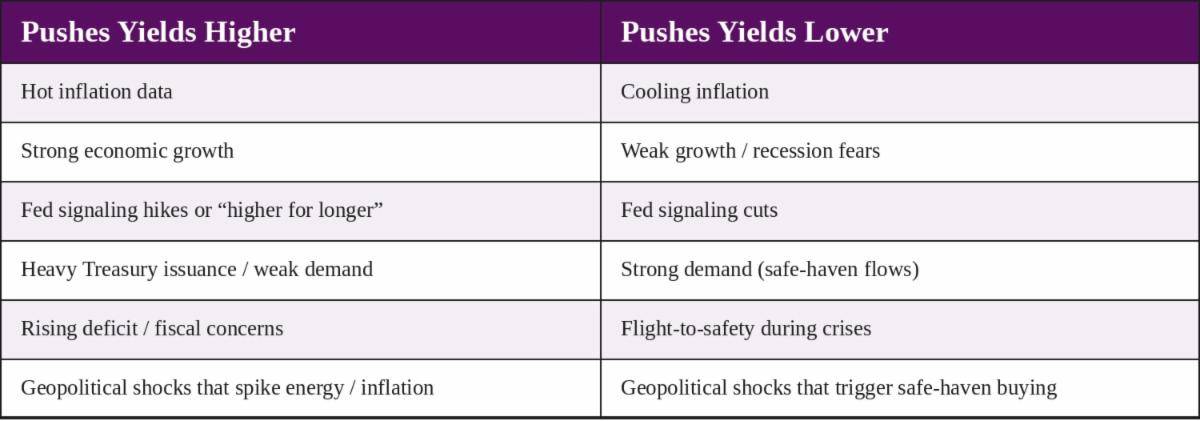
The table below presents some factors that influence the direction of Treasury bond yields.

Source: Moore Financial Advisors

Bond Market Current Issues

It is a fact that yields have pushed higher in the US, as well as in other countries, this year.

From a low point of 3.9% in early January 10-Year Treasury yields climbed nearly a percentage point, to 4.78% in early September.

Short-term Treasury Bond and Bill yields are also up by about a percentage point and currently sit at about 4.0%.

It’s also true that for many investors, returns for high quality intermediate and long-term bond funds have fallen short of expectations in 2026.

The benchmark US Bloomberg Aggregate Bond Index, which is made up of thousands of high-quality issues, including US Treasuries, guaranteed mortgage-backed securities, and corporate bonds, has produced a negative return of -0.25% year-to-date as of September 4.

Financial markets experts point to several factors behind the increase in yields, including:

  • investors’ concerns that inflation is too high
  • central banks around the world aren’t doing enough to contain inflation
  • governments are acting in fiscally irresponsible ways by running large, successive deficits – particularly since the pandemic

These are valid concerns and could lead to more upward pressure on bond yields in the future, but do not point to imminent crisis.

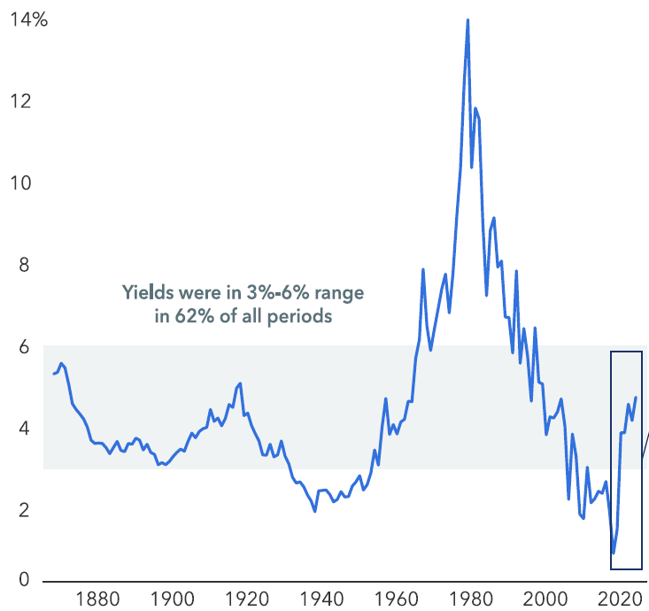
Courtesy of Capital Group, the chart below shows a 155-year history of long-term Treasury bond yields going back to 1871. 

Source: Capital Group

Prior to 1962, the data represents the average long-term government bond yield; from 1962 forward, the data represents 10-Year Treasury yields as of December 31 each year within the period.

The data shows that 62% of the time, long-term Treasury bond yields fall within a range of 3% to 6%.

When bond yields move out of this range, it’s a strong possibility that something may be amiss in the economy or the financial markets.

In the 1970s and 1980s, the US economy was stressed by energy shocks, rolling recessions, and elevated inflation, which pushed interest rates well above the normal band to record high levels.

In the 15 years following 2006, the US economy was challenged by fallout from a global financial crisis (2008-2009) and a pandemic (2020) which pulled interest rates well below the normal band to record low levels.

Today’s interest rates, when viewed through a long-term historical lens, sit comfortably in the middle of the normal band.

According to analysis done by JP Morgan asset management, 10-year Treasury yields have averaged 5.7% since 1958. A 10-year yield approaching 4.8% is hardly indicative of “crisis”, “shock”, or “havoc”.

To some extent, modestly higher yields can be considered good news for bondholders.

With stock markets at record highs, the rise in yields reflects a resilient global economy that can absorb higher borrowing costs. And higher yields mean investing in bonds today will deliver more income over time.

Why Hold Bonds in Your Portfolio?

Even though the environment for bond investors has been challenging for most of 2026, the main reasons for owning high-quality bonds, including US Treasuries, remain intact:

  • Bonds provide recurring, dependable income
  • Investment-grade bonds with near- to intermediate-term maturities are less volatile than stocks, and can help stabilize a portfolio when financial markets become unsettled
  • Shorter-maturity bonds and bond funds are typically a good source of “liquidity” and convert easily to cash when money must be withdrawn from a portfolio

The bottom line: the sky is not falling in bond-land.

The unsatisfactory returns many investors have experienced in their bond allocations year to date likely have been counterbalanced by satisfactory returns from their stock allocations.

Also, sub-par bond returns this year are coming on the heels of above-average returns for bonds last year.

This return experience is normal and indicative of a generally healthy economic and financial market environment.

For most individual investors, an allocation to bonds is, and will continue to be, an important component of a well-diversified portfolio.

-RK

August 2026 Market Recap:

This month’s financial market commentary has been kept purposefully brief. We’ve provided a separate article entitled Is the Sky Falling in Bond-land? that goes into more depth about developments in the bond market. (You will see that article in our next blog post.)

Resilient corporate earnings were the main development that supported the stock market in August.

Earnings reports for the second quarter ended June 30 in aggregate turned out to be much better than anticipated and far better than last year.

For example, Nvidia, the maker of chips used in AI data centers (and currently the largest company in the US when measured by stock market value) announced stellar results in late August.

But what really caught the attention of investors was Nvidia’s forecast that strong sales growth would continue well into next year.

With most large, publicly traded companies having released their results for second quarter, 76% exceeded analysts’ expectations.

Sales in the second quarter of 2026 were up 15% compared to the same period last year, and earnings were up by 32%.

The month of August was generally positive for both stocks and bonds, reversing the weak performance experienced by most market segments in July.

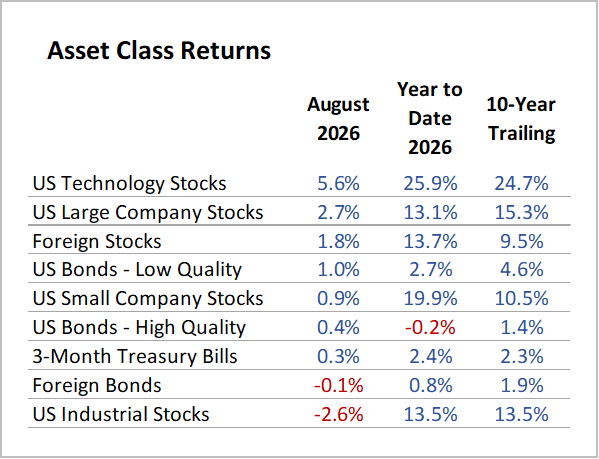
US Technology stocks led the way with a 5.6% increase. Large company US stocks did well, rising by 2.7%, and foreign company stocks weren’t far behind, with an increase of 1.8%. Small company US stocks struggled to keep pace but still generated positive performance of 0.9%.

Gains in the US bond market were more muted, but still generally positive, with high-quality bonds returning 0.4%, and US Treasury bills up 0.3%. Foreign bonds were the laggard, declining by a modest 0.1%.

Here are results for August and 2026 Year-to-Date, compared to longer-term annualized returns (10-Year Trailing):

Source: Morningstar

-RK

Kings

We’re now at peak summer season, and I hope you’re finding time to rest, relax, and enjoy some reading that takes you farther afield. Here are two non-finance books that I’ve enjoyed this summer.

King of Kings: The Iranian Revolution: A Story of Hubris, Delusion and Catastrophic Miscalculation by Scott Anderson

I trace my first recollection of political awareness back to 1979. In 5th grade, one student stood out as more worldly than the rest of us. She talked about the Middle East, oil, political strife, the State Department, and “the Shah” – things I knew nothing about at the time.

I’d filled in some of the gaps since then, but Anderson’s book tells a full story of what happened in Iran in the late 1970s.

Once toasted by President Carter as an unshakable ally presiding over “an island of stability,” commanding the world’s fifth largest army and vast oil wealth— Shah Mohammad Reza Pahlavi fled into exile just fourteen months later, forced out by a religious revolution led by Ayatollah Khomeini.

Anderson frames the collapse as a story of American diplomatic blunders and miscalculations that helped trigger hostilities that have destabilized the region for decades, arguing that the revolution was as world-shattering as the French and Russian revolutions.

What makes it especially resonant now is the broader pattern Anderson identifies: the resentment of economically marginalized, religiously fervent populations toward a wealthy secular elite has fueled unrest across the Middle East, India, Southeast Asia, and Europe – with Iran serving as the template.

The book is a useful lens for understanding how great-power miscalculation and populist backlash can compound into events with generational consequences.


Monsters in the Archives: My Year of Fear with Stephen King by Caroline Bicks

My summer wouldn’t be complete without reading something by, or about, Stephen King.

A few months ago, I was listening to a BBC reporter interview Caroline Bicks, the inaugural Stephen E. King Chair of Literature at the University of Maine.

Bicks told the story that she was instructed by the University of Maine administration to set aside the idea of ever getting in touch with Stephen King, despite her holding the chair endowed by him.

However, King eventually reached out to Bicks, they struck up a professional relationship and friendship, and this book is the product of her having access to his archives.

Monsters in the Archives is part literary master class, part biography, part memoir, and an investigation into our deepest anxieties, drawing on unprecedented access to King’s private papers.

Bicks focuses on five of King’s most iconic early works—The Shining, Carrie, Pet Sematary, ‘Salem’s Lot, and Night Shift—tracing his margin notes and editorial changes to reveal how he built his language, storylines, and characters, and she uncovered unpublished scenes and alternate endings that King allowed her to publish for the first time.

The book offers longtime readers a rare backstage look at how some of the most influential horror fiction of the last half-century was actually constructed, alongside Bicks’s own story of rereading these books as an adult confronting the childhood fears they first stirred in her.

Happy Reading!

-RK

Earnings Bonanza

A note on corporate profits, the outlook for stocks – and the risk posed by higher interest rates

Markets have had a lot to digest this year — a shaky spring, a war in the Middle East, and now a swirl of headlines about tariffs, AI spending, and inflation.

With all of that noise, I wanted to step back to discuss the data that typically matters most for the direction of stock prices: company profits.

What Moves Stock Prices?

Over short stretches — a week, a month, even a year — stock prices can be driven by reactions to all kinds of things: headlines, interest rate movements, electoral outcomes, geopolitics, changes in tax law.

But zoom out to longer stretches of time, and one relationship stands out above all the rest: stock prices move with company earnings.

Looking back over the last 25-plus years, S&P 500 company profits and the index’s share price have moved in the same direction over nearly every long stretch, and no other single factor comes as close to explaining where stocks end up over time.

Other things cause bumps along the way, but earnings are a road unto themselves.

Why is that?

A share of stock is simply a small ownership stake in a company’s future profits — the same way owning a piece of a local business entitles you to a slice of what it earns. When you buy that business, you’re generally willing to pay some multiple of its current profits, based on how much you expect those profits to grow.

If the business’s profits then grow by 20%, and buyers are still willing to pay roughly that same multiple, the business itself is now worth about 20% more.

Publicly traded companies work the same way, just with a price you can check every day: as long as investors keep valuing companies at roughly similar multiples of their profits, growing profits should translate into a rising share price.

That’s why, when we think about the market’s prospects, we start with a simple question: are company profits healthy, and are they likely to stay that way?

Right now, my answer is yes — with one thing to watch, which I’ll get to below.

This year’s earnings season has been one of the best in recent memory. As David Kelly, Chief Global Strategist at J.P. Morgan Asset Management, put it in a July 2026 research note, this earnings season “has started with a blast”:

  • Second-quarter 2026 results have come in well ahead of expectations, with roughly 86% of companies beating Wall Street analysts’ estimates — a noticeably higher hit rate than the historical average.
  • For the full year 2026, analysts now expect company profits to grow by roughly a quarter over 2025 levels — building on solid gains of about 10% in 2024 and 13% in 2025. This isn’t a one-quarter blip; it’s the continuation of a multi-year upswing.
  • Profit margins — essentially, how many cents of profit a company keeps out of every dollar of sales — are near their highest levels in decades. Companies aren’t just selling more; they’re keeping more of what they sell.
  • Looking further out, analysts expect profit growth to continue into 2027, albeit at a somewhat more moderate pace than this year’s exceptional gains. In other words, this isn’t expected to be a one-year sugar high.

The Bigger Picture: a Decades-Long Climb

Zooming out even further helps put this year in context.

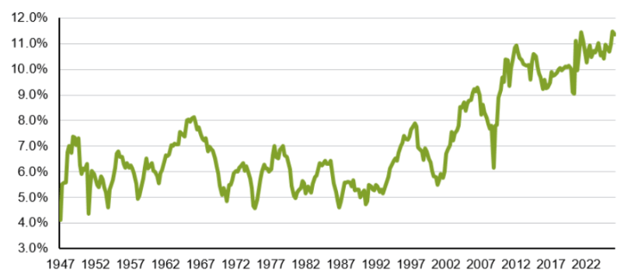
The chart below shows corporate America’s after-tax profits as a percentage of the entire U.S. economy, going back to 1947.

Source: JP Morgan Asset Management

For nearly 50 years, that share hovered in a narrow band around 6%. Since the mid-1990s, it has climbed steadily, reaching roughly 11.4% in early 2026 — essentially double its historical norm.

As Kelly at JP Morgan notes, this reflects a combination of businesses controlling labor costs more effectively and a more favorable corporate tax environment over the past three decades — durable, structural forces rather than a one-year phenomenon.

Watch Out for Interest Rates

Earnings are the foundation for the stock market, but interest rates can be a wildcard.

Here’s the simple version of why interest rates matter: when the Federal Reserve raises interest rates quickly, it makes borrowing more expensive and makes other investments (like bonds) relatively more attractive compared to stocks — which can pull stock prices down even when company profits are perfectly healthy.

We saw this play out a few years ago. In 2022, company earnings and the job market were both in good shape, yet stocks still fell nearly 20%, because the Fed was raising rates aggressively and rapidly (seven times in less than a year) to fight inflation.

It was a reminder that strong profits alone aren’t a guarantee of a rising market if the Fed is working against you at the same time.

So could that happen again? For now, a repeat of 2022 seems unlikely for two reasons:

  1. We’re not starting from an artificially low base. Going into 2022, interest rates had been held near zero for years, which meant the Fed had a long way to climb, in a hurry, to catch up with inflation. Today, the 10-year Treasury yield sits around 4.7% — already close to its long-run historical average of roughly 5.7% going back to the late 1950s. There simply isn’t the same “room” for a shock of similar size.
  2. This year’s inflation uptick has a different cause. Much of the recent rise in inflation traces back to a spike in oil and energy prices tied to the conflict with Iran, rather than a broad-based, self-reinforcing wage-and-price spiral working through the whole economy. Core inflation (which strips out food and energy) was actually cooling coming into this year, before the conflict began. An energy-price shock is a different animal than embedded inflation, and it tends to fade as the underlying disruption resolves rather than requiring an extended period of aggressive rate hikes to stamp out.

To be candid: the Fed has held rates steady at its last several meetings, but it’s possible that we see an interest rate increase or two before year-end if energy-driven inflation stays elevated — a few Fed officials have recently pushed for exactly that.

My expectation is that this would look nothing like 2022’s rapid-fire string of hikes — at most a few adjustments over the course of the next year, rather than a sustained tightening campaign.

But higher interest rates, even if the increases are moderate and reinforce the Fed’s inflation-fighting credibility, may unsettle the stock market.

The Bottom Line

The fundamentals supporting this market are genuinely strong: company profits are growing and margins are near record levels. That growth is expected to continue into next year — and historically earnings growth has been a reliable predictor of a healthy stock market over time.

Interest rates remain the variable most capable of disrupting that picture in the near term, but the setup today looks different from 2022: rates have already adjusted up from post-pandemic lows, and the current inflation pressure looks more like an energy shock than a deep-seated structural problem.

We’re watching both sides closely and will keep you posted if anything changes our thinking.

-RK

July 2026 Market Recap: Financial Markets Update: Trés Amusant

In July, I visited Old Orchard Beach, Maine. The cottage where I stayed with extended family is a short walk from Palace Playland, an amusement park, which first opened in 1902.

My style of ride is the Merry-Go-Round: old-fashioned, somewhat whimsical – and most importantly, one directional. My 12-year-old niece has a different vibe.

Attempting to curry favor, I accompanied her on HyperJump, which Palace Playland’s website describes as: “feel your heart race as you spin around and defy gravity with bursts of speed that send you soaring up and down.”

The HyperJump description is accurate; I may have scored a point with my niece; and two minutes of terror reaffirmed my amusement park ride preferences.

July’s market activity encompassed elements of both Carousel and HyperJump.

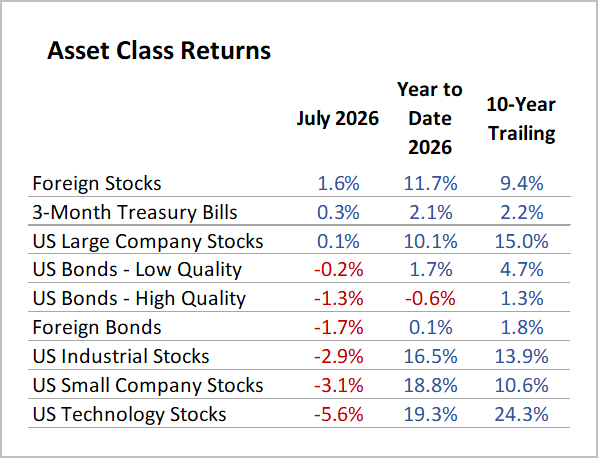
Performance for a good portion of the stock and bond markets was Carousel-like. Foreign stocks (+1.6%), US Treasury Bills (+0.3%) and US Large Company Stocks (+0.1%) all recorded modest positive performance in July.

Other segments of the financial markets, including US Bonds (-1.3%) and Foreign Bonds (-1.7%), registered modest negative performance. Small company stocks declined a bit more (-3.1%), but results were far from stomach-turning.

HyperJump activity was concentrated mainly in the technology sector (-5.6%), and the gyrations were more obvious by looking at individual stock performance for the month.

As the chart below indicates, stock prices of major tech companies ranged from +25% to -35%. Several companies involved in cloud computing and data management soared, while semiconductor manufacturers, which had done very well in the first half of 2027, fell particularly hard.

Source: Morningstar

Away from technology sector, oil prices increased by more than 20% in July, pushed higher by increased hostilities in the Middle East, which helped boost Energy sector stocks by 12%.

In sum, I concur with sentiment shared recently in a note by Jeremy Siegel, Emeritus Professor of Finance at Wharton and Senior Economist at WisdomTree: “The recent rotation away from the market’s most speculative leadership, while uncomfortable for some investors, strengthens rather than weakens the foundation of this bull market.”

Another way of framing this: prices for some technology stocks had come too far, too fast. The downward adjustment in their share prices in July, without a broad-based stock sell-off, is a healthy sign for the market as a whole.

Here are results for July and 2026 Year-to-Date, compared to longer-term annualized returns (10-Year Trailing):

Note: YTD 2026 as of July 31; Source: Morningstar

-RK

When Your Kid Still Can’t Decide – And It’s Almost Senior Year

This is not a topic you will hear much about when the college discussion comes up, or when reading college planning articles, but it is one worth exploring. You may feel like you are all supposed to have everything figured out, the school, the finances, and the major.

However, some high school kids have not figured out what they want to do with their life yet. And that is OK.

Summer is supposed to feel like a break. But if you’re the parent of a rising senior who still has no idea where — or even whether — they want to go to college, this particular summer probably doesn’t feel much like one.

I hear this a lot: “My kid is interested in everything and committed to nothing.” Or the flip side — “They have no idea what they want to do, so they don’t see the point of any of it.”

Here’s the truth: this is more common than you think, and it doesn’t have to derail the process. But it does require a different approach — because pushing harder on a kid who’s already shut down rarely ends well.

First, Separate Their Indecision from Your Timeline

Think about this — the college application process was designed around deadlines, not around human development. Some 17-year-olds genuinely don’t know what they want yet, and that’s not a failure. It’s actually pretty normal.

What is a problem is letting their uncertainty become a reason to do nothing — because the financial and logistical decisions don’t wait for clarity. Deposits, financial aid packages, scholarship deadlines — these have hard stops.

So, the first move is to separate two things:

  • What your child needs to figure out (direction, interest, fit)
  • What you need to drive forward (the financial strategy, the list, the paperwork)

You can do your job even while they’re still working on theirs.

Give Them a Smaller Question to Answer

One of the most common mistakes I see — in conversations with clients’ kids — is someone asking too big a question too soon. “What do you want to do with your life?” is paralyzing. No wonder they go quiet.

Try a smaller focus:

  • What don’t you want? Sometimes elimination is easier than selection. A kid who can’t name a dream school can often rattle off everything they don’t want — huge lecture halls, a campus in the middle of nowhere, a school that feels like an extension of high school.
  • What lights you up, even a little? It doesn’t have to be a major or a career. A flicker of interest in food science, environmental policy, or film is enough to start building a list around.
  • What kind of experience do you want? Big campus energy vs. small community? Urban vs. rural? Close to home or far away? These aren’t career questions — they’re easier to answer, and they narrow the field considerably.

The goal isn’t a five-year plan. The goal is to have enough direction to build a working college list.

Build the List Anyway — With a Financial Safety Built In

Here’s where I push back a little with families: don’t wait for your child to fall in love with a school before you start building the list. Build it around them.

I watched literally hundreds of families fall in love with the university where I worked while on tour, and heard parents say repeatedly, “Well, they love it here, I guess this is it”, without any acknowledgement of price. (It was a beautiful campus on the ocean.)

Which is part of my point here, money has to enter the conversation.

Consider this — every list needs at least one school where:

  1. Your child would genuinely attend if accepted
  2. Acceptance is very likely given their academic profile
  3. The cost is manageable without merit aid — or where merit aid is highly likely

Item #3 is the financial safety, and it’s the one most families forget. I’ve worked with families who built a great, balanced academic list and ended up with no good financial options when the merit scholarship and financial aid letters came in.

That’s a painful place to be in April of senior year.

An undecided kid is actually a good candidate for schools with strong exploratory or undecided tracks — many excellent schools make it easy to start broad and declare later. That’s a selling point, not a compromise.

Have the Money Conversation Now — Not in April

If your child is lukewarm on the whole college idea, the last thing you want is a financial surprise making the decision harder. Or better yet, committing to a school with a high cost of attendance. Before senior year starts, have an honest conversation about what you can afford — and what you’re willing to spend.

That means knowing:

  • Your student aid index (what FAFSA will calculate for financial aid eligibility)
  • What a realistic merit aid scenario looks like at different types of schools
  • Whether there’s a ceiling on what you’ll borrow or co-sign, or pay monthly
  • What a gap year looks like financially if it comes to that

In my experience, kids who “can’t decide” sometimes can’t decide because they’re sensing — correctly — that the adults around them haven’t fully worked it out either.

When you can have a clear, calm money conversation, it often takes pressure off the whole thing.

What If They’re Genuinely Resistant?

Some kids aren’t undecided — they’re resistant. They don’t want to go, or they’re not ready, and no amount of campus tours is going to change that this summer.

If that’s your situation, here’s what I’d suggest:

  • Don’t force it. A reluctant freshman who isn’t ready is an expensive mistake — both financially and emotionally.
  • Explore alternatives openly. Gap years, community college, certificate programs, and work experience are legitimate options. Treating them as such (rather than as failures) often reduces the pressure enough that kids can think.
  • Keep the financial strategy moving anyway. Even if college is deferred a year, your savings, your tax picture, and your aid eligibility will all benefit from planning now.

The Bottom Line

An undecided kid in the summer before senior year is not a crisis — it’s a signal to adjust your approach. Lead with smaller questions, build the financial picture regardless, and make sure the list includes at least one option that works for your family no matter what.

The goal isn’t to manufacture enthusiasm your child doesn’t feel yet. It’s to make sure that when they do get there — and most of them do — you’ve kept the door open and the options real.

That’s what good planning looks like.

-DC

Protecting Your Personal & Financial Information

Identity theft and financial fraud can happen to anyone — and recovering from them is stressful, time-consuming, and costly. Fraud is no longer a distant threat: the FBI logged more than one million online financial crime complaints in 2025, with losses totaling nearly $21 billion, a 26% increase from the prior year.

A June 2026 survey by the CFP Board found that 3 in 5 Americans have either personally encountered financial fraud or know someone who has in the past three years.

Today’s scammers aren’t just sending clumsy emails full of typos. They use artificial intelligence to:

  • Clone voices
  • Generate convincing video calls, and
  • Create personalized messages that include your real name and account details

At the same time, some of the oldest tricks — like stealing a check from your mailbox — remain very much alive. The good news is that many of the most effective protections are simple, free, and take only a few minutes to put in place.

1.  Place a Credit Freeze

A Credit Freeze credit freeze – also called a security freeze – prevents lenders from accessing your credit report, which stops new accounts from being opened in your name. This is the single most effective step you can take to prevent identity theft. It is free, does not affect your credit score, and can be temporarily lifted whenever you need to apply for credit.

Freeze your credit at all four major bureaus:

•        Equifax — equifax.com | 1-800-685-1111

•        Experian — experian.com | 1-888-397-3742

•        TransUnion — transunion.com | 1-888-909-8872

•        Innovis — innovis.com | 1-800-540-2505

2.  Never Share Sensitive Information by Email

Email is not secure. An email account can be compromised in several ways. Emails can be intercepted, forwarded without your knowledge, stored indefinitely, and accessed if either your account or the recipient’s account is ever breached.

For these reasons, email should never be used to transmit sensitive personal or financial information.

Never include any of the following in an email:

  • Bank or investment account numbers — including routing numbers, brokerage account numbers, or wire transfer instructions
  • Social Security numbers — yours, your spouse’s, or your dependents’
  • Passwords, PINs, or security codes — for any account, device, or online service
  • Credit or debit card numbers — including expiration dates and CVV security codes
  • Driver’s license, passport, or Medicare/insurance ID numbers — these are high-value targets for medical and government identity fraud

What to do instead:

  • Call instead of emailing: when an institution needs sensitive information, provide it over the phone using their official published number.
  • Use secure portals: banks, brokerages, and financial advisors use encrypted client portals specifically for sharing sensitive documents. Always use these rather than email attachments.
  • If emailing documents is unavoidable: password-protect the file and communicate the password through a separate channel (such as a phone call), never in the same email.

3.  Use a Password Manager

Weak or reused passwords are one of the most common ways criminals gain access to financial accounts. The good news is that newer, more secure methods are often more convenient than traditional passwords.

Use a Password Manager

  • A password manager (such as Bitwarden, Apple Passwords, or 1Password) generates and stores strong, unique passwords for every account. It will also refuse to fill in credentials on a fake website — a powerful protection against phishing.
  • Never reuse passwords across different accounts. If one site is breached, criminals will try that same password everywhere else.
  • Use fake answers to security questions (e.g., “Mother’s maiden name: k7#mQzT9”) and store them in your password manager. Real answers to these questions are often findable online.

Use Passkeys When Available

Passkeys are a newer sign-in technology that replaces passwords entirely. When a website supports passkeys, use them — you cannot be tricked into giving a criminal your passkey the way you can with a password, because passkeys never leave your device.

Strengthen Two-Factor Authentication (2FA)

  • Enable 2FA on every financial, email, and social media account. Two-factor authentication requires a second form of verification before allowing access, making it significantly harder for someone who has obtained your password to get into your account.
  • Use a hardware security key (like a YubiKey) when available — it is the most secure 2FA option and cannot be intercepted.
  • Use an authenticator app (like Google Authenticator or Authy) as your next-best option. It is significantly safer than receiving codes by text message.
  • Avoid SMS text codes as your 2FA method whenever possible. Text-based codes can be intercepted through SIM-swap attacks.

4.  Protect Your Social Security Number

Your Social Security number (SSN) is the master key to your financial identity — guard it carefully.

  • Never carry your Social Security card in your wallet. Store it in a locked, secure location at home.
  • Do not provide your SSN unless absolutely required. Ask why it is needed and how it will be protected before sharing it.
  • Create a “my Social Security” account at ssa.gov/myaccount to prevent someone else from creating one in your name.
  • Activate SIM-swap protection with your mobile carrier. SIM swapping is a fraud technique where a criminal convinces your carrier to transfer your phone number to their device, giving them access to text-based verification codes. Call your carrier and ask them to add a PIN or passcode requirement before any changes can be made to your account.

5.  Monitor Your Credit & Financial Accounts

Early detection is critical. The CFP Board survey found that more than 2 in 5 fraud victims discovered the fraud within 24 hours — and acting quickly in that window significantly improves the odds of limiting losses and recovering funds.

  • Review your free credit reports at AnnualCreditReport.com — you are entitled to one free report per bureau per year. Review all three.
  • Sign up for free credit monitoring through your bank, credit card issuer, or a service like Credit Karma or Experian.
  • Set up account alerts through your bank and brokerage. Most institutions let you receive a notification for transactions above a threshold you set, login activity from new devices, and password or contact information changes.
  • Review your Social Security earnings record annually at ssa.gov/myaccount to check for fraudulent employment reported in your name.
  • If a data breach occurs at any institution where you have an account, change your login credentials immediately — even if you have not been directly notified by that institution.

6.  Watch Out for Phishing & Scams

Most identity theft does not involve sophisticated hacking — it involves tricking you. According to the CFP Board survey, fraud arrives most commonly through text message (57% of victims reported this channel), email (55%), and phone calls (54%). No single channel is safe; the fact that a message arrives through a channel you use every day does not make it legitimate.

The Golden Rule: You Initiate Contact

  • Do not reply to suspicious emails, texts, or calls
  • Do not click links from unrecognized sources
  • Do not provide any information to someone who has contacted you
  • Instead, contact the institution yourself using a trusted method: type their URL directly into your browser, use a saved bookmark, call the number on the back of your card, or use their official mobile app. Caller ID can be spoofed, so the name on your screen is not proof of identity.

Watch for Urgency — It’s the Biggest Red Flag

A sense of urgency — “your account will be closed,” “act within 24 hours,” “your grandson is in jail and needs bail money now” — is one of the most reliable warning signs of a scam. Legitimate organizations do not pressure you to act immediately. Pause before acting on any message that creates urgency.

Common Scam Types

  • Phishing (email) and smishing (text): these were the two most commonly reported forms of fraud in the CFP Board survey. Suspicious messages urge urgent action — verifying your account, claiming a package is stuck, or warning of a breach. Go directly to the company’s website rather than clicking any link.
  • Vishing (phone) and imposter scams: someone poses as a trusted organization — the IRS, Social Security, Medicare, your bank, or tech support. Hang up on unsolicited callers requesting account numbers, Social Security numbers, or passwords.
  • AI-driven impersonation: scammers increasingly use AI-generated voices and deepfake video to convincingly impersonate a family member or someone you trust. A call that sounds exactly like a loved one in distress is not proof that it is them.
  • Investment fraud: be skeptical of any unsolicited investment opportunity, particularly those involving cryptocurrency, offshore accounts, or promises of guaranteed or unusually high returns. If someone you don’t know well is enthusiastically steering you toward an investment, that is a red flag.
  • Romance and relationship scams: someone builds rapport with you online over time, then eventually asks for money.
  • Lottery and sweepstakes scams: you’ve supposedly won a prize but must pay a fee or taxes first to claim it.
  • Family impersonation scams: if you receive a call or message from someone claiming to be a family member in trouble and asking for money, hang up. Reach out directly to that person using the contact information already saved in your phone.

Be Careful What You Share on Social Media

Scammers routinely mine public profiles for personal details — your birthday, your hometown, family members’ names, recent travel — that make their impersonation attempts more convincing. The less publicly available information a scammer has about you, the harder it is for them to sound credible.

7.  Secure – or Shred – Your Mail & Physical Documents

Physical mail and paper documents remain a surprisingly common source of identity theft, and check theft in particular has been making a quiet comeback.

Thieves steal checks directly from mailboxes and USPS collection boxes — sometimes using long tools with adhesive tips to fish envelopes out of drop boxes. Once they have a check, they use a chemical process called “check washing” to erase the payee’s name and replace it with their own, often increasing the dollar amount as well.

General Mail & Document Security

  • Retrieve mail promptly and consider a USPS PO box or mail hold when traveling.
  • Sign up for USPS Informed Delivery (informeddelivery.usps.com) to preview scanned images of your incoming mail each day.
  • Shred — don’t just discard — all documents containing your name, address, account numbers, or Social Security number. Use a cross-cut or micro-cut shredder.
  • Opt for paperless statements for bank, investment, and credit card accounts to reduce mail-based exposure.

Protecting Against Check Fraud

  • Avoid mailing checks whenever a digital alternative exists. Most banks offer free online bill pay, and most government agencies — including the IRS and state tax authorities — accept electronic payment. Zelle, wire transfers, and cashier’s checks are also safer alternatives for larger payments.
  • If you must write and mail a check, use a gel ink pen, which is significantly more resistant to chemical washing than ballpoint ink. Fill in the entire payee line completely, leaving no blank space a thief could alter.
  • Drop checks inside a post office rather than in a curbside collection box, a free-standing drop box, or your own mailbox. The USPS has acknowledged that blue collection boxes have been targeted by thieves in many communities.
  • Review your bank statements promptly each month, and look at the actual check images — not just the dollar amounts — for anything unfamiliar. Pay attention to the handwriting on the payee line; check washing often results in a change in ink or penmanship.
  • If you are expecting a mailed check to be cashed (for a tax payment, a charitable donation, or any other purpose), follow up within a few weeks if you haven’t received confirmation. Don’t wait months to verify.
  • Consider switching recurring payments entirely to electronic methods. Automatic bill pay through your bank eliminates the need to write checks for regular expenses like utilities, insurance premiums, and charitable giving.

8.  Protect Your Family, Too

Fraud is a family issue, not just an individual one. A CFP Board survey found that older Americans are notably less confident in their ability to detect fraud than younger Americans, and report encountering phishing and smishing at higher rates.

Grandparents and children under 18 are the least likely family members to successfully detect a fraud attempt — yet only 6% of Americans report having spoken with a grandparent about fraud in the past year.

  • Talk to your adult children and grandchildren about fraud — both the digital variety and check fraud. Ask them to flag anything unusual in your accounts or communications, and offer to do the same for them. Younger people face their own risks, particularly investment scams and fraud encountered on social media.
  • Establish a family code word that anyone can use to verify an urgent request for money, by phone, text, or email. If a caller cannot produce the code word, treat the request as fraudulent until proven otherwise — this is a simple but effective defense against AI voice-cloning scams.
  • Ask about designating a trusted contact on your financial accounts. This is a person — typically an adult child or close family member — whom your advisor or institution is authorized to reach out to if something raises concern. It is not a power of attorney and does not give that person authority over your accounts; it simply provides a way to loop in someone you trust when needed.
  • If you have an aging parent or grandparent, consider helping them set up account alerts, review statements with them periodically, and gently encourage them to call you before responding to any financial request they’re unsure about.
  • Watch for warning signs that a family member may already be a victim: unusual withdrawals, new “friends” unusually interested in their finances, confusion about recent transactions, or reluctance to discuss their accounts.

9.  If You Suspect Fraud, Act Fast – and Don’t Be Embarrassed

Speed matters enormously. If you suspect fraud, your first call should be to the relevant bank or credit card company. From there, contact law enforcement and, if appropriate, file a complaint with the FTC at ReportFraud.ftc.gov or the FBI’s Internet Crime Complaint Center at IC3.gov.

One barrier that keeps many victims from acting is shame. The CFP Board survey found that 1 in 4 fraud victims who did not report the fraud stayed silent because they felt embarrassed. Being targeted by fraud is not a reflection of your intelligence or judgment — these are professional criminals using sophisticated tools. The only real mistake is not reporting it promptly.

Treat your financial advisor as a first call, not a last resort, whenever something feels off. If you receive an unsolicited investment offer, hear about a “too good to be true” opportunity, or are simply uncertain whether a communication is legitimate, call us before you act.

-SM

Sources include the CFP Board of Standards (“Don’t Fall For It: Guarding Against Financial Fraud,” June 2026), the FBI Internet Crime Report 2025, and The New York Times.