Monthly Archives

April 2026

How to Be More Tree

How to Be More Tree: Essential Life Lessons for Perennial Happiness by Liz Marvin uses the quiet wisdom of trees as a metaphor for living a calmer, more resilient, and more joyful life.

Through short, beautifully illustrated reflections, Marvin encourages readers to adopt tree-like qualities—such as rootedness, patience, adaptability, and generosity—to navigate stress and uncertainty with greater ease.

The book blends gentle philosophy with practical life lessons, reminding us to slow down, grow at our own pace, weather life’s seasons, and stay connected to others and the natural world.

Marvin’s uplifting meditation on finding lasting happiness by being steady, present, and resilient—just like a tree—seems appropriate, too, for those who celebrate Earth Day on April 22.

College Decision Day 2026:What to Consider Before Committing to a School

As a financial advisor and college planner, along with my experience working at a universities, I have helped hundreds of families leading up to the final stretch to make it to Decision Day- May 1st.

It is exciting for sure, however, it can feel overwhelming! Students are making the crucial decision of where they will spend the next four years, and parents are planning for this significant investment.

Here is a guide to help students and parents make a confident, well-balanced choice—emotionally and financially.

1.     Look Beyond the Sticker Price—Focus on What You’ll Actually Pay

When comparing colleges, don’t get distracted by the published tuition number. What matters is the net price, which is:

  • Total cost
  • minus
  • Grants and scholarships (free money)

If two colleges feel similar, the financial structure often becomes the real deciding factor.

2.     Consider the “2026 College Fit” Instead of the Dream from Five Years Ago

The world has changed quickly—so the idea of the “perfect” college might have, too. Encourage your student to evaluate:

  • Career pathways in a world shifting toward AI and automation
  • Majors with strong workforce demand and internships
  • Updated ROI data showing employment rates and average salaries
  • Campus culture, safety, and academic support

Your student isn’t choosing the best college in general—they’re choosing the best college for who they are becoming now. Parents are considering the best financial fit at the same time.

3.     Don’t Rely on the Waitlist- Be Sure to Have an Overall Plan to Secure Enrollment

Many colleges have been using waitlists heavily in recent years and that will continue due to uncertain enrollment. However, students should have a plan that includes other options:

  • Only accept a waitlist spot if you are sure you would attend
  • Still pay a deposit at a school you are sure is a good fit and would be excited to attend
  • Prepare for a potential long wait to hear about waitlists—it could be summertime that you get a notification

4.     Well-Being Should be a Priority for Students- It Matters More Than Ever

Heading off to college is a big transition. It is crucial to be in a community with a strong support system.

Consider these items:

  • Availability of mental health services and counseling both on and off-campus
  • Academic support (tutoring centers, advising, peer mentoring)
  • Disability or accommodation resources, if needed
  • Residence life safety and structure
  • The feel of the student community—supportive vs. competitive

5.     Check the Small Details: Deposits, Housing, and Important Deadlines

  • Deposit deadlines and refund policies
  • Whether freshmen are guaranteed housing
  • Honors program or scholarship requirements
  • Orientation/registration dates (the earlier, the better)
  • The timeline to submit final transcripts and immunization records

6.     Have The Conversation: “How Are We Paying for College?”

Being open and having a transparent discussion on financing college can reduce stress and help you make an informed and financially feasible decision.

  • Look at any surplus monthly cash flow that can be used to make monthly payments
  • If you are considering loans- look at all the details: Federal student loans, parent loans and private loans. Know the totals you are expecting to borrow and if they are realistic.
  • Look at the student’s potential salary after graduation—is the debt you are considering reasonable?
  • Discuss the student working part-time during school and summers
  • How does the overall college expense affect long-term planning for the family such as retirement goals?

What’s Next?

Maybe the most important step in this long journey—When you make the choice and pay that deposit, it is time to celebrate!

Take a deep breath: Wear the merch, send out notifications to friends and family and enjoy this moment knowing you did your best to prepare for this Decision Day!

Should You Convert to a Roth? What Every Client Should Know

Few strategies in retirement planning generate as much discussion — or as much confusion — as the Roth IRA conversion.

Used wisely, a Roth conversion can meaningfully improve your long-term financial picture. Used carelessly, it can trigger an unexpected tax bill, higher Medicare premiums, and greater taxation of your Social Security benefits.

In this article, we walk through the essential considerations so you can approach this topic as an informed participant in your financial plan.

What Is a Roth Conversion?

A Roth conversion involves moving money from a tax-deferred account — such as a traditional IRA, 401(k), or 403(b) — into a Roth IRA.

The key trade-off is straightforward: you pay ordinary income tax on the amount converted today, in exchange for tax-free growth and tax-free withdrawals in the future.

Unlike a traditional IRA, a Roth IRA is not subject to required minimum distributions (RMDs) during the account owner’s lifetime, and qualified distributions are entirely income tax-free.

Anyone can execute a Roth conversion, regardless of income level. This is an important distinction: while high earners are prohibited from contributing directly to a Roth IRA above certain income thresholds, there is no income limit on conversions.

The Long-Term Case for Roth Conversions

The merits of Roth conversions are most compelling when viewed through a long-term lens. Here is why:

  • Tax-free compounding. Once funds are in a Roth IRA, all future growth is sheltered from income tax. For accounts that have decades to compound, this can translate into a substantially larger tax-free inheritance for you and your heirs.
  • RMD reduction. Traditional IRAs and pre-tax 401(k)s require you to take minimum distributions beginning at age 73, whether you need the money or not. These distributions are taxable as ordinary income, which can push you into higher tax brackets, increase the taxation of your Social Security benefits, and trigger higher Medicare premiums. Converting a portion of your pre-tax accounts to Roth reduces the size of your future RMDs — and the tax drag that comes with them.
  • Tax diversification. Having both taxable and tax-free income sources in retirement gives you far more flexibility to manage your tax bracket from year to year. Rather than being forced to draw entirely from taxable accounts, you can blend Roth withdrawals with other income to stay below critical thresholds.
  • Legacy planning. Roth IRAs can be powerful estate planning tools. Heirs who inherit Roth accounts receive income-tax-free assets, which can be especially valuable if they are in high tax brackets themselves.
  • Protection against future tax rate increases. Current federal income tax rates are historically moderate. Many financial planners believe rates will need to rise in the future to address long-term fiscal pressures. Converting at today’s rates locks in your tax bill before potential future increases.

When Are Roth Conversions Most Beneficial?

Timing is everything with Roth conversions. The goal is always to convert at the lowest possible tax cost. The following windows tend to be most advantageous:

  • The “gap years” — between retirement and age 73. This is the single most powerful window for most clients. If you retire at 62 or 65 but delay Social Security and have not yet begun RMDs, your taxable income may be the lowest it will ever be for the rest of your life. This creates an opportunity to fill up lower tax brackets — such as the 12% or 22% bracket — with conversion income before RMDs, Social Security, and other income layers crowd that space out permanently.
  • Before Social Security begins. As we explain in more detail below, once Social Security begins, each dollar of Roth conversion income can cause additional Social Security benefits to become taxable. Converting before benefits begin avoids this compounding tax effect.
  • Low-income years. A job loss, sabbatical, business down year, or large deductible expense (such as significant medical costs) can create a temporary window where your income is unusually low. These are excellent conversion opportunities.
  • After a market decline. If your IRA has declined in value, converting at the lower balance means paying tax on a smaller amount. When the market recovers, those gains accumulate tax-free inside the Roth.
  • Before ages 63–64 (for those approaching Medicare). Because Medicare uses a two-year lookback to determine your income-related surcharges (IRMAA — explained below), front-loading conversions before age 63 or 64 can reduce or eliminate future IRMAA exposure. Once you are on Medicare, large conversions must be carefully calibrated to avoid crossing IRMAA brackets.

The Social Security “Crowding Out” Issue

One of the most underappreciated complications of Roth conversions is their interaction with Social Security benefits. This is an important point for clients who are receiving Social Security but with little or no other income.

A Roth conversion amount gets added directly to Adjusted Gross Income, which impacts whether Social Security benefits are taxed at 0%, 50%, or 85%.

When you receive Social Security, the IRS uses a figure called provisional income (also known as “combined income”) to determine how much of your benefit is taxable.

Provisional income includes your adjusted gross income, any tax-exempt interest, and half of your Social Security benefit. If this figure exceeds $25,000 for a single filer or $32,000 for a married couple, a portion of your Social Security becomes taxable — up to 85% at higher income levels.

Here is where conversions become costly after Social Security begins: each dollar you convert to a Roth increases your provisional income, which in turn can cause more of your Social Security benefit to become taxable.

The result is a compounding tax effect — you are effectively taxed on both the conversion amount and on an increased share of your Social Security benefit.

The practical implication: For most clients with significant pre-tax IRA balances, the highest-value Roth conversions happen before Social Security begins, during those “gap years” when income is lower and provisional income is easier to manage.

Once Social Security is in payment, conversions can still make sense, but the amounts should be modeled carefully to avoid triggering this compounding effect inadvertently.

Roth Conversions and Medicare IRMAA

If you are on Medicare — or approaching it — Roth conversions require an additional layer of analysis because of the Income-Related Monthly Adjustment Amount (IRMAA).

IRMAA is a surcharge added to your Medicare Part B and Part D premiums when your Modified Adjusted Gross Income (MAGI) exceeds certain thresholds.

For 2026, IRMAA surcharges begin at $109,000 MAGI for single filers and $218,000 for married couples filing jointly. The surcharges operate on a tiered “cliff” structure, meaning that crossing a threshold by even one dollar can increase your annual Medicare premiums significantly.

The two-year lookback. The critical planning wrinkle is that your 2026 IRMAA is based on your 2024 income — not your current income. This two-year lag means that a large Roth conversion you execute today will not affect your Medicare premiums for another two years.

Conversely, a large conversion you did two years ago may be triggering higher premiums right now.

The numbers are real. In 2026, the IRMAA surcharge for Part B can range from an additional $81.20 to $487.00 per person per month, depending on income tier.

For a married couple both on Medicare, a conversion that pushes income into the next IRMAA bracket could cost more than $1,000 in additional annual Medicare premiums per person — sometimes negating much of the tax benefit of the conversion itself.

What this means for planning. The goal is not to avoid Roth conversions out of fear of IRMAA — it is to convert strategically, staying below IRMAA thresholds where possible, and in amounts that optimize the long-term benefit against the near-term premium cost.

Once Roth conversions are complete and your RMDs are reduced (or eliminated), future Roth withdrawals do not count toward MAGI at all, which can dramatically reduce your long-term IRMAA exposure.

The short-term surcharge, properly weighed, may well be worth the long-term premium savings.

When a Roth Conversion Is Not Recommended

As valuable as this strategy can be, Roth conversions are not universally beneficial. Here are the situations where we would typically advise caution or decline to recommend a conversion:

  • Your tax rate today is higher than you expect in retirement. If you are currently in a high bracket and expect significantly lower income in retirement, deferring taxes makes more sense. Pay taxes later at a lower rate, not more taxes now at a higher one.
  • You cannot pay the tax with outside funds. The best Roth conversions are funded with non-retirement assets — money in a taxable brokerage account or savings — used to pay the tax bill. If you would need to withdraw additional funds from your IRA to cover the tax, the conversion becomes far less efficient and potentially counterproductive.
  • You have a short time horizon. Roth conversions take time to deliver their benefits. If you are in poor health, have a limited life expectancy, or need the funds in the near term, the upfront tax cost may not be recouped.
  • The conversion would trigger an IRMAA tier jump that outweighs the benefit. If a conversion amount would push you over an IRMAA cliff — adding thousands in Medicare premiums over multiple years — the math may not work in your favor, particularly for smaller conversion amounts.
  • The conversion would make a greater portion of Social Security taxable. As discussed above, if you are already receiving Social Security and a conversion would significantly increase the taxable portion of your benefit, the effective tax rate on the conversion may be far higher than it appears.
  • You expect to leave assets to charity. If your primary beneficiary is a charitable organization, keeping funds in a traditional IRA may be preferable — charities pay no income tax on inherited IRAs, so the tax deferral benefits accrue to a tax-exempt entity rather than generating a tax bill for you today.

A Note on Process

Roth conversions require careful coordination between your financial plan and your tax return.

At Moore Financial Advisors, we use financial planning software to model conversion scenarios across multiple years, analyzing the interplay between your tax brackets, RMDs, Social Security, IRMAA, and investment returns.

We recommend working in close collaboration with your CPA or tax advisor, because the final conversion decision and execution must be informed by your complete tax picture for the year.

If you have not recently discussed Roth conversion opportunities with us — particularly if you are approaching retirement or newly retired and have significant pre-tax retirement assets — we encourage you to reach out.

The window for the most tax-efficient conversions is finite, and early, thoughtful planning is far more powerful than later-stage adjustments.

Energizer Economy: Why the Iran War Is Unlikely to Tip the U.S. Into Recession

The U.S.-Israel military campaign against Iran, which began on February 28, has delivered the largest oil supply disruption in the history of global energy markets.

The near-closure of the Strait of Hormuz has removed roughly eight million barrels of oil per day from global supply, sending Brent crude surging from around $70 a barrel before the war to a peak near $120.

Gas prices at the pump have jumped sharply, and forecasters from Goldman Sachs to EY-Parthenon have raised their recession probability estimates — Goldman to 30%, EY-Parthenon to 40%.

These are not trivial numbers. But they also mean that the majority view on Wall Street and among professional economists remains that the U.S. will not enter recession in 2026.

Here is why that is, and why I share that assessment.

1.    The U.S. Is the World’s Largest Oil Producer

This is perhaps the single most important structural difference between today and the oil shocks of the 1970s. When OPEC embargoed oil exports in 1973, the United States was heavily dependent on imported crude. Today, America produces more oil than any other country on earth.

While gas prices are still tied to global benchmarks — oil is a global commodity priced in dollars — the U.S. is meaningfully insulated from the supply shock in ways that Europe and Asia simply are not.

The bulk of Gulf crude exports flow eastward to China, India, Japan and South Korea, not westward to the United States. This asymmetry matters: Europe and Asia bear the brunt of the supply disruption, while the U.S. benefits from domestic production capacity that can partially offset global tightness.

2.    Oil Prices Would Need to Stay Much Higher, Much Longer to Cause a Recession

History shows that oil price shocks cause recessions not through a single spike, but through sustained elevation over time.

Economists at Oxford Economics estimate that every $10 increase in the per-barrel price of oil, sustained over roughly two months, shaves about 0.1% from GDP. At current prices — Brent hovering between $90 and $100 — the drag on U.S. growth is real, but manageable.

Oxford Economics’ modeling finds that the true “breaking point” for the U.S. economy would be oil averaging around $140 per barrel for two months or more.

At that level, spillover effects become much harder to contain and the U.S. would approach, but not necessarily enter, recession. Current prices remain meaningfully below that threshold.

Furthermore, the U.S. Energy Information Administration projects Brent crude will fall back below $80 per barrel by the third quarter of 2026 as global markets adjust — assuming the Strait of Hormuz progressively reopens to traffic.

3.    Powerful Fiscal Stimulus Is Still Working Its Way Through the Economy

The “One Big Beautiful Bill Act,” signed into law in July 2025, represents a substantial injection of fiscal stimulus — one that economists believe will provide meaningful support to growth in 2026 and beyond.

Goldman Sachs estimates that tax refunds tied to the legislation will deliver approximately $100 billion, or about 0.4% of annual disposable income, to consumers in the first half of the year. This puts real money in Americans’ pockets at precisely the moment when higher energy costs are squeezing household budgets.

Corporate tax provisions in the legislation are also giving businesses both the capital and the confidence to invest — particularly in AI infrastructure, which has become a significant and largely energy-cost-independent driver of U.S. economic growth.

4.    AI Investment Is a Durable, War-Resistant Growth Engine

One of the most distinctive features of the current expansion is the role of artificial intelligence investment.

Spending on data centers, software and AI-related infrastructure has become a structural pillar of U.S. economic growth, accounting for roughly half of all investment growth in the first half of 2025 according to the Department of Commerce — compared with just 10% in the first half of 2019.

Critically, this investment is largely immune to oil price fluctuations. Technology companies building data centers and AI systems are not materially affected by the short-term price movements of Brent crude.

This creates a significant cushion in the growth picture that simply did not exist in previous oil-shock eras.

5.    The Federal Reserve Has Room to Act as a Shock Absorber

In 1979, when the second oil shock hit, the Federal Reserve under Paul Volcker responded by raising interest rates sharply to combat inflation — and that policy contributed significantly to the recession that followed.

Today, the situation is different. While the Fed is unlikely to cut rates in the near term given renewed inflationary pressure from energy prices, it also has the flexibility to delay further tightening and to move toward easing if the economy weakens materially.

In short, monetary policy is not working against the economy in the way it did in the early 1980s. The Fed remains a potential stabilizer, not an additional headwind.

6.    The U.S. Labor Market Is Resilient


Perhaps the most powerful near-term indicator that recession is not imminent is the continued resilience of the U.S. labor market — and this week’s data reinforce that picture.

On April 3, the Bureau of Labor Statistics released its March Employment Situation report — the first major jobs report since the Iran war began. The headline number was encouraging: the U.S. economy added 178,000 non-farm payroll jobs in March, with the unemployment rate holding steady at 4.3%.

February’s loss 133,000 jobs was revised to reflect the impact of the Kaiser Permanente nurses’ strike, which has since resolved, and followed a gain of 160,000 jobs in January.

March’s rebound is consistent with the view that much of the prior weakness was transitory rather than structural.

Volatility in the jobs market is something to be mindful of but, at this point, is not indicative of an impending downturn.

What might a jobs market “canary in the coal mine” look like?

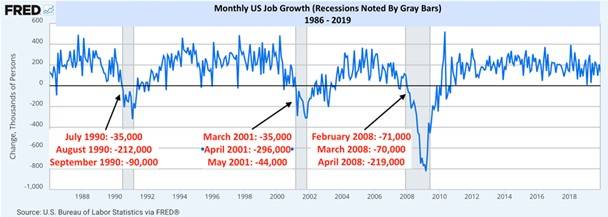
The picture below (courtesy of Datatrek) shows monthly US job gains and losses from 1986 through 2019 and highlights the last three recessions – in 1990, 2001, and 2008 – in grey bars.

The start of each of the last three recessions saw three months of consecutive job losses and in each case one month showed employment levels declining by 200,000 workers (the data is called out in red font).

Source: Datatrek and Federal Reserve Economic Data (FRED)

For the situation today, the economy has created an average of about 15,000 jobs each month over the past half year.

That is a big downshift from the same period a year earlier, when the U.S. was adding 78,000 jobs on average each month, but we are still adding jobs, and it’s enough to keep the unemployment rate steady.

Another window on the employment situation in the US is the weekly initial unemployment claims data produced by the Department of Labor.

The latest release, on April 2 showed that for the week ending March 28, seasonally adjusted initial unemployment claims came in at 202,000 — nearly matching the two-year low of 201,000 set in January. The four-week moving average for initial unemployment claims stands at 207,750.

Today’s labor market statistics are not consistent with an economy on the verge of recession.

Historically, initial claims begin to rise meaningfully — typically above 250,000 to 300,000 on a sustained basis — well before a recession is formally declared.

At current levels, the data show that employers are simply not laying off workers at a pace that signals economic distress.

This is the crucial dynamic: recessions are generally caused not by rising prices alone, but by rising prices combined with rising unemployment. When workers lose their jobs, they cut spending, businesses respond by cutting more jobs, and the cycle feeds on itself.

That negative feedback loop requires a deteriorating labor market to get started — and right now, the labor market is not deteriorating. Employers appear to be choosing to hold on to their workforce even as energy costs rise, absorbing some margin pressure rather than triggering layoffs.

Until weekly unemployment claims begin trending meaningfully higher, the unemployment rate climbs toward 5%, or monthly payroll additions turn consistently negative, the labor market will remain an important shock absorber for the US economy.

What We Are Watching

None of this means the risks are trivial. We are monitoring three variables closely:

  • The duration of Strait of Hormuz disruptions. A prolonged closure — measured in months rather than weeks — would change the calculus significantly. If oil prices average $140 or above into the summer, recession risk rises sharply.
  • Consumer spending. Energy costs are effectively a tax on households, and if they cause consumers to meaningfully pull back on discretionary spending, the resulting slowdown in business activity and hiring could become self-reinforcing.
  • Inflation persistence. If the oil shock pushes headline inflation durably above 4%, the Fed’s room to maneuver shrinks and the stagflation scenario becomes more credible.

The Bottom Line

The Iran war has made 2026 a more difficult year for the U.S. economy. Growth will be slower than it might otherwise have been, inflation will be stickier, and uncertainty is elevated.

But the U.S. enters this challenge with significant structural advantages: energy self-sufficiency, fiscal momentum, an AI-driven investment boom that seems to be durable, and a Federal Reserve that retains meaningful flexibility.

History tells us that oil shocks cause recessions when they are severe, sustained, and met with policy that amplifies rather than cushions the blow. None of those three conditions are clearly in place today.

As I was writing this article, the tagline for the ad campaign for Energizer batteries came to mind: “still going”.

Despite a foreign conflict with wide-ranging implications, including grave concerns by many US consumers and a current sky-high oil price, the US economy is still going.

While the risks to an economic downturn are significantly higher now than they were before February 28, my sense is that the U.S. economy will navigate this shock without entering recession in 2026.

March 2026 Market Recap: Resiliency, Tested

The war in Iran that began in late February continued throughout March. This put downward pressure on stock and bond prices, as investors worried about how long hostilities would last.

The main concern in March was the inflationary impact of significantly higher oil prices.

The price of oil rose between 50 – 65% in March (depending upon which benchmark oil price is referenced). Many Americans are now paying $4 per gallon of gas.

If the war shows no signs of letting up soon, investors’ concerns will shift to the broader impact on the economy, the likelihood of slower growth, the impending hit to company profits, and the possibility of recession.

We are not at an economic crossroads yet.

The US economy has proven resilient in the face of stress in the energy markets in the recent past.

For example, there was no recession in 2022 when oil prices spiked after war broke out in Ukraine. It’s reasonable to expect that this also will be the case in 2026.

Currently, most forecasters still expect the US economy to expand in 2026 (see the following article) and for company profits to rise.

But if hostilities extend well into the spring, US economic resiliency may be tested further, which would likely mean continued challenges for the financial markets.

The month of March closed with a positive tone with stocks rising 3% on the last day of the month as the US administration signaled its willingness to end the military campaign in Iran.

Investors need to keep in mind that the political and military situation is fluid and volatile; that stocks could decline significantly from today’s levels; and that developments in the Middle East will have a strong impact on the financial markets in the months ahead.

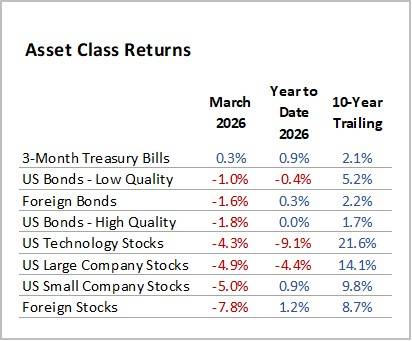
Here are results for March and 2026 Year-to-Date, compared to longer-term annualized returns (10-Year Trailing):

Note: YTD 2026 as of 3/31/2026; Source: Morningstar