Category

Market Updates

December 2023 Market Recap: Old Year Wrap Up

Political polarization, bank failures, recession concerns, terrorist activity and global military conflicts were all troubling issues that weighed on the minds of investors last year. However, financial markets showed resilience, stock markets climbed, and for many investors, portfolio returns turned out to be satisfactory in 2023.

A group of technology-focused companies, commonly referred to as the Magnificent Seven – Alphabet, Amazon, Apple, Meta Platforms, Microsoft, Nvidia, and Tesla – had an extraordinary year, with each stock returning 49% or more. “Mag 7” returns comprised the bulk of the S&P 500 Index’s full year gain of 26%.

To put some perspective around the scale of these companies, the combined market value of the Mag 7 at the end of 2023 was greater than any other single country’s stock market.

Bond returns were less ebullient, but still positive – breaking the trend of two consecutive years of negative returns in 2021 and 2022. The Bloomberg Aggregate Bond Index, a benchmark for bond performance, returned 5.7% in 2023.

Behind the positive bond performance at year-end, there were wild swings in prices and yields throughout the year.

Market participants’ opinions on the likely path of inflation and concerns about how the Federal Reserve might respond with adjustments in short-term interest rate policy were factors behind the bond price swings.

Despite the intra-year volatility, the yield on the 10-Year Treasury note finished 2023 exactly where it started, at 3.88%. Short-term Treasury yields closed the year much higher, though, reflecting the inflation-fighting activity from the Federal Reserve, which included multiple increases in short-term interest rates.

Below is a snapshot of stock and bond returns by quarter for 2023.

RK

November 2023 Market Recap: Talkin’ Turkey

A bird was on the table for many toward the end of the month. The financial markets plated something nice in November, too – allowing investors to talk turkey in a favorable way.

Two economic reports released in November helped stocks and bonds take flight.

At the beginning of the month, the Labor Department’s regular monthly update on the jobs market showed signs of cooling. Less demand in the labor market suggests an easing of upward pressure on wages and points to the possibility of more modest price increases for goods and services.

The October inflation report, released November 14, provided another positive catalyst for both stocks and bonds. Consumer prices rose 3.2% in the year through October, decelerating from the previous month and showing encouraging signs under the surface.

Inflation has come down meaningfully over the past year after hitting a peak in the summer of 2022. The consumer price report provided further evidence that inflation is headed in the right direction.

In November, the S&P 500 Index of large company US stocks had its highest monthly return in 2023, rising by 9.1%. Foreign stocks also participated in the celebration, with the MSCI EAFE Index rising by 8.2%. Bonds realized their best monthly gain since 1985, as the Bloomberg US Aggregate bond index returned 4.6%.

Year-to-date, US stocks gained 20.7% through the end of November, and foreign stocks have returned 12.4%. Bonds have staged a comeback and were in the black a week before Black Friday. Through the end of November bonds had returned 1.9% year-to-date.

RK

October 2023 Market Recap: Interest Rate Specter

The unrelenting increase in Treasury bond yields and the stubborn inflation situation spooked the stock market in October. Hostilities in the Middle East and the fractious political environment in the US have also heightened investors’ concerns.

The negative financial market trends from August and September continued through most of October.

Stock returns fell again, further eroding a strong advance during the first half of 2023. The S&P 500 Index, which tracks the largest stocks in the US, slid into correction territory during the last week of the month (a decline of more than 10% from a recent peak) before ending the month on a more positive tone.

For October, the S&P 500 index of large company US stocks declined by 2.1%. Foreign stocks declined by 2.9%. Bonds took a beating last month, too: the Bloomberg US Aggregate Bond Index fell by 1.6%.

Below is a Summary of October Returns.

Year-to-date, stocks are holding onto gains. As of October 31, US stocks gained 10.6% and foreign stocks were up 3.8%. Bond returns year-to-date remain in the red: through the end of October, the major US bond market index declined by 2.6%.

RK

September 2023 Market Recap: 3 Out of 4 Ain’t Bad

Following a punishing first nine months of 2022, stocks had been on a roll, with prices rising for three quarters in a row: Q4-2022, Q1-2023, and Q2-2023. But a swoon in August and September ended the streak.

The recent stock market decline ranged from 2% to 5% during the third quarter, depending on which index you choose to follow. To paraphrase Michael Lee Aday (aka Meat Loaf), three out of four ain’t bad.

Intermediate and long maturity bond yields climbed significantly during the quarter, with the 10-year Treasury yield reaching its highest level in sixteen years toward the end of September, at 4.6%. Higher yields translate to lower prices for bonds.

In fact, if interest rates continue to rise into the end of 2023, investors may witness something that hasn’t happened before: three consecutive calendar years of negative returns for US Treasury bonds.

The US dollar bucked the recent negative trend and reached new highs for 2023 in September. Compared to other major currencies, the US dollar appreciated by about 3% in the third quarter.

Dollar strength places additional pressure on foreign stocks, because for US-based investors, the total return of a foreign investments also incorporates changes in the value of US dollar. Foreign stocks declined by 4.9% during the third quarter.

Oil has also bucked the recent negative price trend affecting stocks and bonds. For more on developments in the oil market, see the next section.

Below is a summary of quarterly returns for stocks and bonds as of September 30.

What to make of the recent market fluctuations?

The ebb and flow of stock and bond prices (volatility) is a normal part of investing. In most calendar years, we see significant intra-year drops: for stocks, on average, the intra-year drop is about 14%, and for bonds, about 3.5%. Yet most years still end in positive territory for stocks and bonds.

A key principle of successful investing: keep market volatility in perspective. This means not just focusing on recent performance, but on your broader goals and objectives, and on the long-term investment returns of your portfolio.

-RK

August 2023 Market Recap: Summer Slump

The financial markets entered a summer slump in August.

The US government debt rating downgrade by Fitch Ratings was the initial catalyst for higher Treasury yields (and lower prices) early in the month. Minutes from the Federal Reserve’s July meeting, where interest rate policy is set, were released in mid-August and supported the narrative that central bank officials won’t be in a rush to bring rates down any time soon.

Market participants’ interpretation of the Fed’s interest rate policy kept the pressure on bond yields and hurt returns.

For August, the Bloomberg US Aggregate Bond Index fell by 0.63%. Through the end of August, the US bond market return year-to-date was still positive at 1.6%.

Higher bond yields took some of the summer heat out of stocks. For the month of August, the S&P 500 index of large company US stocks fell by 1.63%. Foreign stocks sold off by 3.9%.

Year-to-date, though, stocks are still significantly in the black. US stocks gained 18.7% and foreign stocks were up by 10.9% as of August 31.

Below is a summary of August returns.

RK

July 2023 Market Recap: Stocks Heat Up

Stock market heat stayed high in July. Better-than-expected economic growth, declining inflation, and receding recession fears were supportive of the “new bull” which began last month.

For the month of July, the S&P 500 index of large company US stocks rose by 3.3%. Foreign stocks climbed by 2.7%. Year-to-date as of July 31, US stocks gained 20.6% and foreign stocks were up by 12.6%

However, stronger-than-expected economic growth, along with the possibility of interest rates needing to stay higher for longer to cool inflation, put downward pressure on the bond markets.

The Bloomberg US Aggregate Bond Index fell slightly last month (less than 0.1%). Through the end of July, the bond market return year-to-date was 2.25%.

Below is a summary of July returns.

RK

June 2023 Market Recap: Sheepish Bull

Sheepishly, a bull emerged in June.

While investors’ worrying about the next economic downturn may give the National Pastime a run for its money, so far this year falling stock markets have proven to be “so 2022”.

A bull market occurs when a stock index rises more than 20% from its most recent low. For US stocks, the recent low point occurred in October. The recovery, which continued during the second quarter of 2023, means US large-company stocks have attained bull status.

For many investors, the mood may feel more cautiously optimistic than wildly celebratory.

Significant ground has been regained, with US large-company stocks up nearly 17% this year. Even so, stocks are still lower today than when compared to the all-time peak in early January 2022, due to the 18% downdraft experienced last year.

Bonds are also in the black in 2023, but the previous three months proved more challenging, as interest rates moved higher (and bond prices declined). The Bloomberg US Aggregate Bond Index fell by 0.94% in the quarter ended June 30. Year-to-date, bonds returned 2.25%.

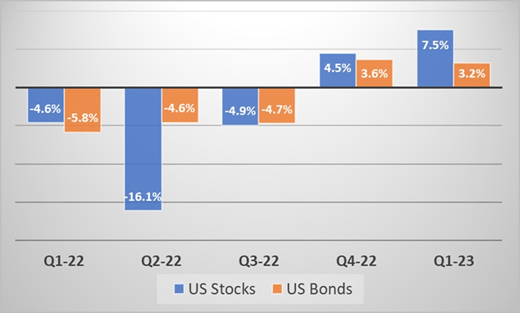
Here’s a quarterly stock and bond returns recap, going back to the beginning of 2022.

RK

May 2023 Market Recap: Stalled Momentum

Financial market momentum stalled as the threat of a default on US government obligations intensified in May.

An agreement by Congressional leaders and the President to raise the debt ceiling until 2025 addressed default risk, allowing market participants to breathe easier at the end of May.

For the month of May, the S&P 500 index of large company US stocks rose by 0.5%. Foreign stocks had a tougher go and declined by 4%. Year-to-date as of May 31, US stocks gained 9.7% and foreign stocks were up by 7.7%

Bonds lost some ground as interest rates rose. The Bloomberg US Aggregate Bond Index fell by 1.1% last month. Through the end of May, bonds returned 2.6%.

Below is a summary of May returns.

RK

April 2023 Recap: Stocks’ Sunny Outlook

Despite April showers, the financial markets maintained their sunny outlook.

For the month of April, the S&P 500 index of large company US stocks rose by 1.6%. Foreign stocks climbed higher still, up by 2.9%, helped by a US dollar that weakened against other major currencies. Year-to-date as of April 30, US stocks gained 9.2% and foreign stocks were up by 12.2%

Bonds rose along with stocks. The Bloomberg US Aggregate Bond Index rose by 0.6% last month. Through the end of April, the bond market rally in 2023 translated to a gain of 4.2%.

Below is a summary of April returns.

RK

March 2023 Recap: Two Good Quarters

Despite recent problems in the banking sector, stocks started the year on a strong note.

The US benchmark S&P 500 gained 7.5% in the first quarter of 2023. Foreign stocks also climbed, with the EAFE Index (Europe, Australasia and the Far East) up 9%. Technology stocks had a stellar quarter, rising by nearly 21%. Bank stocks were on the other end of the spectrum, falling by more than 17%.

And bonds participated in the rally, too. A near half-of-one-percentage-point drop in intermediate-term interest rates—despite short-term rate increases by the Federal Reserve in January and March—translated to a gain of 3.2% for the Bloomberg Aggregate Bond Index, a key gauge of the US bond market.

Here’s a recap of stock and bond performance by quarter, going back to the beginning of last year.

RK