Category

War with Iran: What It Means for Investors – and What to Do

As we absorb the events unfolding since the United States and Israel launched joint military operations against Iran on February 28, I want to begin by acknowledging what I suspect many of you are feeling. For those of us who believe in diplomacy, value restraint, and care deeply about the human costs of armed conflict, the current trajectory of U.S. foreign policy is profoundly troubling — and I share those concerns.

However, a fuller discussion of the moral and humanitarian dimensions of this conflict falls outside the scope of this letter. My purpose here is a narrower one: to examine the military and political landscape as it stands now and to assess the risks this conflict may pose to the economy, the financial markets, and your financial plans.

This letter focuses on:

1.     An assessment of the current situation

2.     What to monitor going forward

3.     Recent financial market and economic developments

4.     Geopolitical uncertainty and stocks

5.     What this means for your financial plan

1: Current Situation Assessed – The Convoluted Case For War

One source that I found particularly helpful was the March 6 podcast of The Dispatch entitled “The Convoluted Case for War with Iran.” The Dispatch is a non-partisan but conservatively oriented show covering US politics, policy, and culture.

Host Steve Hayes was former editor-in-chief of The Weekly Standard. Co-host Jonah Goldberg is a conservative journalist and fellow at the American Enterprise Institute. Guests Mike Nelson and David French are both ex-US military officers.

All commentators offered context for and criticism of US actions in Iran. Below is a summary of the podcast.

Core Questions About the Conflict

The conversation is organized around two central questions: (1) Why is the United States engaging in military action against Iran at all? and (2) Why did the administration choose to act at this specific moment?

A secondary theme throughout the episode is whether the administration has adequately explained its strategy and end goals to Congress and the public.

Substantive Case for Action (“Why?”)

The panel broadly agrees that, on substance, a case for military action against Iran is not difficult to articulate. Iran is described as a long-standing adversary of the United States, engaged for decades in hostile activity through proxies, regional destabilization, and attacks that have resulted in American casualties.

Participants emphasize that Iran’s ideological hostility toward the U.S. and Israel, combined with nuclear ambitions, has long placed it in a distinct category among U.S. adversaries. On this point, there is general consensus among the panelists that Iran’s behavior over many years provides a plausible justification for the use of force.

Timing of the Conflict (“Why Now?”)

The more contested issue is timing. Participants argue that the current moment presents a strategic window: Iran’s regional proxy network has been weakened, its air defenses and military infrastructure have been degraded, and traditional deterrence mechanisms appear less effective than in prior years.

From this perspective, acting now may be less costly than acting later, when Iran could rebuild capabilities or enhance deterrence. However, while the panel finds this reasoning coherent, they repeatedly note that it has not been clearly or consistently articulated by the administration itself.

Messaging and Public Explanation

A major theme of the episode is criticism of the US Administration’s messaging. Participants express concern that multiple, shifting explanations have been offered for the war, sometimes inconsistently and retroactively.

This, they argue, undermines public confidence even where valid strategic reasons exist. The discussion highlights the risk that unclear or contradictory explanations make it harder for the public to understand the objectives of the campaign or assess its success.

Tactical Success vs. Strategic Outcome

The panel generally agrees that, from a tactical and operational standpoint, early military actions appear effective in degrading Iranian capabilities. However, they stress that tactical success does not automatically translate into strategic success.

A recurring concern is the absence of clearly defined end goals. Without explicit criteria for success — such as regime change, deterrence, or long-term containment — the administration retains broad flexibility to declare victory, but at the cost of strategic clarity.

Long-Term Risks and Historical Analogies

One participant raises concern that the campaign resembles a strategy of periodically weakening an adversary without fundamentally resolving the underlying conflict. Historical analogies are drawn to past situations where temporary degradation of hostile regimes delayed, rather than prevented, future retaliation.

The panel cautions that Iran’s willingness to absorb losses and respond asymmetrically could mean that consequences emerge months or years later, potentially through terrorism or proxy activity rather than direct confrontation.

Constitutional and Governance Considerations

Beyond military strategy, participants emphasize that bypassing Congress and failing to prepare the public is not merely procedural. They argue that democratic legitimacy and public understanding are essential for sustaining military action and managing long-term consequences.

The 4–5 Week Policy Outlook

The episode concludes with host Stephen Hayes noting that President Trump has suggested the operation could last four to five weeks and posing a forward-looking question: what outcomes would be encouraging, and what warning signs might indicate escalation or failure?

A more optimistic outlook would feature a short-duration operation, limited regional escalation, sustained degradation of Iranian capabilities, and a clear conclusion to hostilities.

A more concerning outlook would involve unclear objectives, prolonged engagement, retaliatory attacks beyond the immediate conflict, or a cycle of repeated military action without durable resolution.

Overall Takeaway

From a markets and policy-risk perspective, the episode suggests that uncertainty and clarity matter at least as much as military outcomes. Tactical success alone does not eliminate risk; how policymakers define objectives, communicate progress, and conclude operations will likely shape market responses more than any single military development.

2: What To Monitor Going Forward

This checklist identifies indicators we may monitor to help contextualize events as they unfold, as well as the related risks and uncertainties.

  • Duration and Scope of Military Operations – Why it matters: Duration clarity often affects markets and prices more than initial military action.
  • U.S. Policy Clarity and Governance Signals – Why it matters: Policy predictability and institutional process influence confidence and risk assessment.
  • Regional Escalation Indicators – Why it matters: Indirect escalation can affect markets even without direct U.S.–Iran confrontation
  • Energy Market Sensitivities – Why it matters: Energy prices can influence inflation expectations and broader macro assumptions.
  • Retaliatory or Asymmetric Risk Signals – Why it matters: These risks often emerge later and are harder for markets to price in advance.
  • Market Behavior vs. Headlines – Why it matters: Differentiating noise from signal helps assess whether risk is being repriced by financial assets or absorbed.
  • International Diplomatic Activity – Why it matters: Diplomatic engagement can materially alter risk trajectories without military change.
  • Domestic Political Spillovers – Why it matters: Domestic politics can influence policy durability and future decision-making.

3: Recent Financial Market and Economic Developments

The initial market reaction to Operation Epic Fury was surprisingly muted. On the first trading day after the February 28 strikes, the S&P 500 closed essentially flat. That composure didn’t last.

As the conflict expanded through the week — with Iranian retaliatory strikes hitting Gulf state infrastructure, the Strait of Hormuz effectively closing to commercial shipping, and oil storage facilities coming under attack — investor sentiment shifted considerably.

By week’s end, market participants were no longer treating this as a brief geopolitical tremor but were instead pricing in the possibility of sustained economic disruption. US large company stocks declined by 2% in the first week of March; foreign stocks slid by nearly 7%; and US investment grade bonds were down by about 1%.

Oil and Energy: The Central Transmission Mechanism

Oil prices have been the most direct channel through which the conflict is affecting markets. Brent crude had risen roughly 27% since the strikes began, and traded around $93 per barrel as of Friday, March 6. The oil price rise continued on Monday, with Brent crude moving above $100 per barrel.

The concern extends well beyond Iran’s own output of approximately 3 million barrels per day (roughly 4–5% of global supply). The Strait of Hormuz, through which passes about a fifth of the world’s oil and liquefied natural gas, has been effectively closed due to threats and the withdrawal of cargo insurers.

Approximately 20 million barrels per day flow through the region — representing about 20% of global demand — and there is simply no way to replace that volume from other sources if the disruption persists.

The scenario analysis matters here. According to JP Morgan’s energy research team, current oil prices reflect markets pricing in a Strait of Hormuz closure lasting 3–4 weeks, but not longer.

If the strait were to reopen tomorrow, oil would likely fall back to around $65 per barrel, since the market was well supplied before the war.

If hostilities extend beyond a month and the strait remains closed, the price of oil could stay well above $100 per barrel for some time. Each $10 increase in crude oil prices adds an estimated 0.2 to 0.4 percentage points to the inflation rate.

Goldman Sachs has warned that prices could reach $150 per barrel — all-time highs — if the conflict continues through the end of March.

The disruption extends beyond crude oil. Natural gas facilities in the Gulf, such as those in Qatar, have been taking gas out of their systems to limit damage from potential strikes. Even after hostilities end, it will take time for these facilities to ramp back up, creating inflationary pressure particularly for Asian markets that depend on Middle Eastern gas.

Refinery activity in some Gulf states has been reduced by 20–30%. Shipping rates have skyrocketed: the daily charter rate for a very large crude carrier, which normally runs around $50,000, reached $430,000 per day at the start of the week. These lag effects mean that even a swift resolution to the conflict would not immediately normalize energy markets.

For U.S. consumers, the most visible effect is at the gas pump. The average price of gasoline rose to approximately $3.25 per gallon as of March 6, up $0.27 in a single week. (The average price of gasoline moved even higher on Monday, March 9 – toward $3.50 per gallon).

If gasoline prices climb to $3.50 or $4.00 per gallon and stay there, it will squeeze lower- and moderate-income consumers and weigh on consumer spending — not enough to push the economy into recession on its own, but enough to be felt.

A Structural Difference: The U.S. as Energy Exporter

One important distinction from prior oil shocks — and a reason for cautious optimism — is that the United States is now a net energy exporter and the world’s largest oil producer.

In previous conflicts (1979, 1990, 2008), every additional dollar spent on oil was flowing overseas to foreign producers. Today, much of that spending stays in the domestic economy, benefiting U.S. producers.

This is a meaningful structural change that limits the drag on U.S. growth relative to prior energy shocks, though it does not eliminate the inflationary impact.

Winners and Losers: Rotation Accelerates

The war has reinforced and accelerated a rotation in market leadership that was already underway.

Value and dividend-oriented stocks have continued to outperform growth stocks, a pattern consistent with historical precedent: Morgan Stanley research has found that value and dividend yield tend to outperform in the month following geopolitical shocks that push oil prices higher. Energy companies and defense contractors, which populate both categories, have benefited directly.

Internationally, the damage has been more severe. Energy-importing economies — Europe, Japan, and South Korea — have been hit hard.

South Korea’s market fell 16% in the past week, and international stocks broadly have declined roughly 6–7% from their pre-war highs, a pattern similar to the early days of Russia’s 2022 invasion of Ukraine. The dollar has strengthened as the U.S., with its energy exporter status, is relatively better positioned than major importers.

Within the U.S. market, a notable pattern has emerged: the stocks that had risen the most before the war started have fallen the most since, while previous laggards have held up better or even gained ground. This reflects both a reassessment of economic winners and losers and a reduction in borrowing by institutional investors.

The Economic Outlook

Before the strikes, the global economy was accelerating and expanding faster than in 2025. The U.S. economy entered this period on relatively solid footing: consumer and business spending had been robust, asset prices had boosted household wealth, and there were early signs that the long manufacturing slump might be easing.

JP Morgan’s base case for U.S. GDP growth is approximately 2% for 2026, though the quarterly path is uneven: a softer first quarter (around 1% annualized, reflecting weather effects and delayed tax refunds) followed by a pickup to 2–3% growth in the second and third quarters, then moderating again in the fourth quarter. This base case assumes a relatively short conflict.

On inflation, the picture is more nuanced. JP Morgan expects inflation to rise above 3% by June, driven primarily by energy prices, then to decline as oil prices moderate — potentially returning to 2% by year-end and below 2% by 2027. But this path depends heavily on the duration and scope of the conflict. A prolonged disruption to energy markets would make this trajectory considerably less favorable.

The Fed’s Dilemma

The conflict complicates the Federal Reserve’s path forward. Before the war, markets expected multiple short-term interest rate reductions (cuts) in 2026. Now, betting markets show the odds of multiple cuts falling, with one cut or no cuts becoming more likely.

The concern is straightforward: rising oil prices feed into inflation, and the Fed may feel it cannot cut rates into an inflationary environment — even if the economy softens. This creates a potential stagflationary dynamic that, while not the base case, is now being actively discussed by economic forecasters.

The Fiscal Backdrop

This conflict arrives against a fiscal backdrop that offers less cushion than in prior military engagements. U.S. national debt stands at approximately $33 trillion — more than $250,000 per household.

The Congressional Budget Office projected a $1.9 trillion deficit for 2026 before accounting for war costs, which are currently estimated at $50–100 billion but subject to revision.

How the war will be funded remains an open question. All of this adds to overall government borrowing and creates a headwind for fixed income markets – which reduces the likelihood that Treasury bond yields will decline.

What This Means for Investors Today

As JP Morgan’s chief global strategist David Kelly put it on a recent client call: the message in this environment is to diversify against unknown risks. The underlying U.S. economy is not in danger of recession from this conflict alone, and markets so far have reflected more caution than panic.

But the range of possible outcomes is wide, and tail risks — whether from a prolonged conflict, an escalation beyond the current theater, or unexpected second-order effects — are elevated.

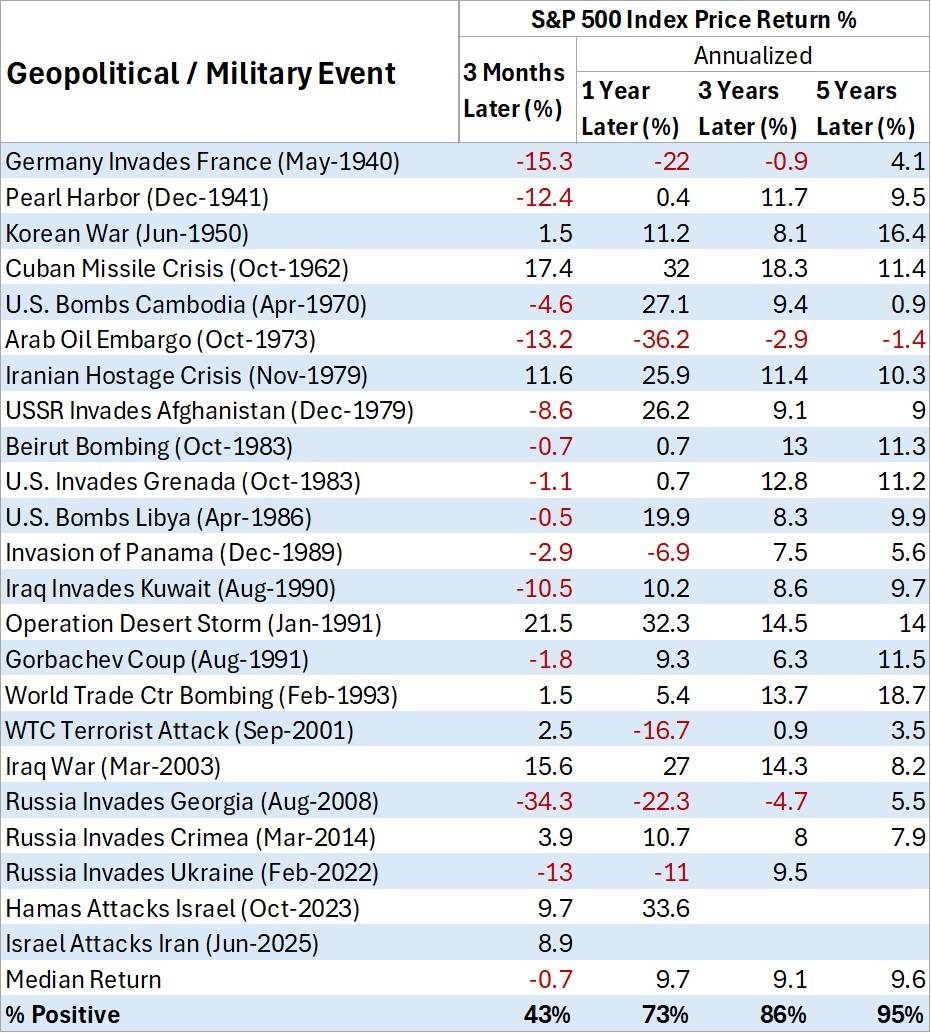
As discussed in the next section, geopolitical shocks have historically been poor reasons to abandon a long-term investment strategy. The S&P 500 has a median return of 9.7% in the year following major geopolitical disruptions, according to research by the Hartford Funds (see table below).

But the key variables are duration and scope: a contained, short-duration conflict is far more manageable for markets than a prolonged engagement with escalating regional consequences. This is precisely why the signposts outlined in Section 2 matter so much — and why we will continue to monitor them closely on your behalf.

4: What Geopolitical Uncertainty Means for the Stock Market

Geopolitical uncertainty can cause short-term market volatility, but when faced with disruptive episodes in the past, the stock market has been resilient.

In fact, as the table below shows, stocks generated positive performance one year after a geopolitical / military event 73% of the time, considering twenty-two instances since World War II.

Source: Hartford Funds

And the longer the investment time frame, the more likely the positive return. Five years after a major geopolitical / military event, in all but one instance, the stock market was higher.

The one case where stocks were still struggling five years after the start of an event was the Arab Oil Embargo of October 1973. The reason why stocks had such a hard time in the mid-1970s had to do with both cyclical issues (long recession) and structural issues, including: price controls; the influence of unions in the labor market; and dependence on foreign oil.

Today, the structural foundation of the US economy is different. Unlike in the 1970s, the US is now the world’s largest producer of oil and natural gas. And the US economy is far more energy efficient today, so a spike in oil prices can’t “break” the US economy as easily as it once did.

Also, the Federal Reserve has a long history of anchoring inflation expectations, which would help prevent a 1970s style inflationary wage-price spiral.

While we can’t completely rule out a scenario for the stock market that parallels the mid-1970’s, I would assign this type of outcome a low likelihood.

5: What This Means for Your Financial Plan

While the current conflict introduces real uncertainty into markets, we do not believe it is likely to fundamentally alter the financial plans of most U.S.-based investors. Here is why — and what, if anything, you should be thinking about.

Your plan was built for environments like this

A well-constructed financial plan accounts for the reality that markets will periodically experience shocks — whether from geopolitical events, recessions, policy surprises, or other disruptions.

If your portfolio is appropriately diversified and aligned with your time horizon and risk tolerance, it is already designed to absorb periods of elevated volatility. The historical data above reinforces this: markets have recovered from the vast majority of armed conflicts, and the longer the time frame, the more reliable that pattern has been.

The U.S. economy has structural buffers

As discussed in Section 3, the United States is now a net energy exporter — a meaningful change from prior oil shocks that sent dollars overseas and deepened domestic downturns.

The economy entered this period with solid consumer balance sheets, strong employment, and rising asset values.

While higher energy prices will create headwinds for some households and sectors, the base case among major forecasters remains positive GDP growth for 2026. This is not the kind of backdrop that typically derails long-term financial plans.

Short-term volatility is not the same as long-term risk

It is natural to feel uneasy when markets are volatile and the news is alarming. But the decisions that matter most for your financial future — your savings rate, your asset allocation, your tax planning, your withdrawal strategy — are driven by factors that operate over years and decades, not days and weeks.

Reacting to short-term market moves by selling equities or shifting to cash has historically been far more damaging to long-term outcomes than the events that prompted the reaction.

That said, this is a reasonable moment to review — not overhaul — your plan. There are a few areas where a check-in may be worthwhile:

  • Cash reserves and liquidity. If you are retired or approaching retirement, confirm that you have adequate cash and short-term reserves to cover near-term spending needs without being forced to sell into a down market. A general guideline is about 12-24 months of spending in liquid, low-volatility holdings (which can include savings in bank accounts in addition to cash and short-term bond fund holdings in investment accounts).
  • Rebalancing opportunities. Market dislocations can push portfolios away from target allocations. If equities have declined meaningfully relative to bonds or other holdings, rebalancing back toward your target — essentially buying into weakness — is a disciplined way to take advantage of volatility.
  • Tax-loss harvesting. For taxable accounts, market declines can create opportunities to realize losses that offset gains elsewhere in the portfolio, improving after-tax returns without changing your overall investment posture.
  • Emotional preparedness. This may be the most important item on the list. If the current environment is causing you significant stress about your portfolio, that itself is useful information. It may indicate that your allocation carries more risk than you are truly comfortable with — and a calm, deliberate adjustment now is far better than a panicked one during a deeper downturn.

Our Commitment

We are monitoring this situation closely and will continue to share our assessment as events develop. If you have questions about how the conflict may affect your specific circumstances, or if you would like to review any aspect of your financial plan, please do not hesitate to reach out. That is exactly what we are here for.

February 2026 Market Recap: Foreign Markets Lead the Pack in February

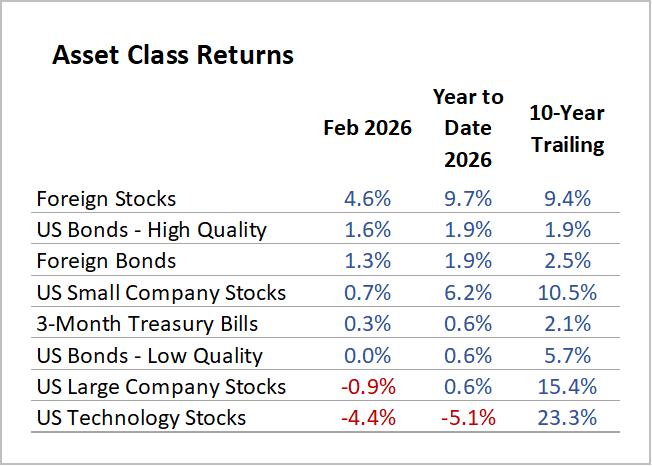
The big market story for the year through February has been foreign stock market leadership. Foreign stocks almost matched their excellent January performance (4.9%) in February (4.6%). Currency was not a significant driver of dollar-based returns in either period.

In February, US large company stocks slipped, declining by 0.9%, compared to January’s positive return of 1.5%.

Within US equities, the rotation out of large company US technology stocks has shifted from January’s move into small company stocks to February’s preference for non-technology large company US stocks.

The bond markets continued to show positive results. Intermediate- and long-term Treasury bond yields declined over the course of February. The 10-Year Treasury bond yield actually fell below 4% for the first time in several months. The benchmark for US Investment Grade Bonds returned 1.6% in February.

Here are results for February and 2026 Year-to-Date, compared to longer-term annualized returns (10-Year Trailing):

Note: YTD 2026 as of 2/28/2026; Source: Morningstar

Checklist for My Family

Sally Balch Hurme, is an elder law attorney and longtime expert on aging, family caregiving, and end‑of‑life planning. She has spent decades working with families on issues such as long‑term care, estate planning, and decision‑making during medical crises, and she has also served in advisory and educational roles related to aging and public policy.

In Checklist for My Family: A Guide to My History, Financial Plans, and Final Wishes, Hurme delivers a practical, compassionate resource designed to help individuals organize the information their loved ones will need in the event of illness, incapacity, or death.

The book’s strength lies in its checklist format, which walks readers through topics that are often postponed because they feel overwhelming or uncomfortable. Hurme covers far more than just finances.

The guide prompts readers to record personal history, key contacts, legal documents, financial accounts, insurance policies, digital assets, medical preferences, and final wishes.

By breaking these subjects into clear, manageable sections, the book reduces the likelihood that important details are forgotten or left scattered across files, emails, and conversations.

This book is especially useful because it is about preparing families to act with clarity and confidence when it matters most. For spouses, adult children, and other caregivers, having this information in one place can significantly reduce stress, conflict, and uncertainty during already emotional times.

For the person completing the checklist, the process itself often leads to better conversations and more intentional planning. In short, Checklist for My Family is a valuable complement to professional financial and estate planning—helping ensure that a well‑designed plan can actually be carried out smoothly by the people you care about most.

When Should You Claim Social Security?

Executive Summary

Social Security is one of the few sources of guaranteed, inflation-adjusted income available in retirement, so the decision of when to claim is critical for building a resilient income plan—especially for couples planning for a potentially long retirement. In many households, the benefit that matters most is the one that may later become the survivor benefit, which is why coordinated strategies often differ between partners.

This article explains the key trade-offs (income now vs. higher income later), how portfolio and market risks can affect the ‘bridge’ years, and common myths to avoid, with brief case studies showing why strategies can differ for earnings-gap couples versus near-equal earners.

The article draws from a paper by Brian Allevia, a research analyst at the Social Security Administration, recently published in the Journal of Financial Planning, as well as articles from practitioners Edward McQuarrie, William Bernstein, Derek Tharp, and Michael Kitces.

A Deceptively Simple Question

One of the most common questions we hear from clients approaching retirement is deceptively simple: “When should we start Social Security?”

If you’ve ever tried to answer that question by searching online, you already know the problem: the internet offers confident advice in every direction. “Always claim at 62.” “Always wait until 70.” “Just calculate your break-even age.”

The truth is more nuanced—especially for couples.

Social Security is a unique component of the retirement plan. For most households, it’s the only source of income that is (1) guaranteed for life and (2) inflation-adjusted. That combination makes it a foundational building block for a retirement that could last 25, 30, or even 35+ years.

A more appropriate question to start with may be “how long might retirement last?”

When people debate Social Security claiming, they often frame it as an investment decision: “Will I get my money back if I delay?” But the bigger issue for many retirees is longevity risk—the risk that you live longer than expected and need steady income far into the future.

Delaying Social Security can be valuable because it increases the amount of inflation-adjusted income you cannot outlive, strengthening the “income floor” that supports your lifestyle even if markets disappoint or inflation runs higher than planned.

And this matters even more for couples: while any one person may or may not live into their 90s, the odds that at least one spouse/partner does so are meaningfully higher. That’s one reason delaying can look especially attractive for couples—because the higher benefit may be paid for as long as either spouse is alive (through survivor benefits).

Income Now vs. Higher Check Later (For Life)

You can generally claim Social Security as early as 62 or as late as 70. Claiming early means you receive more checks sooner, but at a permanently reduced monthly amount. Waiting means fewer checks at first, but a higher monthly benefit for life.

Example (illustrative): A retiree might receive roughly $2,100/month at age 62, $3,000/month at full retirement age (around 67), or $3,720/month at age 70.

A quick note on “break-even”: People often ask for the “break-even age”—the point when total dollars received by delaying exceed total dollars received by claiming early. Break-even analysis can be a helpful reference, but it’s incomplete.

The breakeven period depends on inflation and the returns you assume you could earn if you claimed earlier and invested the payments (or avoided withdrawals).

More importantly, break-even analysis often misses the real retirement planning goal: building an income plan that can support you if you live a long life—and for couples, supporting the surviving spouse as well.

Why Couples are Different: Not Two Separate Decisions

For married couples, Social Security is rarely just “two independent choices.” It’s a household decision.

Survivor benefits change everything: When one spouse dies, the surviving spouse generally keeps the higher of the two benefits. That means the higher earner’s claiming decision often determines the survivor’s long-term income.

This is why many studies and planning frameworks often find that for “traditional” couples—where one spouse clearly earned more—the strategy that often makes sense is: higher earner delays (frequently toward age 70) and lower earner claims earlier.

Complexity warning: Couples can face thousands of claiming combinations once you account for worker benefits, spousal benefits, and survivor benefits.

As more couples reach retirement with similar earnings histories, the “standard” strategy can shift—sometimes dramatically—based on age differences and earnings ratios.

Why One-Size-Fits-All Advice Doesn’t Work – Two Case Studies

Case Study #1: A classic earnings-gap couple (where the familiar approach often fits)

John is 66 and Meghan is 64. John has the stronger earnings record and expects about $3,200/month at full retirement age, while Meghan expects about $1,600/month (illustrative).

They asked: “Should we both wait until 70 so we get the biggest checks?”

For John and Meghan, the survivor benefit is the center of the analysis. If John delays, his benefit increases—and if he dies first, Meghan can step up to that higher amount as her survivor benefit. The result is often a meaningful increase in the survivor’s lifetime inflation-adjusted income.

A coordinated strategy that frequently fits this earnings-gap structure is: John (higher earner) delays (often toward or at age 70) and Meghan (lower earner) claims earlier (sometimes at 62 or around full retirement age depending on cash flow and goals).

Case Study #2: Near-equal earners (where the strategy flips relative to earnings)

Jane is 66 and Lucy is 68. They both worked full careers and have very similar benefits, with Jane’s record slightly higher: Jane ≈ $3,050/month at full retirement age and Lucy ≈ $2,950/month.

They assumed: “Jane is the higher earner, so Jane should delay to 70.”

In near-equal earner couples, the survivor-benefit advantage of delaying the “higher” record can be smaller because the two benefits are already close.

In these cases, research suggests timing and age order can matter more—specifically, the advantage of having the spouse who can reach age 70 first be the one who delays, so the household begins a maximized benefit sooner while maintaining survivor protection.

So for Jane and Lucy, a coordinated approach can look like this: Lucy (older, slightly lower earner) delays to 70, while Jane (younger, slightly higher earner) claims earlier (for example, around full retirement age).

That’s the flip relative to earnings: the lower earner delays and the higher earner claims earlier. As more couples retire with similar earnings histories, this nuance becomes increasingly important—and it’s why we avoid blanket rules-of-thumb.

The Portfolio Question: Can You Fund the Bridge Years Safely?

Claiming decisions don’t happen in isolation. They interact with your investment portfolio.

If you delay Social Security, you typically rely more on savings early in retirement, then rely less later because Social Security covers more of your ongoing expenses. That can be a great trade—if the bridge is affordable and well-managed.

Reasons delaying can be attractive: Delaying can increase the inflation-adjusted income floor, reducing the risk of running short later in life—especially if markets disappoint or inflation rises more than expected.

Reasons delaying may be less attractive for some households: Delaying can increase sequence-of-returns risk if markets decline early and you’re forced to take larger withdrawals while waiting.

Bottom line: The decision often comes down to how much guaranteed, inflation-adjusted income you need to feel secure—and whether the bridge years can be funded without undue risk.

Behavioral Realities: the Best Strategy Is Also the One You’ll Follow

There’s also a human element here.

Some retirees are more comfortable spending from a “paycheck” than drawing down investments. In practice, delaying Social Security can sometimes lead to underspending and reduced enjoyment, particularly early in retirement.

At the same time, delaying the right benefit—especially for couples where survivor benefits matter—can be an effective way to protect the household later in life, when flexibility is lower and the consequences of reduced income can be more severe.

Our goal is to find the strategy that balances both: enjoying the early years of retirement and protecting long-term income security.

A Practical Framework for Evaluating Claiming Decisions

When we help clients decide, we typically walk through four questions:

  1. Which benefit is most important for survivor planning? If one benefit is clearly higher, its claiming age often has outsized impact because it can become the survivor benefit.
  2. What does longevity look like for your household? We consider family history, health, and the realistic possibility that one spouse lives well into their 90s.
  3. How will we fund the bridge years, and what is the market risk? We assess the portfolio withdrawal plan and the potential impact of early market declines (sequence risk).
  4. What strategy will you feel comfortable sticking with? A plan that creates anxiety is less likely to be followed—so preferences and spending comfort matter.

Common Social Security Myths (and What Really Matters)

Over the years, we’ve noticed that many Social Security decisions are driven by rules of thumb that sound reasonable—but don’t always hold up when applied to real households. These myths persist because Social Security rules are complex, and it’s tempting to reduce an important lifetime decision to a simple slogan.

Myth #1: “I should claim as soon as I break even.” Reality: Break-even analysis focuses on total dollars received, but it often ignores longevity, inflation, market volatility, and survivor income needs.

Myth #2: “If I die early, delaying was a mistake.” Reality: This treats Social Security like an investment rather than what it often represents in a plan: longevity insurance.

Myth #3: “For couples, both spouses should always delay.” Reality: In reality, it often does not pay for both spouses to delay.

Myth #4: “The higher earner should always be the one who delays.” Reality: Often true in earnings-gap couples—but not always. In near-equal earner couples, the strategy can flip relative to earnings.

Myth #5: “Delaying is always better than investing the money.” Reality: Portfolios carry risk and inflation is unpredictable. Whether delaying makes sense depends on portfolio size, withdrawal needs, and sequence risk.

Myth #6: “There’s a single right claiming age for everyone.” Reality: Claiming decisions vary by health, longevity, earnings history, household dynamics, portfolio structure, and preferences.

Bringing It All Together

Taken together, these myths point to a simple conclusion: Social Security claiming is not about finding a perfect age—it’s about building a resilient retirement income plan.

For some households, that means delaying at least one benefit to protect against a long life and rising costs. For others, it means coordinating benefits to support early-retirement cash flow without sacrificing long-term security.

At Moore Financial Advisors, our goal is not to push clients toward early or late claiming by default. Our goal is to help you understand the trade-offs, coordinate benefits thoughtfully, and choose a strategy that still works if retirement lasts longer than expected or markets don’t cooperate.

Social Security is one of the few financial decisions that can permanently raise—or lower—the income you can never outlive. When coordinated carefully, it can play a powerful role in supporting both your lifestyle today and your security far into the future.

If you’re approaching this decision, we encourage you to reach out. A well-designed Social Security strategy is one of the most valuable planning opportunities available—and one that deserves careful attention.

Market Update January 2026: AI Anxiety

For the past three years, developments related to Artificial Intelligence (AI) have captivated investors. Stocks of large technology companies associated with AI have done very well, and the biggest of the bunch have generally performed best.

Recently, however, stock market sentiment has shifted from AI excitement to AI anxiety.

The source of this anxiety is twofold, stemming from:

  1. Costs of Building AI: Developing AI infrastructure is costly; it will crimp the near-term profits of the companies building it; and it raises questions about profit margins for the AI infrastructure builders over the long term
  2. Results from Deploying AI: Expanded AI usage may be disruptive for jobs, companies, and the stock market

The Costs of Building AI

The term “hyperscalers” is being used to refer to the tech company giants that are building and operating massive cloud-based computing infrastructure that supports the training and deployment of Artificial Intelligence models.

In the United States, the hyperscalers are Alphabet (Google), Amazon, Meta Platforms (Facebook), Microsoft, and Oracle. Collectively, these five companies account for 17% of the S&P 500 index of large company US stocks.

In 2023, the year after ChatGPT emerged on the scene, hyperscalers’ capital expenditures (money spent for acquiring long-lived assets) was about $150 billion. In 2026, it’s expected to be about $650 billion.

For comparison, US federal government defense spending in 2026 is expected to come in at about $900 billion. And, $600 billion is about the size of the economies of Singapore and Sweden (measured by Gross Domestic Product, or GDP).

The sums being spent on AI infrastructure are enormous, and the acceleration of the spending is breathtaking. So, investors are questioning whether the capital commitments will be worth it.

Profitability has been high for the hyperscalers in recent years, but large-scale AI investment is expected to pull down profit margins in the near term. Investors understandably do not like seeing margins decline, even for companies with long-term track records of operational success.

Perhaps AI investment will pay off and returns will start trending higher next year and beyond. Or, perhaps the anticipated demand for the compute capacity will be less than expected, and profit margins will be lower for longer.

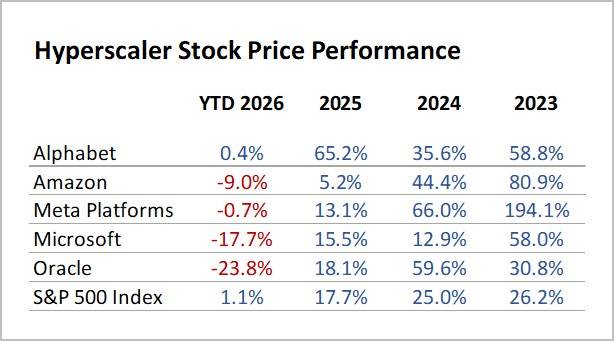
Here’s how hyperscaler stock prices have performed over the past three years, and so far in 2026, compared to the broad market for US large company stocks as represented by the S&P 500:

Note: YTD 2026 as of 2/20/2026; Source: Morningstar

The hyperscaler stock price stall is telling us that investors are less sure that today’s spending will translate to outsized profits in the future.

The Results from Deploying AI

It really is far too early to know what the effects of AI availability and AI usage will be.

But predictions affected stock prices in various areas of the market in the first part of February. Here are some examples:

  • AI developer Anthropic announced it was adding new legal tools to its Cowork assistant to help automate some legal drafting and research tasks. On February 3, shares of companies that provide legal tools and research databases dropped, as did other “software as a service” companies: Examples: Legalzoom dropped 20%; Thomson Reuters declined by 16%; Salesforce fell 7%.
  • OpenAI (maker of ChatGPT) said it was adding an app for homeowner insurance quotes. Shares of insurance brokers proceeded to decline. Example: Marsh & McLennan dropped 8% on February 9.
  • Financial custodian Altruist said its AI assistant could handle some tax-related tasks. Shares of brokers and financial custodians dropped. Example: Charles Schwab lost 7% on February 10.
  • A Florida-based firm said it could use AI to improve efficiency in the trucking business. Shares of airlines, railroads, and trucking firms slid. Example: C.H. Robinson shares lost 15% on February 12.
  • The CEO of Anthropic recently claimed that AI would wipe out half of all entry level white-collar jobs in the next one to five years, and Microsoft’s head of AI said that “most if not all” professional tasks would be automated within 18 months.

Some investors are inclined to shoot first before asking questions and seeing the results of AI deployment and utilization.

Other investors who hear about new technologies and see wild price swings in some stocks of established companies may be unsettled.

In his recent Weekly Commentary from February 17, professor and long-time market practitioner Jeremy Siegel offered these observations:

  • Technological change will continue to disrupt industries, and some business models will be impaired
  • Productivity growth is ultimately deflationary and wealth-enhancing
  • We may even see the long-discussed four-day workweek become viable over time as output per hour accelerates; that is not a recessionary signal, that is a prosperity signal
  • Anxiety is part of every technological transition
  • Today’s data tell us the economy is stabilizing, inflation is receding, and real incomes are rising
  • This is not a backdrop for derailing a bull market; it is a backdrop for its expansion

While it is worth having some perspective on what’s going on underneath the surface of a stock market, trying to pick winners and avoid losers as new technologies emerge is unadvisable.

A better, time-tested approach to investing is to maintain a diversified portfolio with exposure across sectors and markets, and to enjoy a rising tide that lifts many boats over the long term.

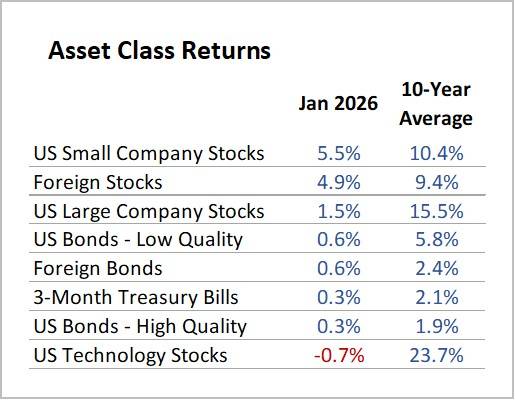
The financial markets got off to a satisfactory start for the first month of 2026. Here are results for January:

Source: Morningstar

Media for the New Year

The new year can act as a catalyst to expand horizons and vary daily routines. So far in 2026, I’ve expanded my regular news diet to incorporate balanced and diverse points of view from foreign-domicile media sources.

Here are three podcasts that I’ve been tuning into regularly, which you might find helpful:

  • BBC News – Newshour: the British Broadcasting Corporation (BBC) is the UK’s national public service broadcaster, founded in 1922 and operating as a chartered corporation, independent from government influence. This podcast is “long-form”, with daily episodes running about 45 minutes.
  • Reuters World News: the Reuters news agency was established in London in 1851 and acquired by the Thomson Corporation of Canada in 2008. This podcast is “short-form”, with daily episodes running about 10 minutes.
  • FT News Briefing: The Financial Times (FT) was founded in London in 1888. The British company Pearson, which had owned the FT since 1957, sold it to the Japanese holding company Nikkei a decade ago. This podcast has a financial markets orientation and is “short-form”, with daily episodes running about 10 minutes.

These daily productions can be accessed using a web browser, but you may find following via a podcast app more convenient. My favorite podcast app is Pocket Casts, which can be downloaded to your phone using the Apple App Store or through Google Play.

-RK

Dealing With Dissonance

Many of us are feeling a degree of dissonance today—an uncomfortable gap between what we sense in the world around us and what we know we should do with our long‑term financial plans.

Some clients have expressed a version of the following sentiment: “I’m worried about where the country is heading. Maybe we should reduce risk until things settle down.”

This reaction isn’t irrational. It’s human. When the social or political climate feels tense, uncertain, or discouraging, it’s natural to want to create stability somewhere—and the easiest lever to reach for is the investment portfolio. Wanting safety when everything feels unsafe is an understandable impulse.

But as understandable as it is, history tells us that making portfolio decisions based on fear, dismay, or frustration with the state of affairs has consistently been a poor long‑term strategy. Not because the feelings are wrong, but because they rarely correspond to actual economic fundamentals.

In this article, I want to do three things:

  1. Acknowledge the emotional reality many people feel today.
  2. Explain why pessimism and portfolio management don’t mix well.
  3. Offer a more constructive framework for evaluating your financial future—one grounded in economic resilience, not political anxiety.

Why We Feel Dissonance

When external events feel chaotic or divisive, we instinctively brace ourselves. Our brains have evolved to treat negative information as a call to action. In other words, the more unsettled we feel, the more likely we are to seek swift, protective measures.

In personal finance, this often leads to two common urges:

  • The desire to reduce risk (“Let’s lower stock exposure for now.”)
  • The urge to protect gains (“The market has done well; maybe we should step aside before things turn.”)

These feelings do not arise because of portfolio conditions—they arise because of life conditions. And the danger is that we adjust our portfolios based on emotion, rather than based on data and long-term requirements.

This is the core of the dissonance: the world around us can feel worse even while the economy and markets continue to function, adapt, and grow.

Why Acting on Pessimism Is Historically Counterproductive

  • Feelings do not predict financial outcomes. Researchers have repeatedly found that consumer sentiment, political sentiment, and investor mood frequently diverge from actual market performance. At various times in history, Americans have felt deeply pessimistic about the nation’s direction—even during periods of strong corporate earnings, rising GDP, and resilient labor markets. Markets care about productivity, innovation, interest rates, earnings, global demand, cash flow, corporate reinvestment, and labor efficiency—not the daily emotional climate of society.
  • Major market gains often occur during times of maximum discouragement. Some of the strongest market performance has happened in years when public confidence was especially low. Market behavior is forward‑looking, and investors who wait for “things to feel better” often end up missing out on significant positive returns.
  • The long‑term track record of disciplined investors tends to be strong. Over any extended timeframe—20, 30, 40 years—the U.S. stock market has shown remarkable resilience. It has grown through wars, recessions, inflationary cycles, political polarization, technological disruption, global crises, and periods of profound national division.

What Actually Deserves Your Attention Right Now

  • The broader health of the U.S. economy. Even in times when the social mood is sour and politics are polarized, economic fundamentals can remain robust. Employment, consumer spending, corporate investment, productivity growth, innovation, and global demand all play central roles in shaping market performance. Today, many of these fundamental economic indicators are trending in a positive direction.
  • The resilience and adaptability of companies. Most successful companies are not fragile—they are adaptive organisms. They evolve in response to changing consumer preferences, technological shifts, supply chain challenges, and cost pressures. And the stock funds selected for your portfolio tend to emphasize large, well-managed, profitable companies.
  • Your personal financial plan—not the news cycle. Your investment strategy is built to support your retirement timeline, spending needs, risk tolerance, tax situation, and estate planning goals. Adjustments should be made in the context of these factors, and not in reaction to political developments.

How to Navigate the Dissonance Productively

  • Acknowledge the emotion without acting on it. It’s OK to feel unsettled. The goal is not to eliminate the feeling—just to prevent it from dictating your financial decisions.
  • Use data, not moods, as decision inputs.
  • Reaffirm your long‑term purpose. Your portfolio is designed to support your life for decades, including years when the world feels off‑kilter.

If you’re experiencing dissonance today, you are not alone. Susan, Donna, Alex and I are here to address your concerns and help you stay the course with your investment strategy and your financial plan.

-RK

January Reset for College Planning

January is one of the most important months in the college planning process. It is a natural time to take a breath and reset, evaluate where you are and create a clear strategy for the months ahead.

Whether you are a junior gearing up and getting into the nitty gritty of it all, or a senior facing decision points, there are opportunities at this stage in the year to set yourself up for success in both admission outcomes and affordability.

Here are some focus points to help you get the year started on the right track.

1. Financial Aid and FAFSA deadlines

Deadlines are critical for these applications to maximize your financial aid. Also, some schools require the forms for merit scholarships even though they are not need-based.

  • Families should be completing the FAFSA and CSS Profile (if required) if they have not already- early submission ensures you do not miss priority windows for university grants
  • Check for other college-specific deadlines such as unique scholarship opportunities separate from merit scholarships

2. Review Academic Progress and Mid-Year Grades

Reflect on your academic progress and be sure to have a plan for the second half of the school year.

  • Mid-year grades matter- colleges use them to confirm academic consistency, make decisions for students who were deferred in the early action process, and evaluate the academic rigor for juniors
  • Check in with teachers if you have any concerns about finishing the year strong to get extra support

3. Evaluate and Focus on Extracurricular Activities and Their Impact

Think ahead about what else you would like to get involved with before college for your own growth and interest and to help with your college applications.

  • Reflect and consider what you want to focus on for spring and summer
  • Do you want to take on a leadership role? Start an impactful project? Set up an experience for summer that will be meaningful for you and your college application?

4. Make a Standardized Testing Plan (Juniors)

Spring is a common testing window. Start making your plan now for spring.

  • Decide on testing or test optional
  • If you take tests, which will you take? SAT, ACT, or both?
  • What will be your test prep? Also, how many attempts will you make?

5. Plan for Spring College Visits Now

College open houses fill up for February and April breaks.

  • Sign up for open houses early and make your hotel reservations early if needed
  • Create a spreadsheet or list of items to compare for each college such as costs, student environment, geography, academics, unique features, etc.

6. Refresh Your College List

Your college list will likely evolve, and that is a good thing. It is a good time to re-evaluate based on these items:

  • Your academic interests
  • Your academic performance
  • Information from your research on the college
  • Likelihood of a merit scholarship (important affordability factor)
  • Geographical location
  • A “best fit” both financially and for the student’s overall experience and comfortability

7. Create Your Student and Family Timeline for the Next Six Months

Having an organized plan and roadmap of upcoming deadlines and “to dos” will help the whole family stay on track and reduce stress.

Some Items for Your January to June Timeline:

  • Testing dates and prep plan
  • Financial aid application deadlines
  • Campus visits
  • Application items for seniors
  • Setting up activities for spring and summer
  • College List review of your top criteria and schools
  • Family meeting times- set time aside during these busy years to create a calm space for discussing your college plans
  • Anything else that needs to be done!

January is a great time to set up expectations and success for the coming year. Thinking about your strategy now and following your own plan and committing to steps will go a long way to being successful in finding the right college fit for the student and the family’s financial situation.

Start your plan NOW knowing you will have a momentous year ahead, approaching the exciting “move-in” day when you see your efforts pay off!

-DC

What Comes Next?

One question at the forefront of many investors’ minds, particularly at the start of a new year is: how might things unfold in the year ahead?

There are cognitive, cultural, and practical reasons why this question is more relevant to us in January than at other times of the year.

From a cognitive perspective, most people find it easier to simplify continuous time into “mental containers”. Chunking time into blocks (like one year) gives the brain manageable units for memory, planning, and comparison.

Culturally, society reinforces annual cycles. Many institutions – from government and schools to private sector employers – organize life around yearly cycles, so we tend to internalize these rhythms and learn to think in this format automatically.

From a practical perspective, year-long blocks match human-scale planning. A year is short enough to imagine, plan for, and track, but long enough to realize meaningful change.

It is important to recognize that, for planning purposes, what happens in the financial markets over the long term is far more important than what occurs tomorrow, next month, or in any one particular year.

Return Expectations

  • Stocks: given three very strong years of stock market returns (nearly 23% annualized from 2023 – 2025), it’s prudent to expect lower returns for stocks going forward: a 7% – 10% return range is a reasonable expectation for 2026. Note that over the very long term (past 100 years) stocks have returned an annualized 10.5%, according to Siblis Research. Also note that JP Morgan Asset Management’s well-regarded research team projects stocks will return a bit under 7% over the next 10-15 years. These are two important reference points to consider when forming an expectation for stock returns in the year ahead.
  • Bonds: return prospects for intermediate-term bond funds are sound:10-Year Treasury bond yields remain above 4%; the Bloomberg US Aggregate Bond Market Index’s yield to maturity is close to 4.5%; and JP Morgan expects 5.2% return for investment grade bonds in the years ahead. So, targeting a 4% – 5% return range for high-quality bonds is a reasonable expectation for 2026.
  • Cash: 3-Month Treasury bill yields are a good reference point for forming a return expectation on cash invested in very short-term, high-quality securities or money market funds. T-Bills currently have an annualized yield of 3.6%, and yields are likely to decline if the Federal Reserve continues to bring down short-term interest rates. So a 2.5% – 3.5% return range on invested cash is a reasonable expectation for 2026.

Risks

  • Policy Risk: Surprise economic policies from the Trump administration, including the potential for imposition of higher tariffs for political purposes, pose a major potential risk for financial markets in 2026.
  • AI Risk: Investors are optimistic that the vast resources that technology-focused companies are plowing into Artificial Intelligence will pay off quickly; if positive AI-related sentiment cools (for whatever reason) it likely would mean downward adjustments for tech company shares and probably a broader-based slump for the stock market a whole.
  • Labor Market Risk: Many households and workers feel that the jobs market is not working particularly well. In 2025, there was a sizable increase in the unemployment rate. It wouldn’t take that much more labor market deterioration for economists to start worrying about the increased possibility of recession.
  • Financial Market Risk: The risk of a steep and extended stock market decline in any given year resulting from problems in the financial markets should never be ruled out. However, current economic conditions are more likely to support growth and positive financial market returns. Instead of girding for the next crash, it’s more constructive to mentally prepare for episodes of stock selling and price fluctuations which typically happen over the course of a year.

The previous bullet point is worth expanding upon. The chart below, courtesy of JP Morgan Asset Management, is one to keep in mind. It shows that annual returns for US stocks are usually positive and often satisfactory, but that intra-year downdrafts are part of the investment landscape.

Annual Returns and Intra-Year Declines for the S&P 500, 1980 – 2025

Source: JP Morgan Asset Management

The key take-aways from the above chart are:

  • During the course of any given year, the S&P 500 Index of large-company US stocks falls, on average, by 14.2% (red dots show intra-year declines)
  • Going back to 1980, annual stock market returns have been positive in 35 of 46 years, or three-quarters of the time
  • The average annual return for large-company US stocks over the past 46 years has been 10.7% (grey bars show full-year returns)

-RK

December 2025 Market Recap: It’s a Wrap: 2025 Market Review

Often from Christmas through year end, investors are treated to a “Santa Claus Rally”, where stock prices rise. But 2025 followed the atypical pattern from 2024: stock prices fell during the final days of the year.

The waning-days-of-2025 drop marks the 13th time the benchmark S&P 500 index fell by more than 1% over that span since 1952.

As catalogued in our Review last year at this time, a “Santa Slump” does not necessarily foreshadow poor returns for the year ahead.

Bespoke Investment Group found that, in the twelve months following a year-end decline of more than 1%, stocks tended to do better. Large company stocks’ median performance after Santa Slum years, in fact, has been a gain of about 12%.

For 2025 as a whole, it was another strong year for U.S. stocks. In 2025, the S&P 500 index of large-company stocks rose nearly 18% and hit 39 new all-time highs along the way. This follows annual returns of 25% in 2024 and 26% in 2023.

Once again, the technology sector was a major contributor to these more-than-satisfactory gains. Tech was the top-performing sector in the S&P 500 during 2025, gaining nearly 25%.

Furthermore, the seven largest tech companies (Alphabet, Amazon, Apple, Meta, Microsoft, Nvidia, and Tesla), often referred to as the “Magnificent 7”, contributed about half of the S&P 500’s price return in 2025.

Outside of the US, stock returns were even more impressive. The MSCI EAFE (Europe, Australasia, and the Far East) index of foreign stocks rose by 31.6%.

One reason why foreign stock returns bested US stocks is that the US dollar fell by about 7.5% compared to other major foreign currencies. Dollar weakness boosts foreign stock returns, when those returns are measured in US dollars.

Even though bond returns lagged behind stock returns, bonds had a good year, too.

A key driver of the positive performance for bonds has been declining interest rates, which helped to push up bond prices. Over the course of 2025, 3-Month Treasury bill yields dropped by 0.7 percentage points, and 5-Year and 10-Year Treasury bond yields declined by 0.6 and 0.5 percentage points, respectively.

For 2025, high quality intermediate-term bonds, measured by the benchmark Bloomberg US Aggregate Bond Index, returned 7.2%For short-term bond funds, where prices are much less influenced by changes in interest rates, results were less impressive, with returns landing in the 4-6% range.

Here’s a snapshot of US stock and bond performance in 2025; the 5-year average annual return for each asset class is included for comparison purposes.

Source: Moore Financial Advisors & Morningstar

-RK